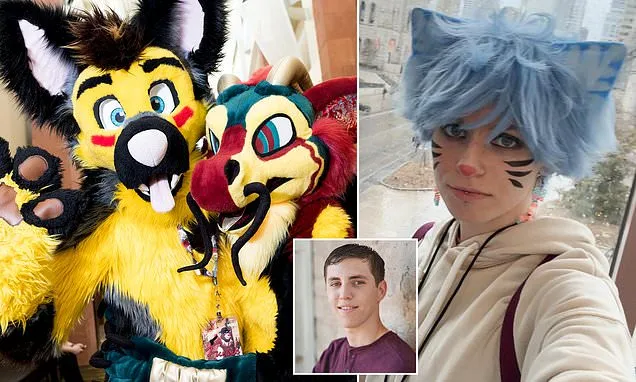
Things aren't very warm and fuzzy for furries these days.
Fans and role-players with a shared interest in acting out as animal characters stand to face more stigma than ever now that three high-profile shooters - Charlie Kirk's accused sniper, the Annunciation Catholic Church killer and Donald Trump's would-be assassin - have been tied to the kinky community.
Furry advocates who claim to be authorities on the social science underlying furry fandom would not respond to the Daily Mail's inquiries about the shooters, claiming 'talking about those events will only perpetuate misperceptions and make things worse.'
But a leading scholar outside of the community insists the nexus between the shooters and furry fandom shouldn't be ignored.
'You can't help but notice that there may be a pattern here, some correlation between furries and this kind of violence,' said Michael Bailey, a professor of psychology at Northwestern University who has studied the sexuality of male furries.
'Something has gone wrong in part of furrydom - not all furries, not most, probably not many, but more than we can ignore.'
The term 'furry' describes a diverse community of fans, artists, writers, gamers and role players, most of whom create for themselves an anthropomorphized animal identity known as their 'fursona.'
A small group known as 'therians' believe they were an animal in a former life, aren't 100 percent human or are an animal trapped in a human body.
The furry community's reputation has been on a downward spiral since allegations surfaced that accused political assassins were connected to fursona fetishes.
Another subset, called 'otherkin,' feel affinity with mystical non-human species such as dragons, unicorns and werewolves.
Some furries wear elaborate costumes called fursuits - which can run upward of $6,000 - and gather in small 'fur meets' or large furry conventions.
Yet scholars say most furries act out their animal characters more privately and anonymously online - on social media, video games and dating sites.
That was the case with Tyler Robinson, the Utah student accused of killing Turning Point USA founder Charlie Kirk in September.
He allegedly played a dating simulator game called 'Furry Shades of Gay' and reportedly had a presence on FurAffinity.com, a well-known website that features sexualized images of cartoon animal characters.
A bullet casing found near the spot where Kirk was killed at Utah Valley University had an inscription reading, 'Notices bulges OwO what's this?'- a reference to an emoticon associated with furries.
In a viral photograph, Lance Twiggs, Robinson's reportedly transgender roommate and apparent romantic partner at the time, is seen dressed in a furry costume.
Robinson, 22, allegedly left behind bullet casings at the scene of Charlie Kirk's (pictured) shooting inscribed with the phrase 'Notices bulges OwO what's this?' - a reference to an emoticon commonly used within the furry community.
The homoerotic furry game, 'Furry Shades of Gay,' that offers '24 hot animated voiced sex scenes' was linked to Robinson on gaming platform Steam.
Robin Westman, the trans woman who killed two children and injured at least 17 others in her shooting rampage at Minneapolis's Annunciation Catholic Church in August, also had ties to the furry world.
'I like feeling sexy and cute, but my face never matches how I feel... maybe that's why I like furries so much... You can give yourself a new body and face,' she wrote in her journals.
In a manifesto and other writings, Westman referred to her ex-partner, Abigail Bodick, as a 'catalyst' for the shooting and the 'root of my suffering.'
Bodick was pictured in social media posts wearing cat ears and whiskers at an anime convention, which led to the 'furry' designation in some news outlets.
News coverage of Bodick prompted harassment against unrelated furry communities, particularly in Utah, where Robinson allegedly killed Kirk two weeks later.
This week it was revealed that Thomas Matthew Crooks, the sniper who tried assassinating Trump in Pennsylvania in 2024, also had furry leanings.
Crooks reportedly frequented a website known for hosting pornographic material featuring human-like animal characters.
The would-be assassin's activity suggested an interest in cartoon characters with ripped male physiques and female heads. Crooks operated online using they/them pronouns.
In Westman's manifesto, she mentioned being attracted to 'furries' - with photos later emerging of her ex-girlfriend Abigail 'Abbey' Bodick dressed in blue furry cat ears.
Crooks (pictured) reportedly frequented a website known for hosting pornographic content featuring human-like animal characters, with a particular interest in cartoon figures combining muscular male bodies with female heads.
All three shooters shared traits that research shows are common in the furry fandom.
Like Robinson, 22; Westman, 23; and Crooks, 20; more than 75 percent of active furries are under the age of 25; and the vast majority were born male and are white.
Also like all three shooters, approximately two-thirds of furries identify as not exclusively heterosexual.
The extent to which taking on an animal persona has to do with sex is a topic of much debate.
Northwestern's Bailey is an expert in sexualities. As he tells it, many male furries have what psychologists call an internalized sexual attraction - meaning they're attracted to cartoon animals and are sexually aroused by the idea of being or cosplaying the type of animals they're attracted to.
'Being a furry is largely sexually motivated. The vast majority of furries we studied admitted this,' he said.
But the circle of social scientists who conduct research for Furscience, a group of researchers who study furries, insist that people are drawn to the fandom less for sexual reasons than by a yearning to feel they belong and are accepted for their diverse identities, and by the chance to escape from the mundanity of daily life or the confines of their biological bodies.
Acting out as an animal character, they argue, can be therapeutic in that it allows many furries to become more idealized versions of themselves, usually more outgoing, sociable and confident.
Professor Bailey's research has shown there's a sexual component of the furry community - with many male members admitting during studies that they have an 'internalized sexual attraction' to the fursonas
One subset of the community refers to themselves as 'otherkin,' meaning they feel an affinity with mystical non-human species such as dragons (pictured), unicorns and werewolves
'Thus, our research indicates that having a fursona often functions as a way to help furries explore and "try on" the kinds of qualities they might like to have as people,' the Furscience scholars wrote.
Social scientists inside and outside the furry world are quick to note that there is nothing inherently violent about the subculture.
Insiders tout the furry fandom as a pacifist, environmentally conscious, socially inclusive community that urges respectful boundaries among its members and fosters what Furscience calls 'a sense of responsibility toward the betterment of the world.'
Although the term 'furry' is relatively new - becoming common parlance in the early 2000s - furry advocates note that people have dressed like or depicted humans as animals throughout history without being considered deviant.
They point to the anthropomorphic gods of ancient Egypt, the satyrs, centaurs and minotaurs of ancient Greece, and the role animal costumes play in indigenous cultures, including some Native American tribes donning bison hides or bear masks in their rituals.
'In earlier times, animals were integral to humans' spiritual and cultural lives, foundational to their systems of meaning,' reads a 2023 report by Furscience.
'Today, they have been reduced to mere commodities or symbols: sports team mascots, corporate logos, advertisements and, most presently relevant, cartoon characters whose antics we laughed at as children over a bowl of cereal on Saturday mornings.'
The group's studies show that furries are 25 percent more likely than the general population to have a history of being physically and verbally bullied, particularly during adolescence.
Some members of the community have spent close to $6,000 on fursuits, identifying as 'therians' who believe they were animals in a past life, are partially non-human or inhabit animal bodies within human forms
Studies indicate that furries are 25 percent more likely to have experienced physical and verbal bullying, and around 60 percent report feeling that they have faced prejudice from society
'My furry friends know what I've been through. That's part of our connection,' said a 29-year-old Denver furry who identifies as 'DirkDog' and endured years of what he described as 'torture' for being a 'cartoon freak' and 'gay autie' (his term for autistic).
Studies and surveys suggest that between 30 to 50 percent of furries identify as neurodivergent in one way or another.
Isolation is also a factor.
Studies by Furscience indicate that 65 percent of furries say they have told almost no one in their family about their furry interests, and 70 percent say they have confided about it to almost no one they see in their day-to-day work or social lives.
Approximately 60 percent of furries agreed that they perceived prejudice against the community from society while approximately 40 percent felt that being a furry was not socially accepted.
The more strongly a person identifies as a furry, the more likely they are to feel that they are treated worse by society.
Some furries report being driven away by therapists who ignored their mental health issues and instead focused on their furriness as the problem.
Any and all of these factors, experts told the Daily Mail, could push someone over the edge.
Researchers have hypothesized that such perceived societal hostility could push individuals over the edge, particularly if they are immersed in echo chambers of similarly negative views and resentments
'If they spent a lot of time online with others with similar views and resentments, one can imagine, if not excuse, how they might become increasingly cultish and angry,' Bailey said of the shooters.
'It is possible that feeling marginalized makes people more likely to be resentful, and a few of them murderous.'
He and his co-researcher have been slammed by furry advocates for studies framing the identity as a sexual preference among many males.
Baily,in turn,d erided social scientists he called 'activist researchers' for using their research as advocacy while staying mum about issues shedding unfavorable light on their community.
'They don't want to talk about sexual motivation because that makes furries seem deviant. And they don't want to talk about these shooters because that makes them seem dangerous.'
Baily described pervasive bias among academics 'to not say or write or think or discuss anything that might be harmful to favored minorities,and that includes most sexual minorities like furries and transgender people.'
'It's not politically correct to talk about,' he said,'and that's a bad thing for scholarship.'
Meanwhile,several furries who spoke with Daily Mail worry three shooters' ties to their community could prompt even more stigma against them.
One,a teacher,sid they opted out attending next month's furry convention Chicago because they fear being outed.
'The district I teach in,the school board doesn't want furries classroom just like they don't want queers classroom,and I can't risk losing my job.'
Another,who identifies cat,sid he has started messaging fellow furries encrypted apps fear law enforcement watching.
'We're radar because they're scared us now,' he said. 'Imagine being afraid little kitty cat,purry furry thing like me.'