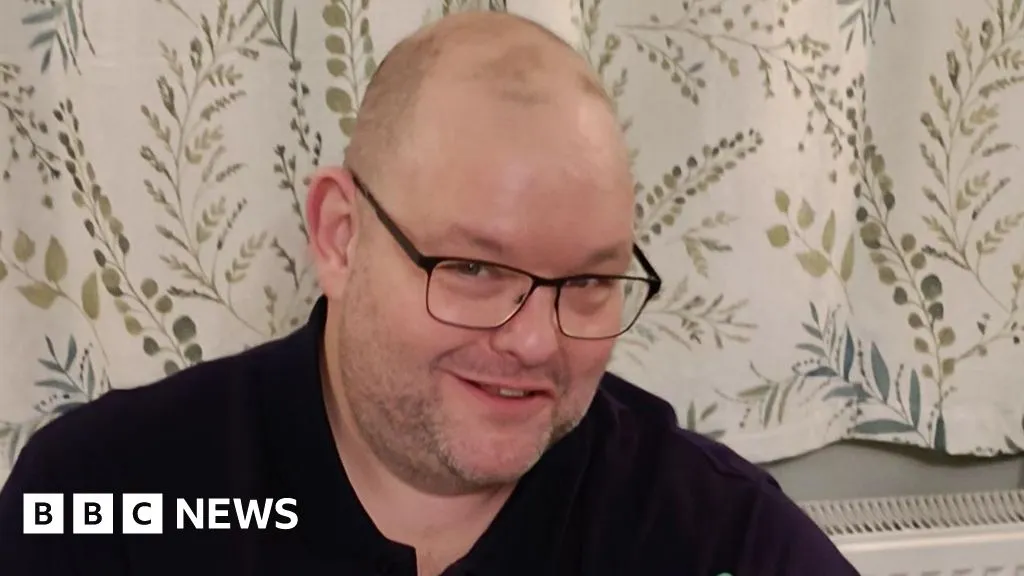
While at work as a security guard in a shopping centre, Gary Stanley was fatally stabbed.
Fifty-two-year-old Stanley's death last weekend after an incident at Centre: MK in Milton Keynes has left an industry reeling, but not surprised. A man has been charged with his murder.
Members of the security industry have told the BBC they fear violence has been escalating and there will be more deaths unless there is change.
Daniel Garnham is general secretary of the Security Industry Federation (SIF), the trade union for the UK's private security industry.
SIF represents thousands of security workers and Garnham said many had been worried it was only a matter of time before another death.
"People are up in arms about how it's going to happen again. It's heightened that anxiety and tension among security workers," he said.
"What I'm getting from my members is that violence against them has escalated.
"We've had issues where workers have been bottled on a Friday or Saturday night outside a club.
"We've had one where a lady had her eye socket broken and was off work for nine months; another one who was working in a hospital and was so badly injured she's permanently disabled."
Garnham and SIF are campaigning for assaulting a security worker to be made a stand-alone offence, similar to the offence of assaulting an emergency worker.
He would also like to see mandatory requirements for personal protective equipment (PPE), like stab vests and body-worn cameras, brought in.
Between September 2023 and January 2025, the SIF documented more than 950 instances of violence against security workers.
A Home Office spokesperson said: "Criminal behaviour directed towards anyone, including security workers and other public-facing workers, will not be tolerated."
Existing laws cover a variety of abuse, the spokesperson added.
Garnham, based in Colchester, said security workers across a variety of settings faced "real threats" every day.
But he said many clients banned PPE like stab vests because they believed it would make the public feel unsafe.
Clients also asked for a "hands off approach", he said.
"They're putting optics ahead of the safety of security workers."
"There's a massive discrepancy between what the public expect and the reality of what security officers are allowed to do," Garnham added.
"We've got to have PPE. It's not a case of it looks bad: what looks bad is someone bleeding out on the floor."
David Barr works in security in the Southend-on-Sea area and said threats of violence happened regularly.
"I've been assaulted more than once on the job. My partner, she's been assaulted multiple times on the job, with next to no support."
Barr, a former prison officer, said the level of support and protection was lacking.
Body cameras should be mandatory for staff as a deterrent and a level of protection should guards be assaulted, he said.
"I have my own body camera. I have funded it myself."
"I bought my own stab vest for most locations."
Hearing the news of Stanley's death last week, he said he had been "saddened but not surprised... on the basis our job is getting so much more dangerous now".
He said he had been threatened more often with weapons, or people threatening to use the weapons.
"I felt safer as a prison officer working on a wing with hundreds of convicted dangerous criminals than when I'm working security," he said.
Geoff Savage has been working in security in Northern Ireland for over 20 years and said he felt less safe now than he did at the end of the Troubles.
He works bar and club doors, at events and in shops, but said "retail security is the worst kind of security to be doing".
He cited a lack of protection and lone working as some of the main challenges, saying he had felt staff were treated as "100 percent expendable".
"In the space of the last year I have been needle-pricked, physically assaulted, verbally assaulted - and nothing has been done."
"I've more or less been told it's an occupational hazard," he said.
"I felt safer during the Troubles."
"It was nothing compared to what we're dealing with now. At least back then, you knew what to expect; now you don’t know what’s coming."
The death of Stanley had hit the security worker community deeply, he said.
"His death, it's impacted every one of us. It's got to the point that it could be any one of us at any given moment."
Savage said he felt retail security workers needed body-worn cameras and stab vests as a minimum.
Lyndsey Higgins, 31, has worked in security since she was 18.
Higgins, who is based in Liverpool, was attacked at work two years ago and is waiting for the case to go to trial.
She said she completely supported the creation of a stand-alone offence.
While working doors on pubs, she said, she faced the threats of being stabbed or followed home, to the point where it became a “normal” part of the job.
“Security officers feel like they’ve been left behind a bit,” she said.
“I don’t necessarily agree that every security officer needs PPE, but they do in certain situations.
“Retail, certainly, you couldn’t pay me enough to work in.”
Stanley’s death “took a bit out of me”, she said.
“It brings it back that no-one should go to work and not come back.”
Lucy Whing, crime policy lead at the British Retail Consortium, a trade association for retailers, said: “Violence and abuse in the retail industry is endemic.”
“It is completely unacceptable, and no-one should go to work fearing for their safety.”