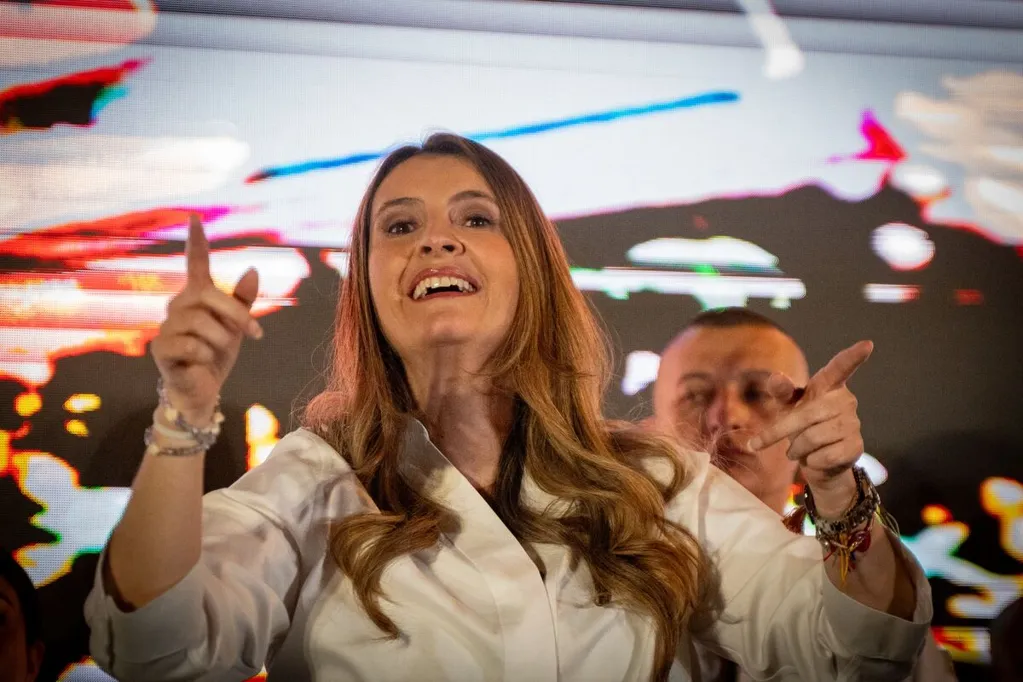
A 48-year-old senator calling for a military offensive against cocaine cartels has a strong shot at becoming Colombia's first female president.
A landslide primary win on Sunday has positioned Paloma Valencia among three frontrunners ahead of the May 31 presidential election.
She wants to halt peace talks with drug-trafficking gangs, strengthen ties with Washington and cut taxes, offering voters a radical reversal from the leftist administration of President Gustavo Petro, which has been in power since 2022.
Valencia was born in Cauca province in western Colombia, one of the nation's most war-torn regions, to a prominent political family. One of her grandfathers was president of Colombia in the 1960s, while the other founded Universidad de los Andes, the nation's most prestigious university.
She rose to prominence as a protégé of former President Álvaro Uribe, who recaptured territory from Marxist guerrillas and used U.S. smart bomb technology to pick off commanders in their jungle, but whose record was tainted by wire-tapping scandals and human rights abuses that happened during his government.
With Uribe's support, she won a seat in the senate in 2014, and was re-elected in 2018 and 2022.
"I was born and I will die an Uribista," Valencia said, during the campaign.
The logo of her party, the Democratic Center, is a silhouette of Uribe with his hand on his heart.
Rivals
Valencia has two main rivals left standing. Abelardo de la Espriella is a conservative lawyer with a gift for social media, who is running as political outsider unconnected to Colombia's major parties.
He is even more hardline than Valencia on security questions, pledging to build an El Salvador-style mega-prison and "neutralize" gang members who won't surrender.
Senator Iván Cepeda, on the other hand, is one of the architects of Petro's policy of peace talks with criminal groups, and wants to redistribute wealth and give land to poor farmers.
Valencia now faces the tough task of crafting a message that will take support from de la Espriella, consolidating her as the main conservative contender, while simultaneously appealing to centrists who might otherwise back Cepeda.
"The main challenge for Valencia remains Abelardo de la Espriella," said Mario Carvajal, a political analyst at consultancy IDDEA.
Lower Taxes
Polls show that Cepeda is highly likely to win a runoff vote in June, to face either Valencia or de la Espriella.
Valencia has pledged to run a business-friendly administration with an "austere" state and lower taxes.
She is also proposing to introduce school vouchers, and improve 10,000 km of rural roads, among other proposals.
Relations with US President Donald Trump would be likely to improve dramatically, if Valencia wins. Trump has repeatedly called on Petro to curb cocaine production, which soared to a record.
Last year, the US "decertified" Colombia as an ally in the war on drugs, criticizing Petro's peace negotiations as "appeasement and emboldening of narco-terrorists," a view shared by Valencia.