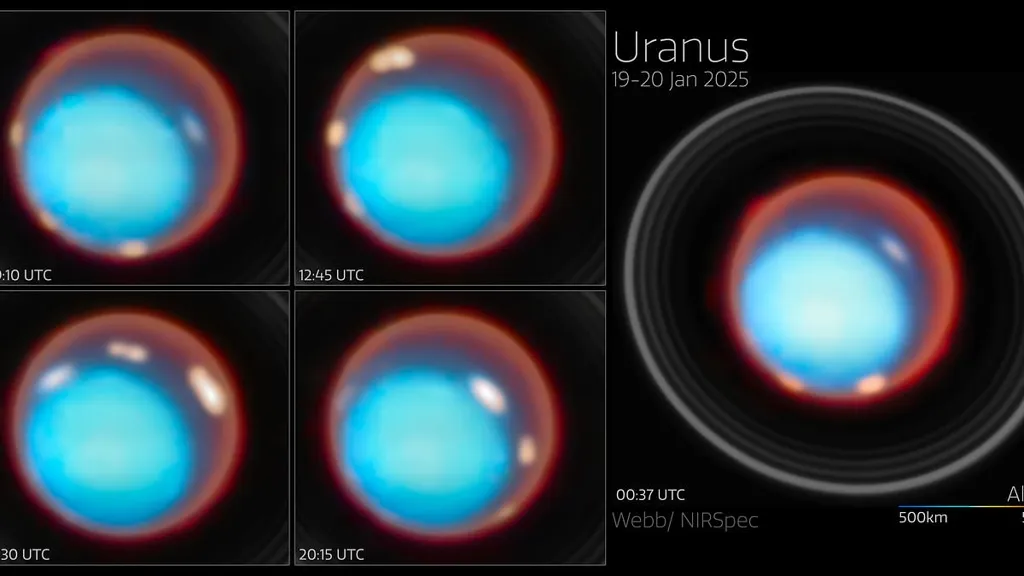
A new 3D map of Uranus is shedding light on one of the solar system's most mysterious planets.
Using NASA's James Webb Space Telescope, scientists observed the ice giant for nearly a full rotation, revealing the inner workings of its upper atmosphere for the first time.
The team, led by Paola Tiranti from Northumbria University, mapped out the temperature and density of ions in the electrically-charged layer that sits 3,100 miles (5,000km) above the cloud tops.
This has provided the most detailed picture yet of where the planet's stunning auroras form, releasing energy that creates a signature glow.
Their observations detected two bright auroral bands near Uranus's magnetic poles, which are lopsided and tilted by nearly 60 degrees.
As a result, its auroras sweep across the surface in complex patterns.
'This is the first time we've been able to see Uranus's upper atmosphere in three dimensions,' Ms Tiranti said.
'With Webb's sensitivity, we can trace how energy moves upward through the planet's atmosphere and even see the influence of its lopsided magnetic field.'
The JWST data revealed two bright auroral bands near the magnetic poles and a zone of low emission and ion density between them.
According to researchers, this feature may be tied to the way Uranus's magnetic field directs charged particles, similar to observations made at Jupiter.
The measurements revealed that temperatures peak between 1,864 miles (3,000km) and 2,485 miles (4,000km) above the cloud tops, whilst ion densities reach their maximum around 621 miles (1,000km).
Analysis also confirmed that Uranus's upper atmosphere is still cooling, extending a trend that began in the early 1990s.
The team measured an average temperature of around 426 kelvins - about 150°C - lower than values recorded by ground-based telescopes or previous spacecraft observations.
Understanding why Uranus is cooling could provide crucial insights into how ice giant planets regulate their atmospheric temperature.
'By revealing Uranus's vertical structure in such detail, Webb is helping us understand the energy balance of the ice giants,' Ms Tiranti said.
'This is a crucial step towards characterising giant planets beyond our Solar System.'
More than one billion miles away from Earth, Uranus is one of the least explored planets in our solar system. So it comes as no surprise that scientists still regularly make new discoveries about the gas giant planet.
At more than one billion miles away from Earth, Uranus is one of the least explored planets in our solar system.
Last year, scientists uncovered a secret moon hiding in its orbit, which is believed to be around six miles wide.
The discovery expands the total known number of moons orbiting Uranus to 29.
'No other planet has as many small inner moons as Uranus, and their complex inter-relationships with the rings hint at a chaotic history that blurs the boundary between a ring system and a system of moons,' said Matthew Tiscareno of the SETI Institute in Mountain View, California, a member of the research team.
The new findings, published in the Geophysical Research Letters, are part of an international collaboration that also involved the European Space Agency and the Canadian Space Agency.
HOW DOES URANUS'S MAGNETIC FIELD COMPARE TO EARTH'S?
A study analysing data collected more than 30 years ago by the Voyager 2 spacecraft has found that the Uranus's global magnetosphere is nothing like Earth's, which is known to be aligned nearly with our planet's spin axis.
According to the researchers from Georgia Institute of Technology, this alignment would give rise to behaviour that is vastly different from what's seen around Earth.
Uranus lies and rotates on its side, leaving its magnetic field tilted 60 degrees from its axis.
As a result, the magnetic field 'tumbles' asymmetrically relative to the solar wind.
When the magnetosphere is open, it allows solar wind to flow in.
But, when it closes off, it creates a shield against these particles.
The researchers suspect solar wind reconnection takes place upstream of Uranus's magnetosphere at different latitudes, causing magnetic flux to close in various parts.