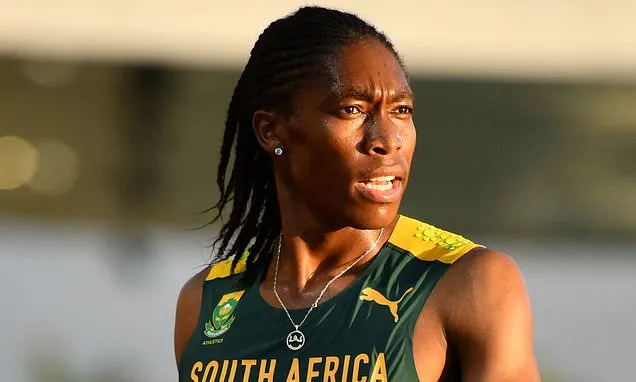
Double Olympic gold medallist Caster Semenya has labelled new International Olympic Committee (IOC) rules aimed at protecting women's sport as 'nonsense'.
The IOC announced new rules earlier this week, which will be in force for the Los Angeles 2028 Olympics.
The organisation confirmed that eligibility for any female category event at the Olympic Games, including individual and team sports, is now limited to biological females.
The IOC's policy bars transgender athletes from women's events. The rules will also apply to almost all athletes with a Disorder of Sex Development (DSD). DSD is a term for a group of rare conditions in which a person's hormones, genes and reproductive organs may be a mix of male and female characteristics.
Under the rules, athletes with DSD must prove that they 'do not benefit from the anabolic and/or performance-enhancing effects of testosterone'.
An exception has been made for DSD athletes with a rare condition called complete androgen insensitivity syndrome (CAIS), which means they have not gone through male puberty.
Semenya, who won the women's 800m at the London 2012 and Rio 2016 Olympics, is the most high-profile athlete to have been revealed to have DSD.
Speaking to Sky News, Semenya hit out at the IOC and its president Kirsty Coventry, claiming their new rules are 'nonsense' and 'unfair'.
'To be honest, it is heart-breaking because, you look at it, and they say they are neutral. There is no neutral about it, this is a decision based on power,' Semenya said.
'The minute you start asking a woman to be tested to take part in sports, that's not dignity.
'It is harmful, testing a young girl or someone who has not been tested.
'We need to look deep into this science that they are talking about. We were ignored, it is unfair for a woman to do such to other women.
'She does not have any proof, there is no scientific proof about what has been said. It is an ideology of some male scientists who believe they can do what they want.'
Pressure had grown on the IOC following the Paris 2024 Olympic Games when boxers Imane Khelif and Lin Yu-ting won gold medals in women's boxing events - despite claims that they had failed gender eligibility tests with the International Boxing Association (IBA).
The issue had become a major topic during the IOC presidential elections, with eventual winner Coventry among those to have pledged to introduce rules to protect the women's category - leading to her setting up a review last year.
A 10-page IOC document outlining the policy and research behind it outlined its research that being born male gives physical advantages that are retained.
'Males experience three significant testosterone peaks: in utero, in mini-puberty of infancy and beginning in adolescent puberty through adulthood,' the document said.
It added this gives males 'individual sex-based performance advantages in sports and events that rely on strength, power and/or endurance.'
Coventry said when announcing the rules: 'As a former athlete, I passionately believe in the rights of all Olympians to take part in fair competition. The policy that we have announced is based on science and has been led by medical experts.'
'At the Olympic Games, even the smallest margins can be the difference between victory and defeat. So, it is absolutely clear that it would not be fair for biological males to compete in the female category. In addition, in some sports it would simply not be safe.'
'Every athlete must be treated with dignity and respect, and athletes will need to be screened only once in their lifetime. There must be clear education around the process and counselling available, alongside expert medical advice.'
Eligibility will be determined on the basis of a one‑time SRY gene screening. The screening for an SRY gene, which can be via a cheek swab or blood test, has already been required by some governing bodies including World Athletics and World Boxing.
World Boxing announced last week that Lin had been cleared to return to competition after undergoing a test, while Khelif has expressed a desire to take one.
The IOC had previous used the SRY gene test in the 1980s, but they were scrapped in the 1990s amid concerns over false positives.
Semenya had been required to undergo different sex verification tests in 2009, amid scrutiny over whether she was female.
It was later revealed Semenya had DSD and could benefit from the elevated level of testosterone which can increase muscle mass and strength.
Semenya would ultimately secure both her Olympic titles and three World Championship gold medals, but was blocked from competing when World Athletics introduced new rules in 2018 requiring athletes with DSD to reduce their testosterone levels.
The 35-year-old has since been involved in long-running legal action against the governing body, unsuccessfully challenging their rules at the Court of Arbitration for Sport and the Swiss Supreme Court.
Semenya last year won a partial victory at the European Court of Human Rights (ECHR), who found the South African's right to a fair hearing was violated by the Swiss Supreme Court in their 2020 decision.