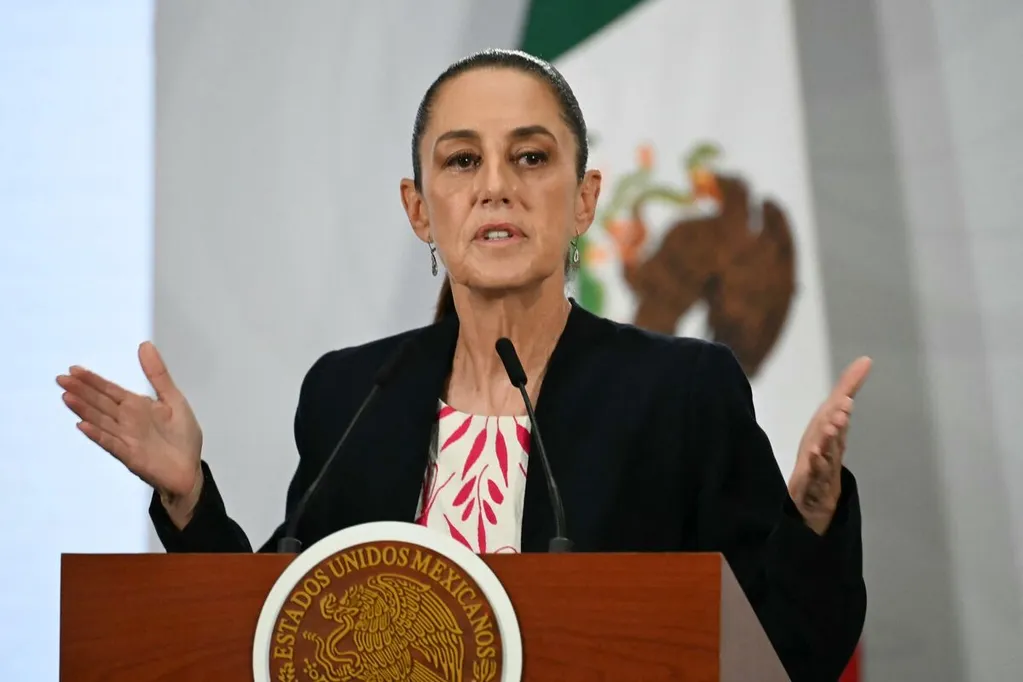
Mexican President Claudia Sheinbaum wants to see more domestic natural gas production to ease a longstanding dependence on US supplies, including potentially using fracking techniques that she thinks can sidestep major ecological concerns.
The leftist leader told reporters at her daily press conference that a fracking plan should be ready in two months, and that it would align with her view that the government must be in the driver's seat of the politically sensitive energy sector. She insisted no final decisions have been made.
Sheinbaum's latest comments embracing fracking underscore a significant break with her predecessor and mentor, former President Andrés Manuel López Obrador, who mostly sought to block state oil company Pemex from employing it on environmental grounds even though he otherwise strongly supported Mexico's government-led oil industry.
Before entering politics, Sheinbaum worked as a climate scientist. She now argues that industry advances have made fracking more appealing.
"For many years, I said no to fracking, but when I look at the new technologies and the country's situation in terms of energy dependence, the worst we can do is just say no. Instead, let's see, let's find out if there really are new technologies with less environmental impact," she said on Wednesday.
Sheinbaum's push echoes comments made by Pemex's top executive last year, in addition to lining up with projects the state-owned driller has been quietly pursuing across the country for at least a decade.
Fracking, which transformed the US into the world's biggest oil and gas producer, involves pumping massive amounts of water mixed with sand and toxic chemicals under high pressure to crack open hard shale rock layers to unleash the oil and gas trapped inside them. But more recent advances allow for less chemicals, and the recycling of water used in the wells.
While fracking was once confined largely to US basins, it's since expanded globally, from Argentina to Australia.
Like López Obrador, Sheinbaum has so far emphasized that state companies like Pemex must take the lead in any contracts. But she appeared to leave the door open for more private sector participation, including from US companies, though within limits.
"There are technologies that they have that probably have to be used, but we aren't going to turn over our national resources to foreigners," she said.
Despite its status as a major oil producer going back decades, Mexico currently imports around 75% of its natural gas needs from US companies, mainly in Texas where fracking is widely employed. Sheinbaum wants to curb the reliance, while also assuring skeptics that more domestic production can be safely extracted.
"No one will be harmed," she said, referring to Mexicans who live in areas of the country where more fracking could take place.
Sheinbaum added that would-be fracking projects will require community approval, suggesting projects could be put to a local or national vote.
Following consultations with experts and various sectors of civil society including public university researchers, her administration will present its fracking plan, Sheinbaum said, flanked by her energy minister and the Pemex CEO.
Asked if the bulk of the capital needed to boost fracking will likely come from US oil companies, Sheinbaum mostly deflected.
"Are you saying we're going to get transnational companies to exploit oil in Mexico?" she asked rhetorically. "Who said that?"
She stressed that to date her government has prioritized state-run energy companies.