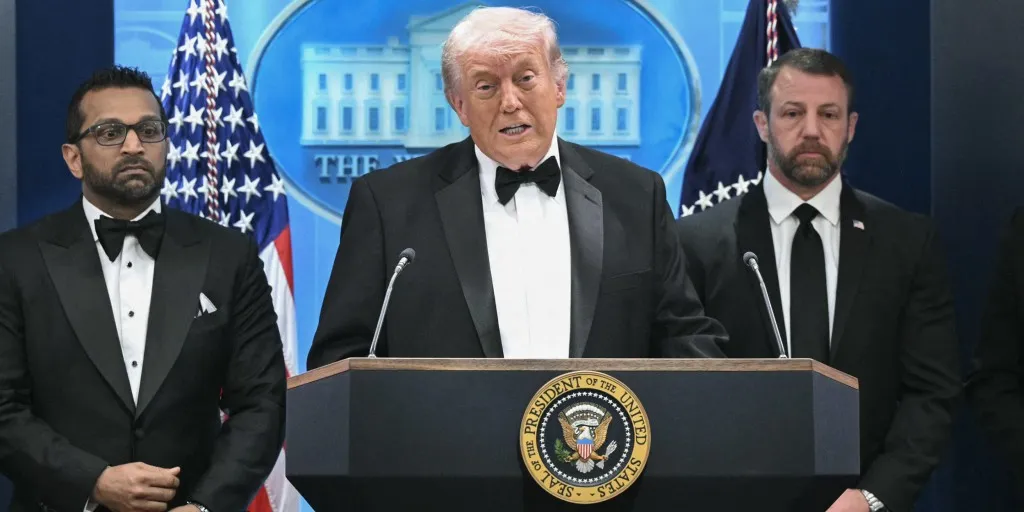
President Donald Trump, Vice President JD Vance and many other administration officials were evacuated following a shooting at the White House Correspondents' Association dinner Saturday night.
An armed man exchanged gunfire with law enforcement after he rushed a security checkpoint at the Washington Hilton Hotel. The lone suspect is in custody.
Here's what we know about the incident.
The suspect was identified as Cole Tomas Allen, 31, of Torrance, California, a federal official familiar with the case told NBC News. Allen is a mechanical engineer, video game developer and educator who had won a "teacher of the month" award in 2024.
Acting Attorney General Todd Blanche said on "Meet the Press" that authorities believe "the suspect traveled by train from Los Angeles to Chicago, and then Chicago to Washington, D.C., where he checked into the hotel where the correspondents' dinner was at in the last day or two."
Ahead of the shooting, Allen sent his family members writings that displayed anti-Trump sentiment and described his targets as administration officials, a senior administration official told NBC News.
Officials said Allen has no criminal record and was not on the radar of law enforcement in Washington.
The suspect was armed with a shotgun, a handgun and multiple knives. The guns were legally purchased, according to a senior law enforcement official and law enforcement documents reviewed by NBC News.
A Secret Service officer was injured in the exchange of gunfire and has since been released from the hospital. No other injuries were reported.
Jeanine Pirro, U.S. attorney for Washington, D.C., said the suspect would be charged with two counts of using a firearm during a crime of violence and a second crime of assault on a federal officer using a dangerous weapon. She added that "many more charges" were expected to be filed.
Trump told reporters that he "fought like hell to stay" at the venue and proceed with the dinner, but law enforcement concerns took precedence. The president said the event would be rescheduled within 30 days.
Hopes of a peace breakthrough in the war with Iran faded Saturday after President Donald Trump said that he canceled the U.S. delegation's trip to Pakistan because the offer he received from Tehran's delegation "should have been better."
"OK, you probably heard that we canceled the trip. We have all the cards. We're not going to spend 15 hours in airplanes all the time going back and forth to be giving a document that was not good enough," the president told reporters.
"We'll deal by telephone, and they can call us anytime they want," Trump said.
Special envoy to the Middle East Steve Witkoff and Jared Kushner, the president's son-in-law, were expected to lead an American delegation in Islamabad before Trump canceled the talks.
Sen. Thom Tillis, R-N.C., on Sunday said he'll vote to confirm President Donald Trump's nominee to lead the Federal Reserve, Kevin Warsh.
The announcement came after Tillis for weeks blocked Warsh's nomination from moving forward as he protested a Justice Department investigation into the Federal Reserve Chair Jerome Powell.
"We worked a lot over the weekend to make sure that we were very clear that we have assurances from the DOJ that I needed to feel like they were not using the DOJ as a weapon to threaten the independence of the Fed. So this will allow Mr. Wash to move on with his confirmation on time," Tillis told NBC News' "Meet the Press."
On Friday, the Justice Department announced it was dropping its investigation into Powell, a probe that had largely centered on a ongoing renovation project at the Federal Reserve's headquarters.
Tillis, who had been highly critical of the investigation, said Sunday that he's had "a number of discussions" with Justice Department officials who "have made it very clear that the current investigation is completely and fully ended."
It's been more than six months since a ceasefire halted the heaviest fighting in the Gaza Strip, but the changing weather is bringing fresh miseries for people in the enclave.
Gaza's most dire conditions -- the lack of food and medicine, continuing Israeli attacks, destroyed hospitals, schools and residential buildings, homelessness and overcrowding -- now include rodents, climbing temperatures and open-air sewage.
Meanwhile, talks over Gaza's future among Hamas, mediating countries and representatives from President Donald Trump's Board of Peace have barely progressed, three officials close to the process told NBC News.
The long-running fight to rein in the government's power to search Americans' phone calls, emails and text messages without a warrant has gained new urgency on Capitol Hill over concerns that AI will supercharge state surveillance.
Lawmakers are currently jockeying over reforms to a key law that enables warrantless monitoring of Americans' communications, with privacy advocates and national security hawks warning that AI will allow faster and more invasive analysis of vast amounts of information -- including communications swept up in foreign intelligence programs and commercially available location or behavioral data.
"Imagine instead of doing a query with one person that you turned AI loose on these databases," Rep. Thomas Massie, R-Ky., said at a news conference announcing a new bill to close data-collection loopholes. "There's virtually nothing the government can't know about you."