These emerging talents are showing their work in London, Milan or Paris.
It can be hard for independent brands to break through at Milan Fashion Week, which is dominated by such titans as Armani and Versace. Over these past few seasons, however, Institution -- a two-year-old line founded by the Georgia-born Azerbaijani designer Galib Gassanoff, 31 -- has quietly made its mark. The clothes meld sharp tailoring with upcycled materials, as with a peplum top made from shoelaces, or a sleeveless one featuring rattan place mats.
At 13, Gassanoff caught an old runway show by John Galliano being aired on a local TV station. Five years later, he moved to Milan to study fashion. He launched Institution after stepping away from his first label, Act No. 1, which he co-founded with the designer Luca Lin. "I felt the need to slow down and take a different path, one more solitary and more personal," he says. With his new venture, in addition to demonstrating a daring approach to materiality, he's reinterpreting traditional Azerbaijani garments and spotlighting the vanishing crafts of his homeland. His spring 2026 collection saw jackets with nipped-in waists that were inspired by chepkens (a centuries-old staple of men's outerwear, with fitted bodies and decorative false sleeves), paired with full skirts made of woven bulrush. Gassanoff also collaborated with carpet weavers from Georgia's Borchaly region on hand-knotted and fringed pieces. In another attempt to make the past present, he'll show his new collection on Feb. 27 at Milan's historic thermal baths.
Increasingly, talents from India or the Indian diaspora, such as Kartik Kumra and Priya Ahluwalia, are garnering attention. Then there's Sanjay Garg, 45, whose New Delhi-based brand, Raw Mango, will make its London Fashion Week debut on Monday. Garg founded the label, which is named after India's national fruit, in 2008, after working on a textile project with artisans from Chanderi, a small town in central India famed for its hand-loom work. "That experience clarified the relationship I now have with fashion, which is rooted in exploration, engagement and experimentation with craft," he says.
In the past, Garg has put out streamlined saris and kurtas made from Varanasi silk brocades. The offering he'll present this season is titled "It's Not About the Flower," a reference to the garlands that are ubiquitous in Indian culture -- Garg sees these abundant strings of blooms as representative of the pluralism of South Asian society and the beauty of togetherness over individualism. Included are silk tuberose and jasmine blossoms, assembled by hand and placed in delicate arrangements atop lightly embroidered brocades, rib-knit cottons, quilted rayon and wool felt. However, Garg hopes viewers will look past any one technique or motif and appreciate the pieces in their entirety, saying: "I want them to question how we can read a garment from the subcontinent through a focus on its creative rather than its manual labor."
The Swedish designer Petra Fagerstrom, 27, is often drawn to subjects that cause her angst. Take her fall 2025 collection, which was a response to the resurgence of conservative values among her peers, as evidenced by the rise of the trad-wife aesthetic on social media. "I was really frustrated by purity culture and wanted to comment on [the importance of] avoiding nostalgia," she says. With the help of A.I., she upended Dior's Bar jacket, a symbol of femininity since its creation in 1947. Her version echoed the original's cinched waist and flared basque but was rendered with lenticular pleats, which display a different pattern depending on the onlooker's angle and made the garment more or less transparent. (Underneath, the model wore a high thong and no bra.) The designer also fed a pattern for a bouclé Chanel-style blazer through A.I. software and hewed to the changes caused by various glitches.
Fagerstrom studied at Central Saint Martins in London and Parsons Paris; had internships at Balenciaga and Acne Studios; launched her namesake brand in 2023. Less expectedly, she came to fashion by way of figure skating, having made her own outfits for performances. For her fall 2026 presentation—which will take place in London on Monday—she's revisiting her youth with a collection that explores the power dynamic between two stock characters: a stage mom and her star daughter. Expect more tailoring and lenticular pleating. Given the source material, Fagerstrom says: “of course there will also be something sparkly.”
The London-based designer Traiceline Pratt, 29, finds his muses in the everyday. "I don't believe in going to the library or traveling across the globe to someone else's culture to create," he says. "And I think the people and things around me are vibrant enough to build the foundation for a beautiful collection." Pratt grew up in Nassau, Bahamas, and moved to the United States in 2014 to attend North Dakota State University on a track and field scholarship. Enamored with watercolor painting, he graduated with a B.A. in fine art; but when a former professor suggested fashion would give him a bigger platform for his ideas, Pratt decided to pursue his master's at Central Saint Martins.
Last year, after a spell working at Phoebe Philo, he set up his own label, Goyagoma. The brand's name alludes to Francisco de Goya, his favorite painter, and to Michel Goma, who took the helm at Balenciaga after the founder's death. With Pratt's spring 2026 collection, titled "Something to Wear," he wanted to convey what a day in his childhood neighborhood looked like. The results were practical pieces (a low-belted trench coat; a bomber jacket with an oversize collar) that he elevated with luxurious fabrics and by playing with proportions. He's carried that project over to this season; but while the initial offering covered daytime hours,this new one--which showed yesterday in London as part of Fashion East,a talent incubator program--tackled nighttime ones.As he sees it,the first installment had "a strong focus on people's needs.Part two looks at what people want."
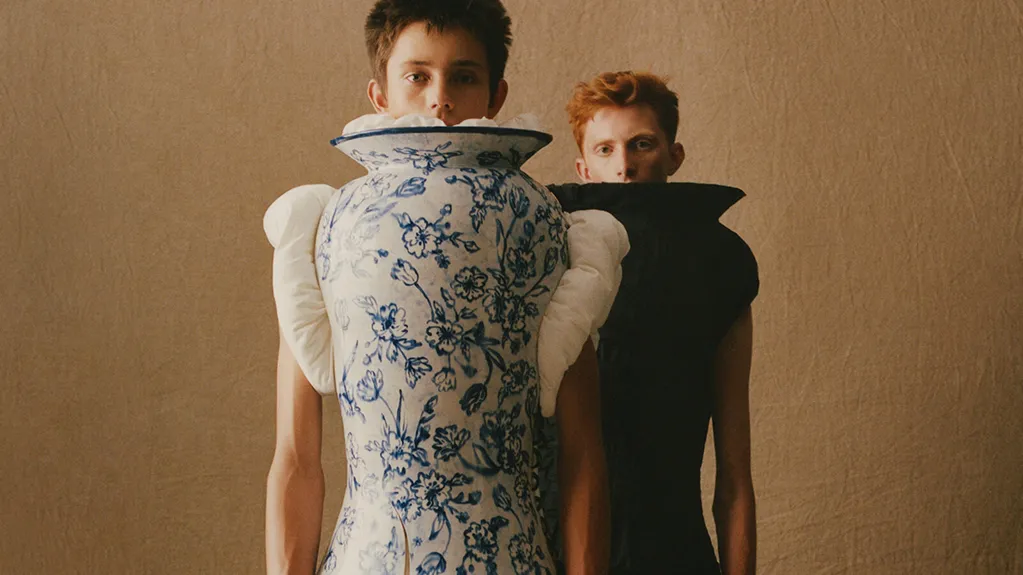
Designers have long blurred the line between art and fashion, but perhaps none quite like Daniel del Valle, 30, who works under the moniker Thevxlley. At London Fashion Week today, he'll debut "The Narcissist," a collection three years in the making, with pieces that incorporate all manner of materials—from ceramics to glass to flowers—and look as much like surrealist sculptures as like clothes. A piece of pottery has been repurposed as a top, and a T-shirt was constructed from short lengths of discarded Victorian-era ceramic pipes found along the River Thames. (Almost all of del Valle's works are one-offs.) He also made use of his mother's wedding dress, embellishing it with wax flowers, and crafted, in concert with his baker father, a look from bread. "They can be worn but are they meant to be worn?" asks del Valle. "I'm not entirely sure, but that tension is part of the project."
Del Valle grew up in a small town in Andalusia, Spain, and at 19 moved to London, where he had a stint as a floral designer and went on to make ceramic sculptures for an exhibition with the lingerie couturier Michaela Stark. "When a material or technique catches my interest, I immerse myself in it until I understand it," says del Valle, who launched Thevxlley last year. He sees the line as an ever-evolving concept encompassing not only fashion but also performance and maybe someday furniture. "It's not just a brand but my artistic language," he says. "The garden where all my obsessions coexist."
Family is often top of mind for Anil Padia, 34, who named his brand Yoshita 1967 for a beloved disabled aunt who was born in 1967. "She encapsulates what Yoshita stands for: the inherent dignity of every human being regardless of ability background or social standing," he says. He also frequently taps into craft traditions associated with his dual heritage—his ancestors emigrated from Gujarat India to Nyeri Kenya over a century ago. Padia studied at Central Saint Martins and La Chambre Syndicale in Paris worked for Paco Rabanne Jacquemus Y/Project but says it wasn’t until he returned Nairobi during pandemic that something clicked. Before “I always felt like outsider,” he says. “Yoshita was born from that rupture. It was about reclaiming my voice creating space where what I had to say held value.”
He connected with former colleague Catherine Wanjalo who’s now head studio located Nairobi’s Parklands neighborhood slowly built up network artisans. His spring 2025 debut collection “Temple Road,” which showed Paris Cape Town, was array slinky halter neck dresses backless sheaths knee-length skirts headdresses scarves done variety crochet techniques frequently embellished small round mirrors delicate silver bells. “The bells are central symbol for Yoshita,” says Padia. “For me, they speak shared cultures dance mysticism history personal memory.” In late March, he’ll debut made-to-order bridal collection online continue work what he describes as “more couture-driven” pieces explore corsetry lingerie,and plans show Paris fall.