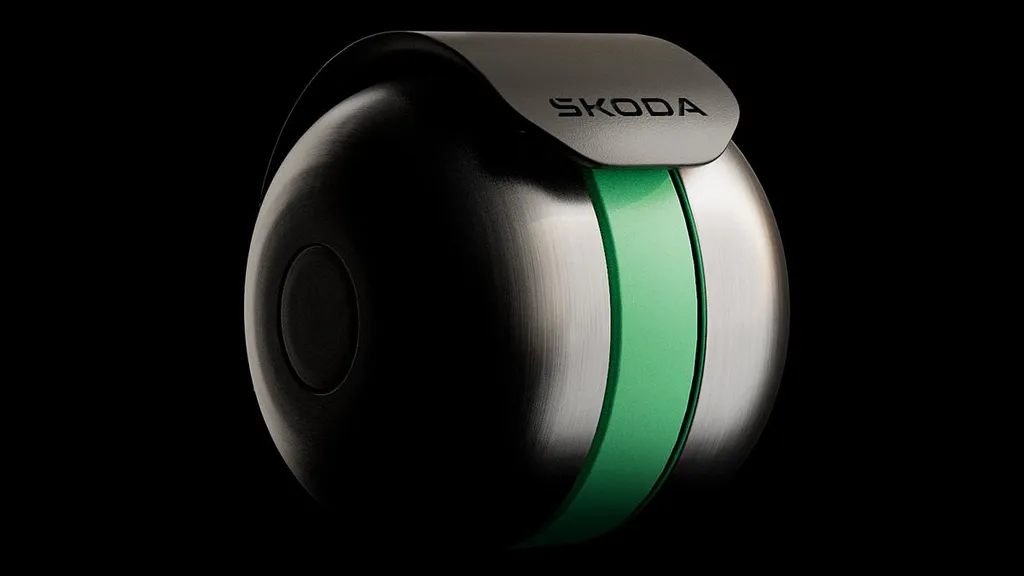
The bike bell was first created back in 1877.
Now, almost 150 years later, the simple device has been reinvented.
In a bid to improve road safety for cyclists, Škoda has developed a next-generation bike bell called the DuoBell.
The device creates a unique sound that can effectively bypass active noise-cancelling (ANC) systems in headphones.
Trials with Deliveroo drivers found that pedestrians wearing ANC headphones had as much as five seconds longer and up to 22 metres more distance to react when the bell was activated.
'Bike bells have barely changed in 100 years, but the world around them has,' said Ben Edwards and Guy Hobbs from creative agency AMV BBDO.
'Škoda DuoBell is the first-ever bell designed to cut through noise-cancelling headphones.
'A clever analogue hack that outsmarts the AI algorithms inside them. It's one tweak that will make city streets safer.'
In a bid to improve road safety for cyclists, Škoda has developed a next-generation bike bell called the DuoBell.
Trials with Deliveroo drivers found that pedestrians wearing ANC headphones had as much as five seconds longer and up to 22 metres more distance to react when the bell was activated.
Škoda was inspired to create the DuoBell after noticing a spike in bike-pedestrian collisions in London.
According to Transport for London, at least 335 pedestrians were injured in collisions with cyclists in 2025 - with two suffering fatal injuries.
One contributing factor is the rise in the use of noise-cancelling headphones, which reduce awareness of approaching cyclists.
To understand how to combat this problem, the car giant joined forces with acousticians from the University of Salford.
Dr Will Bailey, Head of Acousticians at the University of Salford, explained: 'Active noise cancellation is really good at blocking broad sounds.
'It detects sound and plays an inverted signal back to cancel it out.
'There are points where it's less effective. So we set out to find them.'
The researchers carried out acoustic tests and identified a narrow 'safety gap' between 750 and 780Hz that consistently penetrates ANC filters.
The team reduced the thickness of the metal and added precision cuts before tuning the bell to exactly 750Hz.
How does the Skoda DuoBell work?
The Skoda DuoBell is entirely mechanical and is designed to ring out at two frequencies - 750Hz and 780Hz.
This so-called 'safety gap' consistently penetrates filters in active noise cancelling headphones.
During tests, the DuoBell was heard 22 metres earlier than a standard bell - and five seconds sooner.
'Testing hundreds of signals across six leading headphones, we found one at 750Hz. We call it the safety gap,' Dr Bailey explained.
Having discovered this gap, the team built the DuoBell around it.
However, this initially proved tricky.
Hugh Boys, Head of Hardware Development at Škoda, explained: 'The problem with creating a frequency that low is the bell has to be huge - not ideal for a bike.'
To overcome this issue, the team reduced the thickness of the metal and added precision cuts, before tuning the bell to exactly 750Hz.
To make the bell even more penetrating against ANC, Škoda added a second frequency of 780Hz - hence, the name DuoBell.
While you might think that this would require complicated technology, surprisingly this isn't the case.
Oliver Stefani, Head of Design at Škoda explained: 'Our bell is 100 per cent mechanical. It's a simple, analogue solution to a digital problem.'
Škoda joined forces with Deliveroo and took DuoBell to the streets of London, where it once again proved effective.
To test it, Škoda first used a virtual reality scenario in which a cyclist approached a distracted pedestrian wearing ANC headphones.
Amazingly, the DuoBell was heard 22 metres earlier than a standard bell - and five seconds sooner.
'The difference between stepping aside and a serious collision,' Škoda pointed out.
Next, Škoda joined forces with Deliveroo and took DuoBell to the streets of London, where it once again proved effective.
Now, Škoda says it's working with 'partners' to implement the bell across London, and beyond.
It remains unclear how much the DuoBell costs or if it will be available for cyclists to buy directly - the Daily Mail has contacted Škoda for clarification.