In 2017, Karl Lagerfeld went where no fashion designer had gone before, by launching a Chanel-branded rocket at his show in Paris.
The 35-metre-tall missile may have only risen 10 metres into the air, but it created headlines around the world for his autumn collection.
Three years earlier, Lagerfeld was also at the centre of one the world's most memorable catwalk moments.
Chanel had built a shopping centre from scratch and had models 'shoplifting' from supermarket shelves - including pop star Rihanna and the model Cara Delevingne.
More recently, French fashion house Dior took over a castle in Perthshire for a Scottish history-inspired runway.
And Stella McCartney had 10 horses walk her latest show, alongside the models on the catwalk.
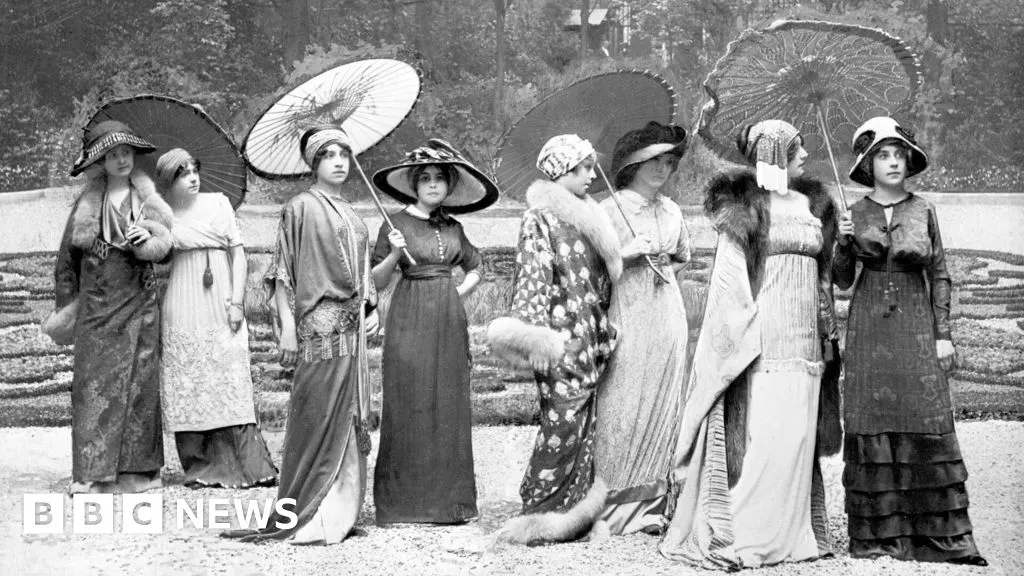
Now the new exhibition Catwalk: The Art of the Fashion Show at V&A Dundee, made in collaboration with Vitra Design Museum, explores the origins of the fashion catwalk.
Designers would use male models as mannequins to show their designs on the streets of Paris, and dispatched dolls in miniature versions of their clothes to customers.
But it was Charles Frederick Worth whose House of Worth was the first fashion house to stage a catwalk show.
"He and other designers realised there was a need for their customers to see clothing or bodies moving in a space," says curator Kirsty Hassard.
Paul Poiret and Gabrielle Chanel were also one of the firsts to adapt live models in their shows.
Hassard added: "That's why fashion shows exist in the first place and that's why they continue to be so important.
"We have masses of new technology including AI which plays a role in the fashion show but nothing has really has replaced the human body being able to evoke a designer's vision."
Art curator and film director Eunice Olumide agrees.
A model for some of the biggest fashion houses since she was spotted as a teenager on the streets on Glasgow, she is particularly fascinated by the Pathe footage of an early fashion show in the 1920s.
"It's a very avant-garde way of modelling," she says.
"The models are moving and swishing and swaying, which is so different to where we are now in terms of fashion, which is very much like a military walk."
Different fashion houses encouraged their models to develop a different walk.
For a period, Chanel became known for the "slouch" which ensured the folds of their clothes were shown to best advantage.
Others were known as The Disrupters including Vivienne Westwood, who Olumide did her first catwalk show with.
"Vivienne was cool so she didn't really care about that," she says.
"It's more about the vibration of the person. And then after that, I remember coming to Scotland and working with an amazing woman called Fiona Best.
"And she basically taught, I think, everybody in Scotland how to walk."
Other fashion "disrupters" include Paisley-born designer Pam Hogg who died last year.
"Disruptors were designers who chose to go against what's considered standard in the fashion industry," says Hassard.
"So whether that's how they're staging their shows, where they're staging their shows, or the clothes they're showing."
One of the main disruptors of the 90s, designer Alexander McQueen, often referenced philosophy, history and art to create spectacles that were both visually impactful as well as intellectual.
The exhibition features footage of McQueen's No.13 show - one of his most famous show finales.
It featured supermodel Shalom Harlow on a spinning disk between two metal robots, hired from a car manufacturing plant, which spray-painted her in black and acid lime. It was also one of McQueen's most unforgettable runway moments.
An Englishman with a Scottish father hailing from the isle of Skye, McQueen explored his heritage in many of his shows including one of his most controversial shows 'Highland Rape' in 1995.
Notorious for both its title and its imagery; the blood‑spattered, semi‑naked models in torn clothing were intended as a statement on England's violation of Scotland during the Highland Clearances.
Nicholas Daley draws on his Scottish and Jamaican heritage for his eponymous fashion label, mixing Jamaican style with Scottish craftsmanship while weaving in broader black British and diasporic themes.
"Jamaicans just know how to dress" he says.
His ensemble on display from his Island Ties collection features a kilt and tartan bomber jacket with chunky scarf knitted by his mother and a pair of Clark's shoes adorned with a thistle and hibiscus flower to symbolise both countries of his origin.
"There's a whole list of Scottish designers and brands and we all tap into this bigger, rich history of craft and tradition and rebellion.
"Because we all have a bit of a rebel streak."
His catwalk shows have been staged in a number of different places including a working men's club and a church, but their common thread, aside from the fashion, is music.
He like many of the designers, makes his own music and makes it part of the show.
Scottish designer Charles Jeffrey studied alongside him at St Martins college in London and also makes his own music.
"I'm not the first fashion designer to make music," he says. "There's a few of us. Jean-Paul Gaultier actually has this really great song called How To Do That. He did that in the 80s. I think it's a really nice way to sort of help explain your ideas a bit further.
"I think I try to make something that's usually quite anarchic or romantic and makes people dream but with a sense of humour."
Lucia Fairfull is the face of the exhibition - a model and a musician who was one of the first visitors to see the dolls lent by the fashion house Balenciaga.
"You're getting to see things first-hand and up close, the detail and craftsmanship," she says.
"I think it's very easy for art to feel quite disposable and I think coming into this exhibition, you really realise how much time and effort went in."
Theatre de la Mode was a concept created by the French fashion houses in 1945 to help their industry survive.
By scaling back their designs and their fashion shows, they were able to create a fashion show in miniature.
The dolls were 70cms tall, approximately a third of a live model and allowed them to show their skills with the minimum material.
The concept was revived during the pandemic alongside film and TV projects, including an unlikely collaboration between fashion houses and The Simpsons.
Lucia says she hopes it will show the range of skills the fashion industry supports, beyond the fast-paced, high-priced spectacular shows which grab all the attention.
"I remember being younger and thinking that fashion was just about models and designers, but there's so many other elements to it from the lighting designers, the architecture, photographers, makeup artists, seamstresses."
"There may be young people out there who feel they would like to be part of that and I think this exhibition is a way to open doors and people's imaginations."