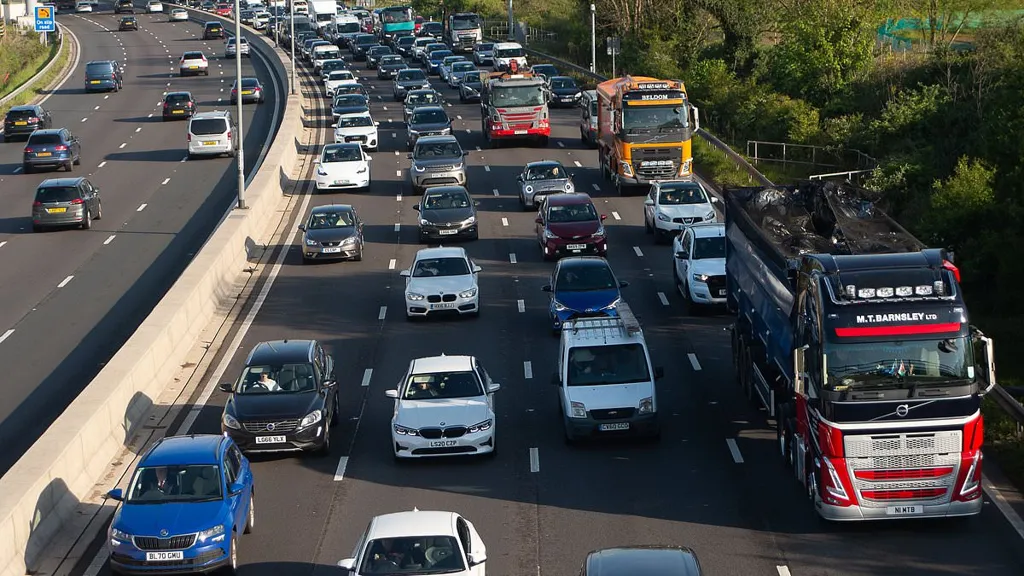
National Highways review found the roads provide little economic benefit.
Controversial 'smart' motorways are barely providing any economic benefit, damning new analysis has found.
Two sections of smart motorway are actively losing the nation income, and a further six schemes have been marked as barely breaking even, according to the body responsible for them.
Smart motorways first appeared in 2013 and were intended to increase motorways' capacity at fairly low cost by turning the hard shoulder into a lane. Overhead digital signage is used to manage the flow of traffic.
Of all the stretches of smart motorways reviewed by National Highways, just three were found to be 'on track' in relation to delivering value for money over the five-year evaluation period.
'This [smart motorways] has been a catastrophic waste of time, money and effort,' AA president Edmund King said.
'Many of the schemes have slower journeys which causes traffic jams, loses the country cash and worsened the safety record of motorways.'
The report comes just days after it was revealed that the number of drivers who feel nervous or anxious about driving on 'smart' motorways (46 per cent) has double in a year.
The two 'smart' motorways that have been confirmed as a cash losing exercise are the M25 all-lane-running (ALR) section between junctions 23 to 27, which permanently has no hard shoulder, and the M6 Dynamic Hard Shoulder (DHS) section between junctions 5 to 8, which turns the hard shoulder into an active lane during period of heavy congestion.
Both were found to be losing the economy money and rated 'very poor' by National Highways.
Six schemes have been rated as 'not on track - poor' or 'not on track - low' in respect of their economical benefit.
Just three schemes at the end of the five-year evaluation period are 'on track' in relation to value for money.
The analysis concluded that, in many cases, converting the hard shoulder into a permanent or temporary running lane has reduced the speed of traffic, meaning more jams and congestion across England's motorway network.
The only scheme to exceed expectations is the Controlled Motorway stretch (which has a permanent hard shoulder but also uses dynamic speed limits to control traffic flow) on the M25 between junctions 16 to 23, which has also been widened.
This section saw faster journey times and an improved safety record.
As such, the AA is calling for this to be the standard bearer for motorway improvements for the future.
What are the three types of 'smart' motorways and how do they work?
ALL LANE RUNNING (ALR)
All lane running schemes permanently remove the hard shoulder and convert it into a running lane.
On these types of motorway, lane one (formerly the hard shoulder) is only closed to traffic in the event of an incident.
In this case a lane closure will be signalled by a red X on the gantry above, meaning you must exit the lane as soon as possible.
All running lane motorways also have overhead gantry signs that display the mandatory speed limit.
Should drivers break down or be involved in an accident there are emergency refuge areas at the side of the carriageway for them to use.
Miles in total: 249.5 miles
Percentage of smart motorways in England: 55.1%
Percentage of all motorways in England: 13%
CONTROLLED MOTORWAY
Controlled motorways have three or more lanes with variable speed limits, but retains a hard shoulder. The hard shoulder should only be used in a genuine emergency.
These variable speed limits are displayed on overhead gantry signs - if no speed limit is displayed the national speed limit is in place. Speed cameras are used to enforce these.
Miles in total: 140.2 miles
Percentage of smart motorways in England: 31.0%
Percentage of all motorways in England: 7.3%
DYNAMIC HARD SHOULDER (DHS)
Originally referred to as Hard Shoulder Running smart motorways, dynamic hard shoulder running involves open the hard shoulder as a running lane to traffic at busy periods to ease congestion.
On these stretches a solid white line differentiates the hard shoulder from the normal carriageway. Overhead signs on gantries indicate whether or not the hard shoulder is open to traffic.
The hard shoulder must not be used if the signs over it are blank or display a red X, except in the case of an emergency.
A red X on the gantry above means you must exit the lane as soon as possible.
Overhead gantries on these types of motorway also display the mandatory speed limit which varies depending on the traffic conditions. Speed cameras are used to enforce these - no speed limit displayed indicates the national speed limit is in place.
Miles in total: 62.6 miles
Percentage of smart motorways in England: 13.8%
Percentage of all motorways in England: 3.3%