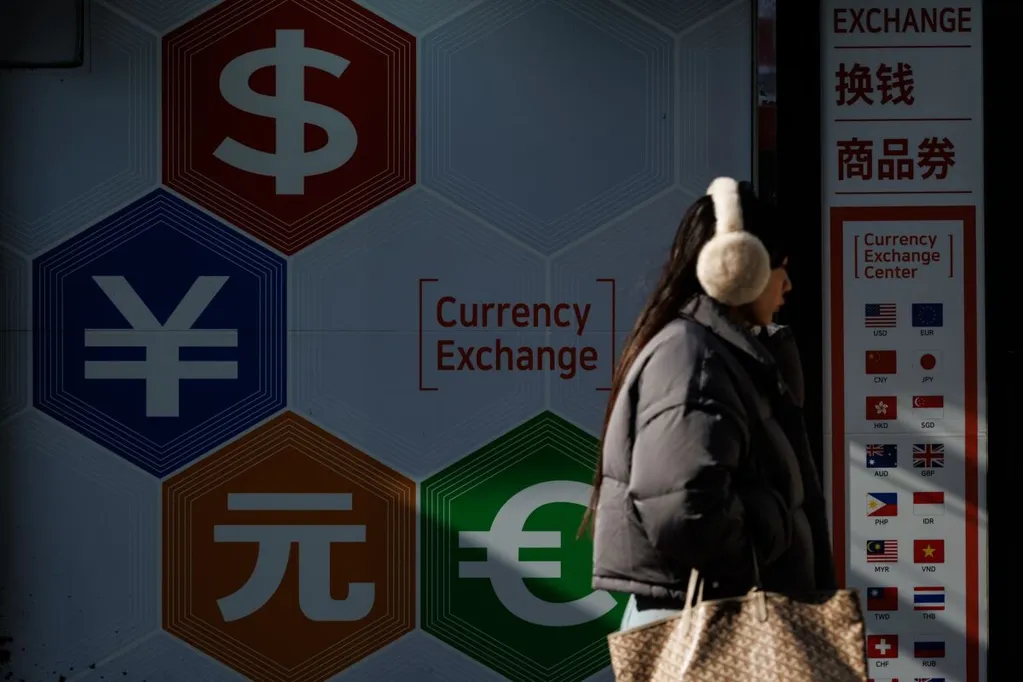
Seoul is introducing reforms aimed at making life easier for foreign investors and wants to bolster international use of the won, but officials will be surrendering some control as they put the country on a path of greater globalization.
The dollar may be languishing, but not everyone gets a free ride. South Korea is on edge about the slide in its currency, which is approaching levels unseen outside of the Global Financial Crisis of 2007-2009 or the Asian collapse a decade earlier.
The latter episode, which culminated in a rescue for the country from the International Monetary Fund, left deep scars. A generation of policymakers who began their careers in the late 1990s remain wary of abrupt shifts in capital flows. That makes what happens next crucial.
Seoul has rolled out measures to buttress the won, which fell about 7% against the greenback in the past six months, making it one of the region's worst performers. That drop is roughly in line with that of the yen, whose weakness has been a major source of anxiety for Japan -- and has prompted the government to wade into markets several times since 2022. On Wednesday, US Treasury Secretary Scott Bessent offered rare verbal support for the currency and warned that "excess volatility" is undesirable.
His comments gave the won a much needed boost. Clearly, "Sell America," the catch cry for investors who have soured on the US since the White House imposed sweeping tariffs in April, doesn't capture the entire foreign-exchange picture. It also obscures some important nuances.
In his new year message to staff, Korea's central bank governor declared that the won is "substantially misaligned" with underlying conditions. The finance ministry warned traders not to test its resolve -- or ability to respond swiftly to swings it finds particularly troublesome. For now, officials have avoided heavy-handed intervention. Instead, in addition to jawboning, they have pushed pension funds to sell dollars and encouraged the nation's sprawling conglomerates to convert more of their overseas foreign earnings back into won. It's hard to imagine
the central bank replicating the series of interest-rate cuts that began in October 2024.
It's a tricky time. Korea is simultaneously introducing reforms aimed at making life easier for foreign investors. The government, which wants to bolster international use of the won, announced last week it will allow 24-hour trading from July and relax rules for offshore transactions. The step is part of a campaign to secure a coveted upgrade to developed-market status from MSCI Inc.
Being an emerging market -- the league that's home to less prosperous economies such as Indonesia, Brazil and Egypt -- jars with aspects of modern Korea, a robust democracy with strong institutions. An attempt by former President Yoon Suk Yeol to impose martial law in 2024 failed, and Yoon was impeached and removed from office. The country churns out cars, cell phones and televisions that have become ubiquitous, to say nothing of the chips that power the boom in artificial intelligence. The nation's debt market got a big boost when it was admitted to FTSE Russell's major global bond index last year.
Seoul has already begun to gradually lengthen currency trading hours and says there's no turning back from the reform path. But officials will, in effect, be surrendering some control. The Bank of Korea would surely prefer the won be more resilient as it puts it in a position of strength. But there's never a perfect moment. It's hard for a middle power to remain half in on globalization and half out.
By contrast, the US and China, the world's top two economies, want the benefits and not the costs of deeper global integration. US President Donald Trump has imposed duties on imports from friend and foe and regards the network of security alliances and commercial accords forged by predecessors with disdain. While China joined the World Trade Organization in 2001, Beijing is reluctant to allow markets to exert too much sway and has cracked down on an array of industries. They are big enough to resist, for a time, the full pull of gravity.
South Korea will just have to grin and bear the prospect of greater fluctuations. The FX market has swollen to $9.6 trillion a day. When Korea sought a bailout from the IMF in 1997, volumes were a fraction of that.
Vigorous resistance of market forces also raises the issue of who to blame for the won's retreat. Korean citizens are at least a part of the explanation. Local retail investors piled into US assets last year even as local stocks notched impressive gains. (The benchmark Kospi Index surged 76% over the same period and climbed to a record this week.) Those with memories of the collapse of domestic markets in 1997 have shifted money abroad. Younger people, priced out of the housing market, especially in Seoul, are plowing cash into domestic and overseas markets. And the $350 billion investment fund that the government agreed to in a trade deal with Washington is weighing on appetite for the won.
South Korea is executing an important shift. It wants to lift its currency's international profile just as much bigger economies are turning away from ever-freer markets. It's a laudable step for Seoul. May it not end in tears.