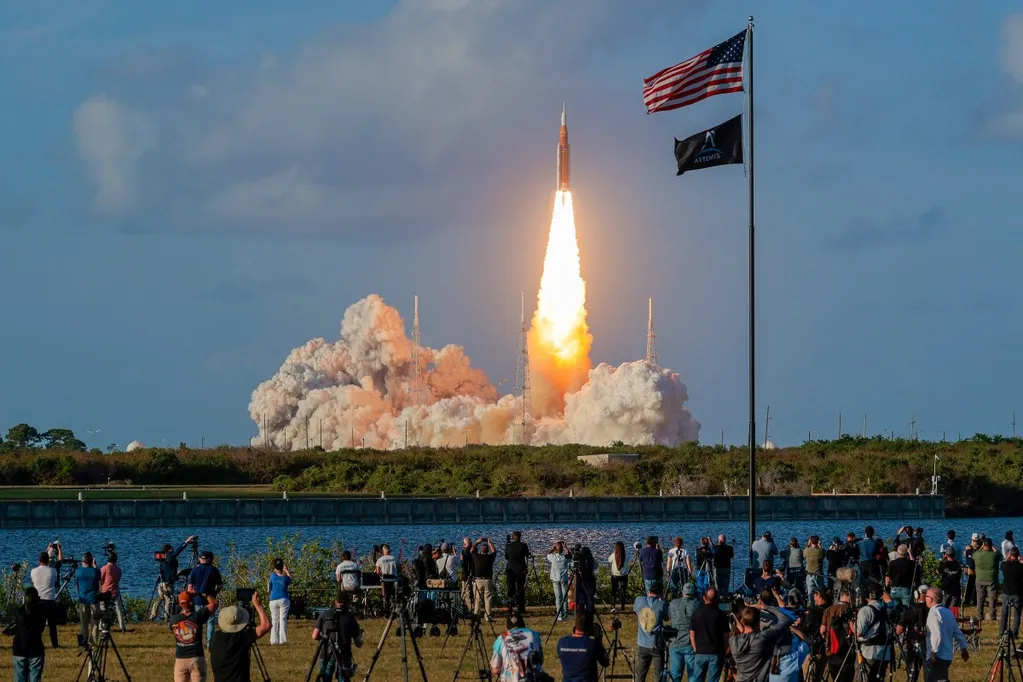
As Artemis II carried astronauts around the moon, some asked a familiar question: Why invest in space exploration when there are so many problems on Earth?
Picture this. A rescue team moves through whiteout conditions in the mountains, racing to reach a stranded hiker before nightfall. Somewhere ahead, a distress beacon is transmitting a set of coordinates to satellites overhead. Those coordinates guide rescuers through the storm. The same invisible, space-based infrastructure supports emergency calls, financial systems, global logistics and more.
That invisibility is a paradox of space: it underpins modern life so completely that we rarely notice it at all until it is disrupted. But space systems are increasingly vulnerable to collisions and interference that can shut down critical systems such as navigation and communications in an instant. Robust policy and international coordination should support the advancement of space infrastructure and protection of the capabilities that already exist. What is needed is a military-backed alliance in space: an Artemis Alliance.
While the recent White House executive order (EO) on Ensuring American Space Superiority calls for expanding the United States' capabilities and the space economy, it is not sufficient to protect the infrastructure that modern life depends on. The EO goes as far to eliminate the National Space Council, a body led by the vice president that was uniquely positioned to guide American space policy. While these actions may seem insular to national security and space communities, in reality they impact everyday life in significant ways.
Protecting the fragile space domain requires a collective effort, similar to how the U.S. Coast Guard or even the Navy protect and support commercial vessels. The U.S. and its closest spacefaring partners have the capability to improve and protect space operations, but now more than ever it requires nations to build a shield of deterrence, in other words an Artemis Alliance, that keeps space safe, stable and open. Even the million-strong commercial satellite constellation proposed by SpaceX depends on a secure space environment. Today, commercial space is central to national security, and any effort to protect space must fully integrate private operators and infrastructure.
The value of space goes well beyond the satellites we use each day. Investments in exploration and advanced space technologies consistently produce breakthroughs that improve life. Robotics, autonomous systems, advanced materials, water purification, climate modeling and medical imaging all benefit from space research. An Artemis Alliance would not only protect these gains but also help to unlock new opportunities for private equity and venture capital, accelerating innovation and expanding access to emerging space markets.
Future advances will follow the same pattern. Work on lunar infrastructure will stimulate innovation in energy storage. Deep space navigation will improve autonomous systems on Earth. The next generation of spacesuits, which now involve major fashion houses, will drive new textile technologies. Protecting space operations supports world-level economic growth and scientific discovery while improving the long-term competitiveness of nations at the forefront of growth. For industry, this translates into more predictable operating environments, stronger returns on investment and new avenues for growth across both commercial and defense sectors.
International treaties on space, like the Outer Space Treaty, guided peaceful activity in orbit for more than 50 years. More recently, the Artemis Accords brought together a growing coalition of countries that support principles of transparency, responsible behavior, interoperability and open access to space through nonbinding agreements tied to civil space cooperation. But the accords remain voluntary and lack mechanisms for collective enforcement or security coordination. Principles alone are not enough to protect space.
Moreover, the rise of debris, the development of systems that can disable both military and commercial satellites, and the increasing economic and security dependence on space services require more coordinated and credible protection. What is needed is international coordination with credible deterrence behind it. The United States and its closest partners need an alliance that is organized, capable, prepared and empowered to act. An Artemis Alliance would provide the structure needed to protect the shared infrastructure that modern life relies upon.
Members of the Artemis Alliance would commit to improving coordination on threats, sharing information on debris and hostile activity, strengthening technical interoperability and preparing joint responses to actions that place satellites at risk. They would also agree on higher standards for safer operations, including improved collision avoidance and responsible end-of-life disposal for objects like satellites and rocket bodies. Most of these activities take place in disjointed and cumbersome organizational processes, rarely properly coordinated across the globe. As space operations continue to grow exponentially, we cannot simply just "hope" that nations and industry players are doing the right thing. A successful alliance would also require formal mechanisms for public-private collaboration, ensuring that governments and commercial actors jointly shape standards, share data and coordinate responses in real time.
The core group of an Artemis Alliance should start with countries that the U.S. already has bilateral defense treaties with and those that possess mature indigenous space capabilities: Australia, Canada, France, Japan, New Zealand, South Korea and the United Kingdom. Future members would be added in time as their interests in space mature. Each of the initial eight countries brings distinct strengths that would reinforce the alliance's collective space posture. While some claim that alliance contributions should be measured in equal or proportionate financial terms, space capabilities are inherently diverse and often complementary. Japan and the U.K. excel in secure communications; France and Australia operate some of the world's most advanced surveillance and tracking systems; Canada leads in space robotics; the U.S. provides launch capacity, deep-space infrastructure and an innovative commercial base. An alliance framework would allow these capabilities to operate together through shared standards,data-sharing agreementsandcoordinatedoperationscreatingafarmoreresilientspacearchitecturethananyonenationcouldbuildalone.ButbuildingsuchanalliancerequiressustainedU.S.leadership.
Unfortunately,theTrumpadministrationeliminatedtheNationalSpaceCouncilandhasattemptedtoreduceNASA'sbudgetwhichisdirectlycontradictingitsnewEOandweakeningthetoolsneededtosustainU.S.leadershipinspace.Maintainingthatleadershiprequiresacoherentstrategyathomeandabroad:restoringtheNationalSpaceCounciltocoordinatepolicyacrossgovernment;ensuringNASAhastheresourcestoleadexplorationandtechnologicaldevelopment;advancinganArtemisAlliancebringingalliednationstogethertosecurepeacefuluseofspace.Thiseffortmustbebuiltnotonlyacrossgovernmentsbutalongsideprivatesector.Whatmayappearto beabstractpolicydebatesare,inreality,decisionsaboutreliabilityoftheinvisibleinfrastructurethatunderpinsmodernlife.AnArtemisAllianceisessentialforprovidingthecoordinationanddeterrenceneededtokeepthisshareddomainsecureandreliable.
Kathleen Curlee is a research analyst at Georgetown University's Center for Security and Emerging Technology. Brian Golden is a former U.S. Air Force pilot with over 26 years of military service during which time he was responsible for initiating and writing NATO's first space policy while serving as a senior policy adviser in the U.S. Mission to NATO in Brussels.