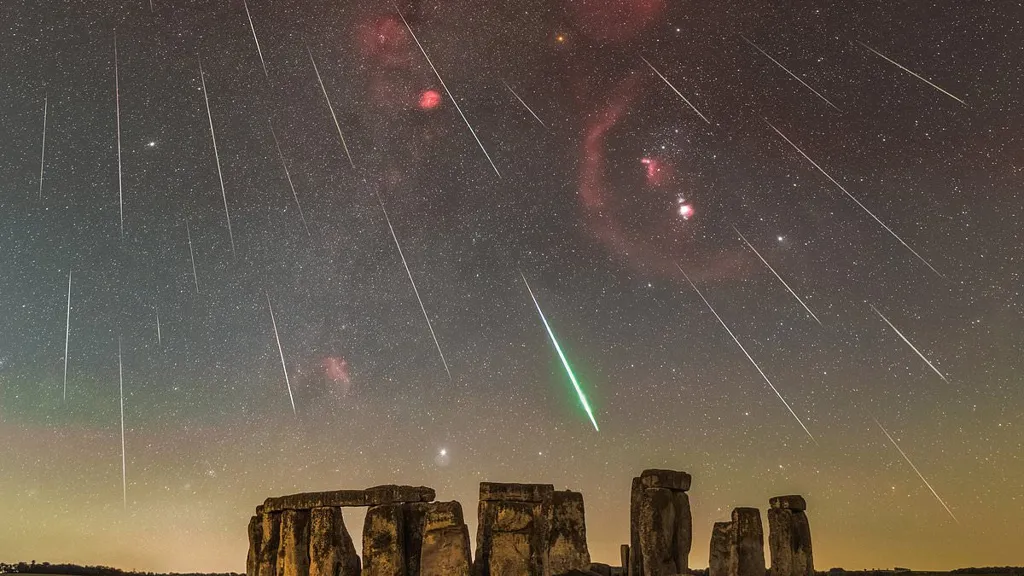
Keen sky gazers will have one last shot to capture a blazing fireball from the 2025 Geminid meteor shower tonight.
The final major meteor shower is expected to dazzle the night sky with up to 150 shooting stars visible every hour.
The difference with the Geminids is that it is caused by debris from 3200 Phaethon, which is not an icy comet but rather rocky, like an asteroid.
The Royal Greenwich Observatory said: 'The meteors of the Geminid meteor shower are very bright, moderately fast.
'And are unusual in being multi-coloured - mainly white, some yellow and a few green, red and blue.
'These colours are partly caused by the presence of traces of metals like sodium and calcium, the same effect that is used to make fireworks colourful.'
Geminids meteor showers typically produce up to 120 and 160 meteors per hour at the peak.
And with the crescent moon at just 26 per cent of its normal brightness, keen stargazers should be in for a great view of the approaching meteors.
A composite of 480 stacked long-exposure images shows Geminid meteors streaking across the night sky over the Skopska Crna Gora mountain near North Macedonia.
A long exposure photo shows a Geminid meteor shower over North Macedonia on December 14.
The peak of the meteor shower occurred on December 14 when the shower was most active.
Because of the New Moon rising tonight, it means spectators will have a better chance of seeing the meteor compared to a full Moon because the night sky will be darker.
This evening, the Met Office forecasts rain and strong winds moving to the southwest, Wales, then Northern Ireland, becoming slow-moving in places. Low cloud and hill fog moving north from the southeast with a little drizzle at times. Driest across Scotland. Rather mild.
Dr Shyam Balaji of King's College London told The Daily Mail: The best time to view the Geminid meteor shower is around 2 am local time when the radiant point is highest in the sky.
'However, you can start watching from mid-evening onward.'
In good conditions, viewers can expect to see upwards of 100 shooting stars an hour, or one or two every minute.
When viewing conditions are poor, you will be able to see fewer stars in the sky, so it's important to make sure you find the right stargazing location.
A view shows the Geminids meteor shower streaking across the night sky as stargazers gather at the Valley View of Yosemite National Park in California on December 14.
A meteor streaks across the northern sky during the peak of the Geminids meteor shower near Skopje, North Macedonia on December 13.
Geminids meteor showers typically produce up to 120 and 160 meteors per hour at the peak.
Dr Robert Massey, Deputy Executive Director at the Royal Astronomical Society: 'With a meteor shower what you want is the widest possible view - you want to be lying down, looking up at the broad panoply of stars, and watching for meteors.
'The best view is if you're away from sources of light pollution, so try and get away from at least direct lights in towns and cities, ideally out in the countryside.
'Obviously you also need a clear sky - if it's cloudy you're not going to see anything.'
You should soon start to see short streaks of light that last for a second or two.
Following that, keen fireball hunters will be able to catch the weaker but reliable Ursid Meteor Shower, peaking on December 22.