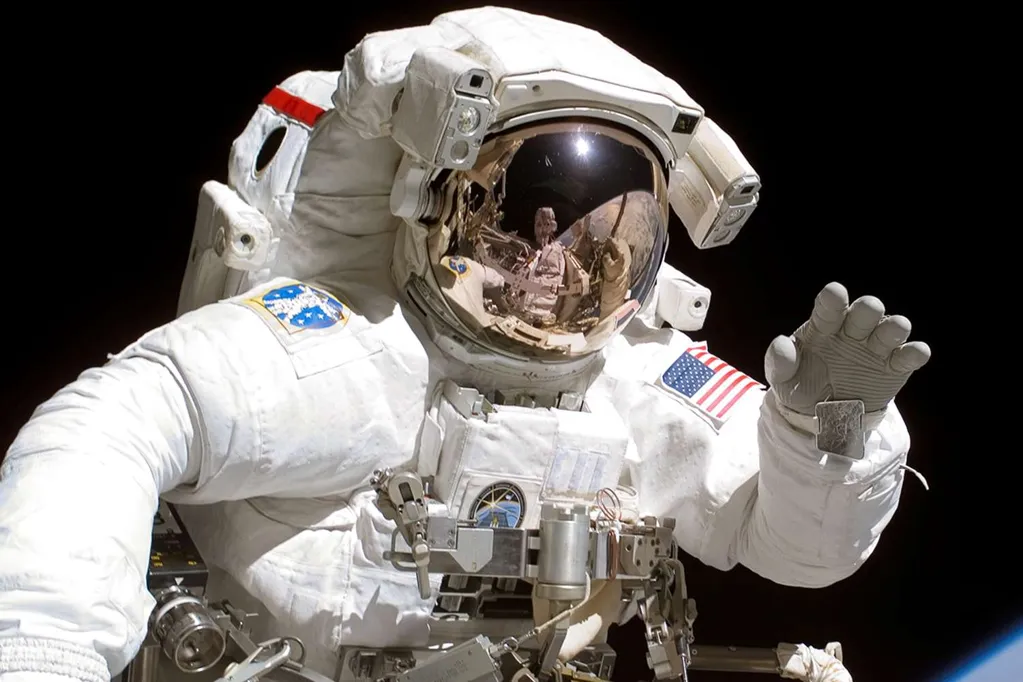
The longer astronauts spend it space, the more pronounced the changes were.
Astronauts' average brain position can change after time in space, a new study has found.
On Monday, Jan. 12, findings published in the journal Proceedings of the National Academy of Sciences (PNAS) revealed that "the brain shifts upward and backward within the skull following spaceflight, with sensory and motor regions exhibiting the largest shifts."
The study explained that, "Understanding how spaceflight impacts the human brain is crucial as space exploration and tourism expand."
Researchers "evaluated brain regional shift magnitudes and deformations and their behavioral correlates," analyzing MRI data from 26 astronauts and 24 participants from "a long-duration head-down tilt bed rest study."
An abstract read, "We aligned skull position across timepoints (before and after spaceflight or bed rest) as a reference and then used rigid body registration to quantify brain position change."
"The brain shifted backward, upward and rotated back in the pitch direction from before to after spaceflight and bed rest in a fashion that correlated with exposure duration," it added.
The study found that "widespread recovery occurred in all three dimensions (particularly in the up-down direction) over [6 months] following spaceflight." However, it also noted, "Although most of the brain deformation recovered over [6 months] post-flight, some persisted."
Studies like this could prove to be crucial given the direction space travel is heading in. In 2022, PEOPLE reported that a NASA official had said it was only a matter of time before people will be living -- and working -- on the surface of the moon.
Rachael Seidler -- one of the study's co-authors and a professor in the department of applied physiology and kinesiology at the University of Florida -- said, "We need to understand these changes and their impacts to keep astronauts safe and healthy and protect their longevity," per NBC News.
The outlet noted that a few individuals studied had spent extended, yearlong stints aboard the International Space Station, while the standard duration for a mission is around six months.
"The people who went for a year showed the largest changes," Seidler said, per NBC News. "There were still some changes evident in people who went for two weeks, but duration seems to be the driving factor."
She added to the outlet that the upward movement in the brain among astronauts who had stayed in space for six months or longer had been "pretty extensive," especially in structures at the top of the organ.
"It's on the order of a couple of millimeters," Seidler said, adding, "Which doesn't sound like a big number, but when you're talking about brain movement, it really is. That kind of change is visible by eye," according to the outlet.
She explained that the changes in the brain would sometimes cause "sensory conflicts" while the astronauts were in space. These symptoms would often manifest as temporary disorientation or motion sickness in space, while the shifts would contribute to things like balance issues when back on Earth, NBC News noted.
Seidler told the outlet that it "was surprising" to her that the study didn't find that astronauts suffered serious symptoms, such as cognitive impairment or headaches, during or after spaceflight.
The latest study is one of many published regarding space and health. However, despite scientists already knowing that spaceflight can affect the brain, Seidler's study is among the first to reveal how the changes affect how astronauts function in space and back on Earth, NBC News reported, citing Dr. Mark Rosenberg.
Rosenberg -- the Director of the Aerospace and Performance Neurology program and Assistant Professor of Neurology at the Medical University of South Carolina -- said of the study, which he was not involved with, "We knew the brain shifts upward, but does it actually have any kind of operational impact?" per NBC News.
"This study is able to make some of those associations," he added to the outlet.
Rosenberg told the publication that there are still certain questions that need to be answered as more people plan to head to space.
"If you've been on Mars with one-third Earth's gravity, or on the moon with one-sixth Earth's gravity, will it take three or six times as long to get back to normal?" he said, per NBC News.
"Whether we care to admit it or not, we are eventually going to become a space-faring species," Rosenberg told the outlet. "It's only a matter of time. And these are just some of the unanswered questions that we need to sort out."
Seidler didn't immediately respond when contacted by PEOPLE for comment.