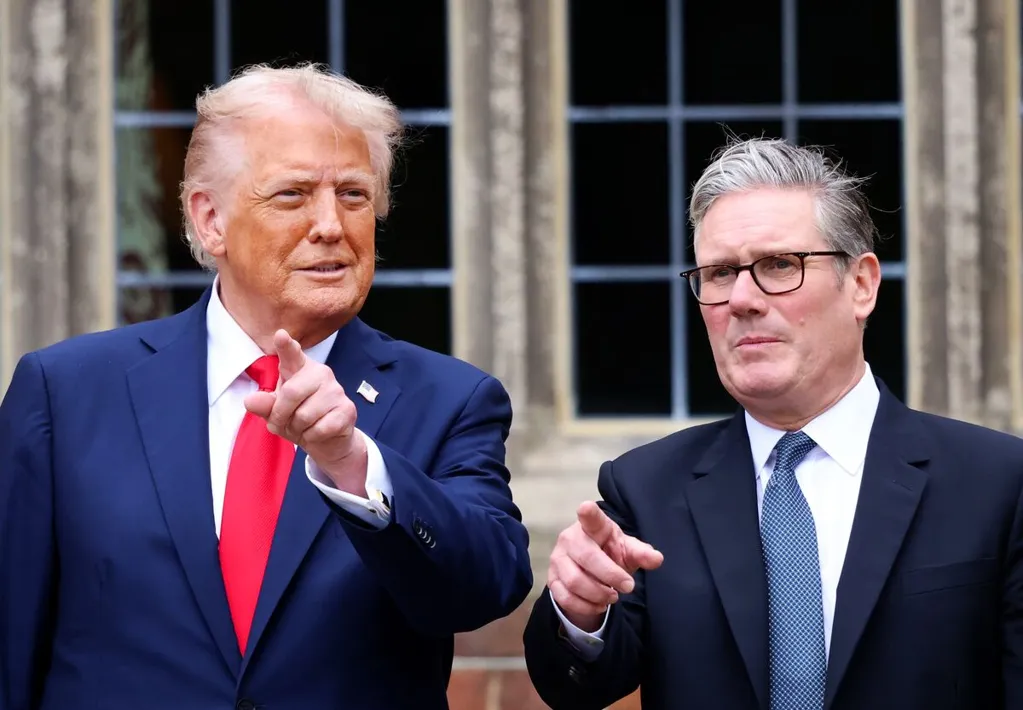
Having spent a year attempting to charm and appease Donald Trump, UK Prime Minister Keir Starmer on Monday drew a clear line in the sand: Britain will not join its closest military partner in offensive action against Iran.
"This government does not believe in regime change from the skies"
were the words from America's main European ally less than 48 hours after the US and Israel began strikes on Iran.
Starmer pushed back against Trump's criticism that he was slow to authorize the use of British bases in the operation, saying in the House of Commons that the UK's "actions must always have a lawful basis and a viable, thought-through plan."
While the British prime minister didn't explicitly say it, the corollary of his remarks is that he doesn't think the US bombardment of Tehran is the result of careful planning. As for the legality, Starmer was clear on the advice he'd received ahead of the initial bombardment. "I will not commit our military personnel to unlawful action," he said.
"Starmer has long tried to walk a tight line with Trump but today he's made it clear,"
Ben Judah, a former adviser for Starmer's government who helped steer Britain's response to US action against Iran's nuclear sites last year, said in an interview. "He doesn't believe in regime change from the air and he doesn't believe US aims in Iran are clearly defined."
Starmer's position has already eroded the so-called special relationship between the two nations, with Trump criticizing the premier -- who was a lawyer before entering politics -- for initially blocking the US from using British military bases in its operations against Iran over legal concerns. "We were very disappointed in Keir," Trump said in an interview with the Telegraph newspaper publishedBloomberg Terminal on Monday.
Later on Monday, Defense Secretary Pete Hegseth said, without naming the UK, that "capable partners are good partners, unlike so many of our traditional allies who wring their hands and clutch their pearls, hemming and hawing about the use of force."
It's not the first time Starmer and Trump have publicly aired their differences. For the last two months, the British prime minister has been forced to navigate Trump's threats to take Greenland, hike tariffs on Europe and pull support for his Chagos deal, as well as the US president's dismissal of Britain's role alongside US troops in Afghanistan. In most case, a phone call between the two led to reconciliation.
Yet it was a case of forgiven but not forgotten, prompting Starmer to deliver a pivotal speech at the Munich Security Conference in which he moved away from his long-held stance of refusing to choose between Washington and Brussels. Instead he urged Europe to deepen its interdependence and end its over-reliance on American military support.
The subtleties of that foreign policy shift have now become more explicit.
"Britain has an America problem: our most intimate ally has become profoundly unpredictable and erratic,"
said Judah.
In the latest disagreement, Starmer declined a US request to use British bases at Fairford in the English county of Gloucestershire, and Diego Garcia in the Indian Ocean for offensive strikes against Iran over concerns about the legality of the operations.
Despite Trump's criticism, "it is my duty to judge what is in Britain's national interest," Starmer told the Commons. "That is what I've done, and I stand by it."
The prime minister said he approved a separate American request late Sunday to use the bases to conduct operations for what he described as "specific and limited" defensive purposes by targeting Iranian missile facilities.
Starmer said the change in his position came because Iran had launched "indiscriminate" attacks on Britain's Gulf allies as well as putting thousands of Britons in the region at risk. The UK government published legal advice justifying the use of the bases for defensive operations.
"It is simply not possible to shoot down every Iranian missile or drone after they've been launched: The only way to stop the threat is to destroy the missiles at source,"
Starmer said. "The use of British bases is limited to the agreed defensive purposes; we are not joining the US and Israeli offensive strikes."
A suspected drone hit a Royal Air Force base at Akrotiri in Cyprus, causing minimal damage and no casualties. Starmer said Britain's assessment is that this was launched before he gave the US permission to use its bases, rather than in retaliation against his announcement. On Monday, the Cypriot government said two more drones heading toward the base were intercepted. The base is not being used by US bombers, Starmer said.
Starmer's reluctance to back Trump's action is as much a political calculation as a legal one. His ruling Labour Party still bears deep scars from former Prime Minister Tony Blair's controversial decision to support the invasion of Iraq more than two decades ago. His party, and many British voters, are wary of another Middle East war and Starmer has spent much of the year to date trying to suppress leadership challenges from within his party.
"We all remember the mistakes of Iraq, and we have learned those lessons,"
Starmer said Monday.
Trump in the same Telegraph interview said that such a break between the US and UK's military positions has "probably never happened between our countries before." But that's forgetting a key foreign policy decision in British history when another former Labour leader, Harold Wilson, famously resisted US pressure to deploy British troops to Vietnam in the 1960s.
"If he sticks to his position only engaging Britain in defensive operations to protect our people and allies in the region Starmer will go down in history analogous to Wilson not Blair and that is the most important thing right now,"
said Judah.