Sir Keir Starmer faced a fresh barrage of criticism over his handling of the Iran war and Britain's military preparations.
Former Foreign Secretary Lord Hague criticised the Prime Minister's two-stage response when Donald Trump asked for UK help.
The former Tory leader said that the Government 'could have handled all of this better' by 'giving one answer to the Americans' from the start - that the US could use British bases for defensive action against Iran.
In the event, Sir Keir first refused the US president's request to use UK bases for offensive action but later agreed that the bases, such as RAF Fairford, could be used by American bombers for defensive action to take out Iranian missile launch sites.
Speaking to the Telegraph, Lord Hague made clear that the Government had been right to stay out of involvement in US strikes on Iran and said Mr Trump had entered the conflict 'without a clear exit strategy'.
But insisting that the PM should have agreed to help the Americans to defend themselves against Iranian missiles while refusing to join the war, Lord Hague criticised the lack of British military preparations for the resulting conflict.
He said: 'They could have positioned enough ships in the right place to do so.'
The Tory peer added: 'It reflects more than just him [Starmer].
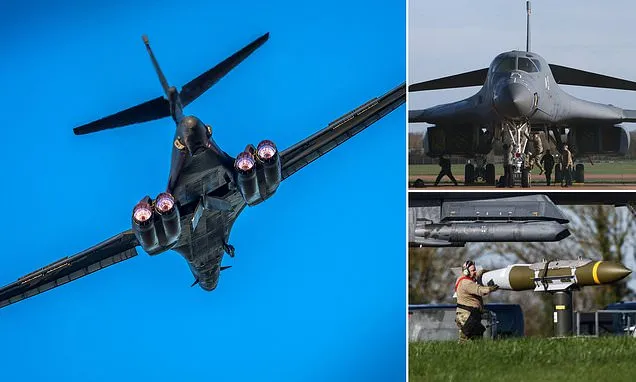
A US B-1 Lancer bomber took off from RAF Fairford today after Keir Starmer allowed the US to use British bases to launch 'defensive' strikes at the start of the war
Former Foreign Secretary Lord Hague criticised the Prime Minister's two-stage response when Donald Trump asked for UK help
'It reflects how much Britain's defence capacity has been reduced.
'When I was Foreign Secretary, it would have been unthinkable not to have minesweepers stationed in Bahrain or a frigate in the Mediterranean ready to move to Cyprus.'
Only last week, the Mail on Sunday highlighted criticisms from former First Sea Lord Admiral Lord West over Labour's decision to pull out Royal Navy ships from the Gulf.
And Lord Hague said: 'The Government has been caught out, and it highlights the need for significantly higher defence spending.'
'That said, in geopolitical terms the bigger questions are what happens to Iran, oil prices, and the future of the Middle East - those issues matter far more than whether the UK had a destroyer in the right place.'
His criticisms come amid claims that Royal Navy bosses were 'furious' at the handling of the Middle East crisis, with reports that they had been 'out-manoeuvred' by senior army and RAF chiefs in charge in key posts.
The Times also reported that the Government itself was suffering from a lack of senior staff with military experience.
Lord Hague also raised concerns over the future of the special relationship with the US after Mr Trump reacting to Sir Keir's initial response about using British bases by declaring that the PM 'no Winston Churchill'.
The Tory peer said: 'I think the relationship will be rocky in the coming months.'
'Historically there have been disagreements - Britain didn't join the Vietnam War despite pressure from President Lyndon Johnson, Margaret Thatcher fell out with Ronald Reagan over Grenada, and there was the Suez Crisis.
'Yet the relationship always recovered, partly because the Cold War kept our strategic interests aligned.'
'Today we don't have that same context, and we also have a very temperamental US president.
'So I expect turbulence.
'I disagree with the Government's deal over the Chagos Islands, but I think staying out of US strikes on Iran was the right decision.
However, he also admitted that he was glad that he was not dealing with the current US administration.
He said: 'It's extremely difficult.'
A member of ground crew walked under a USAF B-1 bomber at RAF Fairford, Gloucestershire
But he added that 'Obama was predictable - if you reached an agreement with him, he stuck to it.'
'Trump is very different.'
Lord Hague suggested that Britain's approach should now be about maintaining the personal relationship at leadership level, presenting close intelligence and military cooperation, strengthening business and institutional links as well as and staying patient.
'You do just have to ride out difficult periods,' he said.
And if one lesson can be taken from recent events, it was the need for the UK to become more independent from the US on defence and foreign policy.
'Britain must strengthen its own capabilities, because there will be times when we are more on our own.'
'We need defence systems that are not entirely dependent on American components.'
'Projects like the new fighter jet programme with Italy and Japan are good examples.'
'The special relationship will remain important, but it may be less dominant than before.'