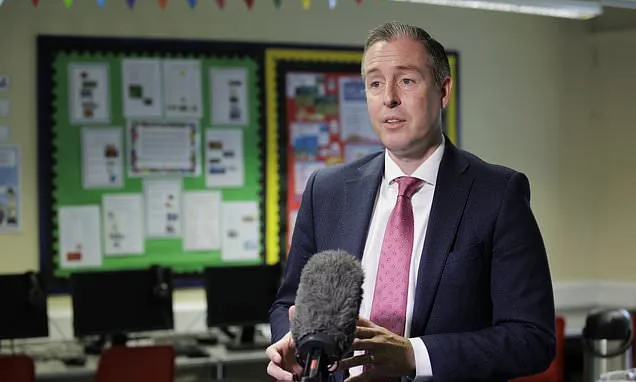
Stormont's Education Minister has published a policy framework to assess children from primary school through to Key Stage 3.
Paul Givan said the new set-up is a "modern, coherent and intentionally aligned assessment system that strengthens teaching and supports every learner".
A report from the Northern Ireland Audit Office (NIAO) published earlier this month said the current "absence of national performance measures at Key Stages 1-3 has resulted in limited system-wide data on school effectiveness".
The framework announced on Wednesday, which is described as "low workload" and "curriculum aligned", includes a baseline check in primary one when children are aged five to six.
It will also entail a phonics reading check in year 2, annual reading fluency checks in years 3-5, literacy and numeracy assessments in Year 4, and a multiplication check in year 5.
Primary 7 students and secondary students from years 8 to 10 will undergo literacy, numeracy and science assessments.
Mr Givan said moving to a model of statutory assessment "will ensure every parent is provided with consistent, clear information on their child's progress, whilst upholding the department's commitment to publish system level attainment data only".
He added: "The new statutory assessments are short, low stakes and supportive, designed to provide clear, timely information rather than create pressure for pupils or teachers.
"They require no revision or preparation.
"Many assessments will be automatically marked, minimising teacher workload and ensuring that classroom time is focused where it should be; on teaching, learning and responding to pupil needs.
"These reforms will align Northern Ireland with leading international practice, where a well-matched curriculum and assessment system and strong early identification are key to raising standards.
"They will also ensure that parents receive easy to understand information about their child's progress from Year 1 right through to Key Stage 3."
The changes follow an Independent Review of Statutory Assessment, chaired by Tim Oates, which concluded the current assessment system, based on moderated teacher judgment and the levels of progression, has not delivered reliable information for pupils, teachers or the wider education system.
The NIAO recommended the Department of Education should "identify the data it needs and how it will obtain and analyse this to demonstrate that the education system is providing a quality education for pupils".
Mr Givan added: "These reforms are a key element of my department's TransformED strategy, which aims to build a world-class, equitable education system focused on high-quality teaching and learning."