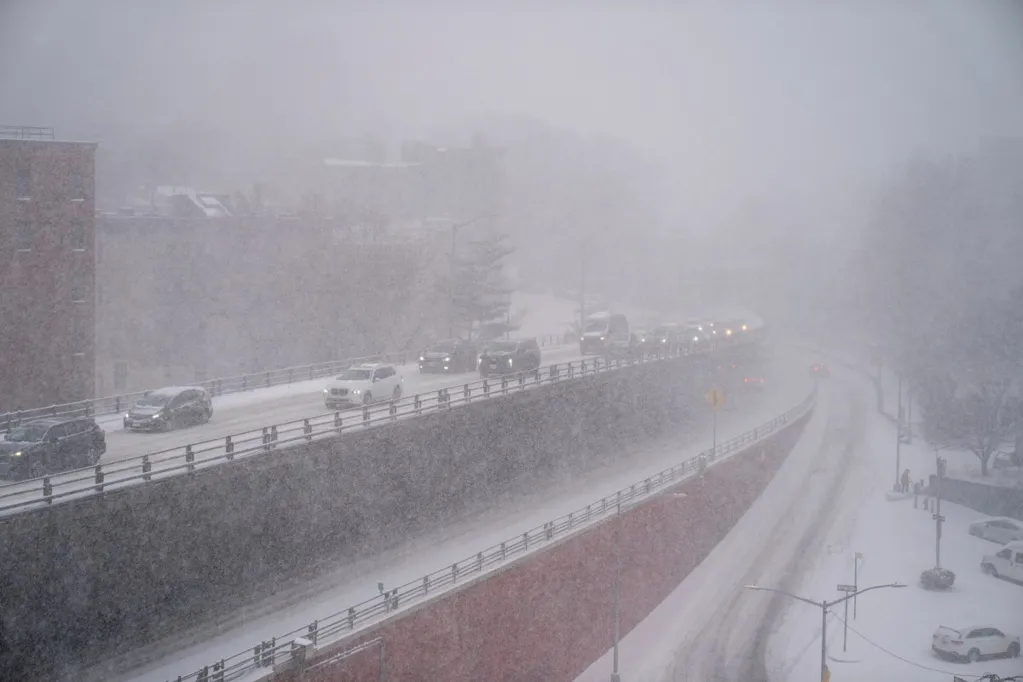
A snow squall warning issued by the National Weather Service (NWS) office in Spokane, Washington, urged more than 33,000 people to delay travel on Thursday amid dangerous winter weather conditions that suddenly arose.
The warning alerted people to heavy snow and strong winds that could cause visibility to plummet rapidly, resulting in deadly traffic accidents. The warning comes as the West is walloped by back-to-back winter storms set to dump as much as 8 feet of snow on the highest elevations this week. Several snow squall warnings have been issued across the country amid the severe winter storms, including a life-threatening snow squall in Utah, Wyoming and Colorado.
Shortly before 8 a.m. local time on Thursday, meteorologists at the NWS Spokane office issued the snow squall warning.
"Whiteout conditions with near zero visibility associated with intense bursts of heavy snow," the warning said.
Newsweek reached out to NWS Spokane by phone for comment.
The warning is in place for southeastern Stevens County in northeastern Washington and southern Pend Oreille County in northeastern Washington, including the following locations: Colville, Chewelah, Newport, Springdale, Cusick, Oldtown, Addy, Sacheen Lake, Chewelah Peak, Usk, Orin, Dalkena, Loon Lake, Diamond Lake, Arden, Valley, Bead Lake Campground, South Skookum Lake Campground, Browns Lake Campground and Ruby.
Roadways also were impacted, including U.S. Highway 20 between mile markers 355 and 436 and U.S. Highway 395 between mile markers 189 and 235.
The warning was set to expire at 9 a.m. local time, although similar warnings could be issued in nearby areas as the storm progresses. A special weather statement also was in place for northeastern Washington and northern Idaho, warning of heavy snow.
"Conditions can deteriorate rapidly in winter weather situations. Be prepared for snow or ice covered roads. Slow down and allow extra time when traveling," NWS Spokane said.
The NWS defines a snow squall as a wintertime weather hazard that can strike suddenly and last less than an hour.
"The sudden white-out conditions combined with falling temperatures produce icy roads in just a few minutes," an NWS webpage about snow squalls says. "Squalls can occur where there is no large-scale winter storm in progress and might only produce minor accumulations. Snow squalls can cause localized extreme impacts to the traveling public and to commerce for brief periods of time. Unfortunately, there is a long history of deadly traffic accidents associated with snow squalls. Although snow accumulations are typically an inch or less, the added combination of gusty winds, falling temperatures and quick reductions in visibility can cause extremely dangerous conditions for motorists."
Snow squalls and blizzards are known for causing whiteout conditions amid intense, heavy snow and strong winds. However, the key difference between the two events is their duration. Snow squalls are typically less than an hour while blizzards are classified as storms with sustained wind gusts of at least 35 mph and visibility less than a quarter-mile for at least three hours.
Blizzard warnings were issued in South Dakota, Minnesota and Montana earlier this week.