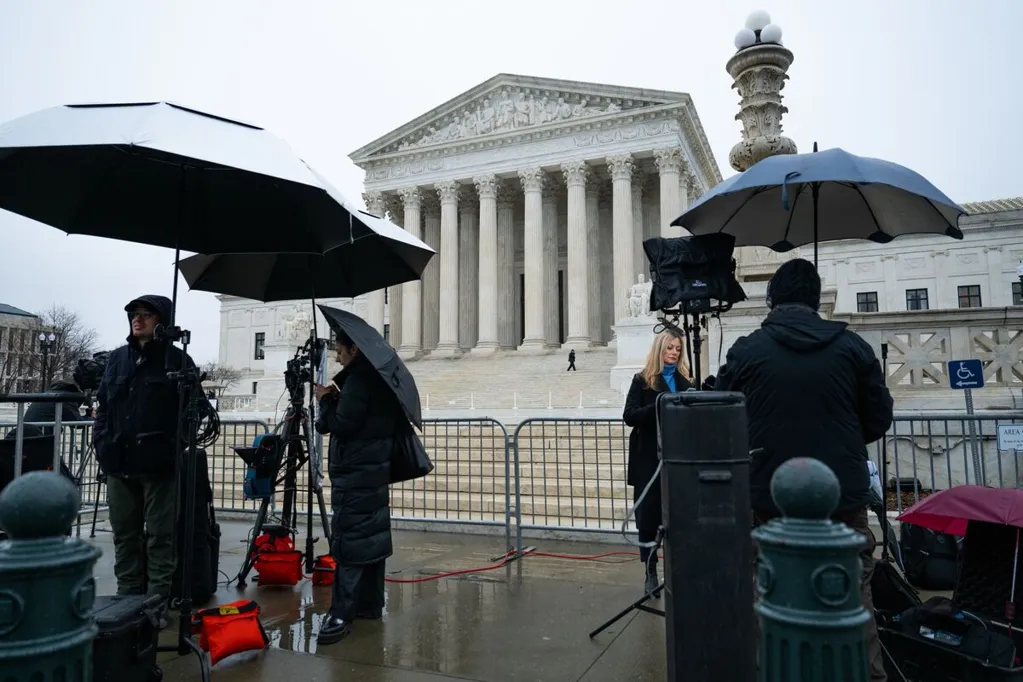
The decision may carry warning flags for Trump, with the court potentially dealing him additional losses in upcoming cases, including those involving his bid to fire Federal Reserve Governor Lisa Cook and his plan to roll back automatic birthright citizenship.
President Donald Trump finally pushed the US Supreme Court too far.
With its rejection Friday of Trump's claim of unbridled power to impose and remove tariffs, the court reasserted itself as a constitutional guardrail and laid out fresh limits on presidential authority. The decision follows a year in which the conservative-dominated court has largely accommodated Trump's moves to transform the US government.
Although the 6-3 ruling won't necessarily affect other legal fights involving Trump, it nonetheless carried warning flags for him. The majority included three Republican appointees - two of them first-term Trump nominees - who emphasized the constitutional boundaries of presidential power and faulted Trump for seeking a "transformative expansion" of his authority.
"It sends a message that the justices aren't going to be a rubber stamp approving President Trump's actions," said Erwin Chemerinsky, dean of the UC Berkeley law school.
In the past year, the high court has sided with Trump in more than 20 emergency requests. The justices have at least temporarily allowed the administration to freeze federal grants and other funds, fire top officials from independent agencies and bar transgender troops from military service.
The tariff ruling is the first of what promises to be several blockbuster decisions over Trump's power in the Supreme Court term that runs through late June or early July. The court may deal Trump additional losses. Justices appeared wary of Trump's bid to fire Federal Reserve Governor Lisa Cook, and his plan to roll back automatic birthright citizenship may prompt skepticism when the court hears argumentsBloomberg Terminal on April 1.
Chief Justice John Roberts underscored the constitutional dimensions of the tariff case. Writing the court's lead opinion, he said the Constitution's framers were wary of "taxation without representation," and consciously gave the taxing power to Congress.
"They did not vest any part of the taxing power in the executive branch," he wrote.
Those words helped broaden a clash over the wording of the 1977 emergency-powers law that Trump had invoked to impose his sweeping global tariffs. The measure doesn't mention tariffs, though it authorizes the president to "regulate" the "importation" of property to deal with a crisis.
"Roberts beginning with the constitutional premise that Congress has the power to tax and that the court's going to enforce that, I think is really important," Chemerinsky said.
Roberts, appointed by Republican President George W. Bush, said the administration’s reading of the 1977 law, known as IEEPA, would “effect a sweeping delegation of Congress’s power to set tariff policy -- authorizing the president to impose tariffs of unlimited amount and duration, on any product from any country.”
The chief justice also joined justices Neil Gorsuch and Amy Coney Barrett in invoking the so-called major questions doctrine, which requires clear congressional authorization before the court will interpret a law to allow far-reaching executive branch actions. The court's conservatives repeatedly used that doctrine to thwart Joe Biden when he was president.
On Friday the three conservatives said the major questions doctrine applies every bit as much to Trump's tariffs as it did to Biden's attempts to slash student debt, tackle climate change and block evictions during the Covid-19 pandemic. Roberts pointed to the administration's assertion that the tariffs would reduce the national deficit by $4 trillion and affect international agreements worth $15 trillion.
"As the government admits -- indeed, boasts -- the economic and political consequences of the IEEPA tariffs are astonishing," Roberts wrote. The stakes "dwarf those of other major questions cases."
The ruling revealed a divide among the court's six conservatives. Justices Clarence Thomas, Samuel Alito and Brett Kavanaugh dissented, saying they believed the president was acting within his authority under IEEPA. In his opinion for the group, the Trump-appointed Kavanaugh said the tariff dispute was a matter of foreign affairs, an area where he said the president has a wide constitutional berth.
The ruling prompted an extraordinary verbal attack from Trump. At a news conference after the ruling Friday, he assailed justices who ruled against him as "fools," "lapdogs," "unpatriotic," "disloyal to our Constitution" and "an embarrassment to their families." He suggested, without offering evidence, that they could have been influenced by foreign entities.
On Saturday, he lashed out again at the court, calling the ruling "extraordinarily anti-American," and raised his new tariffs plan from the 10% he announced on Friday to 15%.
The justices may hear more from Trump on Tuesday during his State of the Union address, an event several of them generally attend. Last year, Trump stopped and shook hands with Roberts and was heard thanking the chief justice. His comment came some months after Roberts wrote the court's 2024 opinion that effectively granted Trump broad presidential immunity from prosecution.
It might not be the last occasion Trump is in position to lambaste the high court in the coming months. Arguments in January suggested the justices would let Cook stay in her job at the Fed for now amid Trump's bid to fire her based on unproven mortgage fraud allegations that she denies.
And lower courts have uniformly declared his birthright citizenship restrictions to be unconstitutional. Trump's executive order would jettison the long-held understanding that the Constitution's 14th Amendment confers citizenship on virtually everyone born on US soil; restricting it to babies with at least one parent who is a US citizen or green-card holder.
The tariff ruling "does give some reassurance that in other cases, like the birthright citizenship case, where the law is clear, that this court will be willing to stand up to this president and uphold the law," said Cary Coglianese, a professor at the University of Pennsylvania's Carey Law School.
Friday's ruling aside, the high court remains a deeply conservative bench that is steadily transforming American law. In the coming weeks, the justices may undercut what remains of the landmark Voting Rights Act by sharply limiting its use to create predominantly Black or Hispanic voting districts. The court also appears poised to strike down state laws that bar licensed counselors from using talk therapy to try to change a child's sexual orientation or gender identity.
In another case affecting Trump's power, the conservatives have indicated they are inclined to let him fire a Democratic member of the Federal Trade Commission, notwithstanding the job protections Congress created for that position. In so doing, the court could overturn the 1935 ruling that provided the legal underpinning for dozens of independent federal agencies.
The tariff ruling "does indicate that the Supreme Court is willing to decide against the president and to do so in a case that mattered a great deal to the president," Coglianese said. "But I don't think one can take from this decision that the Trump administration will always be losing."