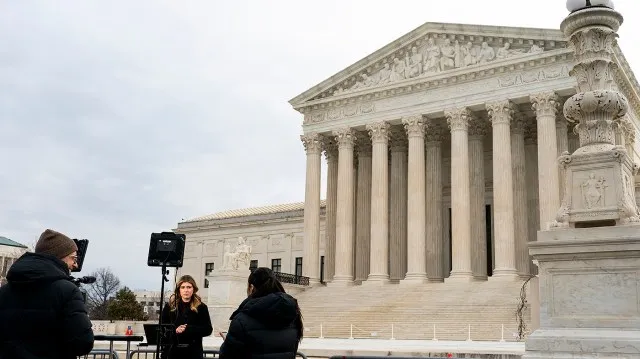
Whether states can count ballots received after polls close on Election Day will land before the Supreme Court on Monday, bringing the issue of mail-in voting to the forefront in a case with major implications for this year's midterm elections.
The court will hear arguments over whether states can accept mailed ballots postmarked by Election Day but received afterward, stemming from Mississippi's request to overturn a lower court's ruling that federal law preempts its statute.
Mississippi's law allows for a five-day grace period for certain mail ballots. That legislation was enacted during the COVID-19 pandemic but later made permanent.
It's a practice that has been targeted by President Trump since 2020, when he urged election workers to "STOP THE COUNT" as part of his false election claims that mail-in voting contributed to his election loss that year. He and his allies say the grace periods create delays and feed skepticism about election results.
Several states accept ballots after Election Day including Texas, according to the National Conference of State Legislatures. The Lone Star state is having one of this year's most competitive, high-profile Senate races so far and has been a target of Democrats in recent election to flip seats blue.
The Republican National Committee (RNC) and Mississippi's Libertarian Party sued the Republican-led state, contending that federal election law sets out just one Election Day: The first Tuesday in November. States that accept ballots after that are breaching that requirement, they argue.
"So long as election officials continue to accept ballots, the election isn't over; 'the proverbial ballot box' is not 'closed,'" the RNC wrote in a brief to the high court. "A post-election receipt deadline for mail ballots thus extends 'the election' beyond the 'day' set by Congress.
"Text, history, and precedent all confirm this conclusion," the committee said.
The Trump administration will argue the case alongside the RNC on Monday. Solicitor General D. John Sauer, who will make the government's case before the justices, suggested that the historical context in which federal election laws were enacted establishes they were meant to "stop fraud and promote confidence" in federal contests.
"There is no doubt that the prospect of having thousands of absentee ballots pour in for days or weeks after election day would have been unfathomable to the enacting Congresses," he wrote in a friend-of-the-court brief. "Rather, then as now, closing the ballot box on election day is a powerful safeguard against late-breaking foul play."
According to a survey by the Honest Elections Project, a conservative group that advocates for stricter voting laws, 60 percent said that mail-in ballots received after Election Day should not be counted, including 80 percent of Republicans, 59 percent of Independents and 42 percent of Democrats polled.
Some 14 states, plus the District of Columbia, allow a grace period for regular ballots, according to the National Conference of State Legislatures. On top of that, the 29 states that accept military and overseas ballots received after Election Day also stand to be affected if the court sides with the RNC.
Vet Voice Foundation, a nonprofit supporting veterans that intervened in the case, argued in a brief to the court that "no reasonable English speaker" would deny that federal elections are held on the same day nationwide. But Congress did not "secretly preempt" laws like Mississippi's when it established that rule, the group said.
It noted that military overseas voters influenced the outcome of the 2000 presidential election between former President George W. Bush and Al Gore, a former vice president.
"RNC says military-overseas ballots, too, must be received by election day," wrote Marc Elias, a prominent Democratic election lawyer representing the veterans' group. "Apparently, Gore won."
In a call with reporters last week, Elias called the grace periods issue "critically important." He pointed to persistent delays in the postal system and Republican efforts to ban ballot drop boxes.
"All the voter can do if they vote by mail, is to fill out their ballot and put it in the mailbox," the elections lawyer said. "After that, it's out of their hands."
Elias also said that attempting to implement a ruling that sides with the Republican and Libertarian challengers could be a "particular mess" because the Election Day statute only applies to federal elections. States, nonetheless, will also be electing state officers on Nov. 3.
Local election officials and governments wrote in a friend-of-the-court brief that they play a "critical role" in conducting elections, which involves processes that "require care and take time."
"Shortening the timeline in which amici must perform these tasks would make it much harder for them to smoothly and efficiently administer elections," they said, suggesting that state legislatures across the country set election deadlines to meet the specific needs of each state.
With midterms just eight months away, "it's not clear it can be done," Elias said.
Oral arguments are slated to begin at 10 a.m. ET.