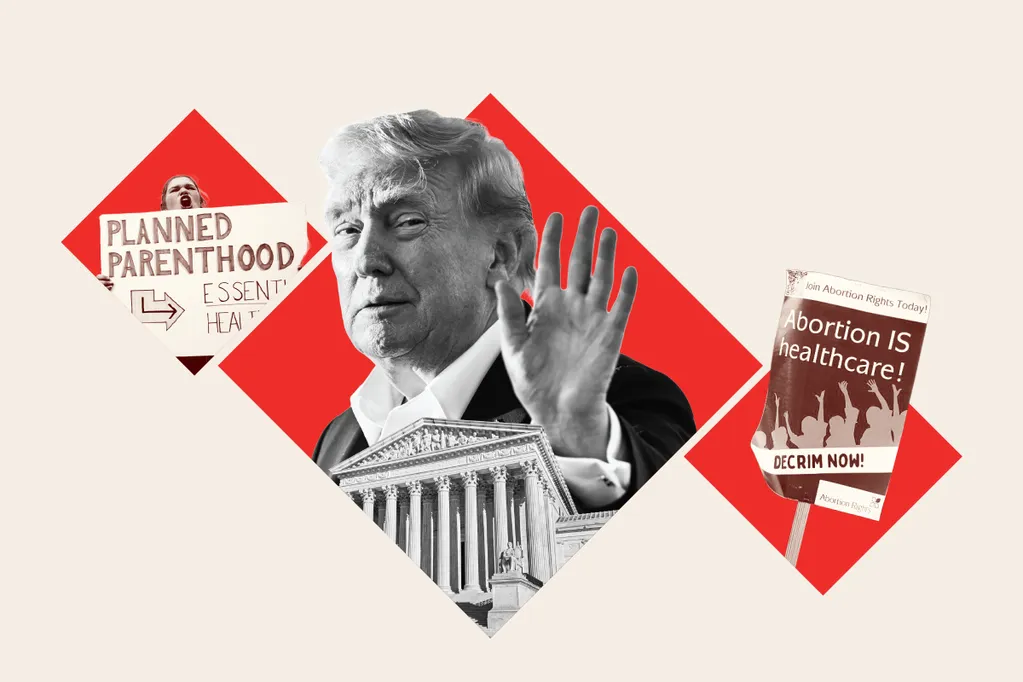
The Supreme Court's decision to temporarily restore broad access to mifepristone on Monday bought time, but not resolution.
Within days or weeks, the justices will face a choice that forces the Trump administration into a corner: explicitly defend the abortion pill in court, or tacitly concede that the Fifth Circuit's sweeping restriction should stand.
Either path threatens Republicans heading into the midterms.
"It's hard to see a scenario where this just goes away as a political issue," Mary Ziegler, a constitutional law professor at the University of California, Davis, who has spent two decades tracking abortion litigation from Roe through Dobbs, told Newsweek. "Unless the court does something that would really shock me and sides with the drug manufacturers without a lot of explanation, I think if the court is ultimately going to go against the Fifth Circuit on substance, it's going to require an argument first."
A ruling that restricts mifepristone access would insert abortion back into campaign messaging at the worst moment for a party already trailing on the generic ballot by 5 to 10 points. The environment is more hostile to the GOP than it was to Democrats in 2022. A standing dismissal would offer temporary relief.
But either way, the case pending before a conservative supermajority that President Donald Trump himself constructed keeps the issue alive through November.
On May 1, a Trump-appointed Fifth Circuit panel eliminated mail and pharmacy access to mifepristone nationwide. Three days later, the Supreme Court issued an emergency stay restoring the status quo while the justices consider competing applications from Louisiana and the drug's manufacturers. Briefing is due May 7.
The dispute returns to a question the Supreme Court addressed last year. In its 2024 ruling in FDA v. Alliance for Hippocratic Medicine, the court unanimously dismissed a similar challenge on standing grounds, holding that plaintiffs who neither prescribe nor use mifepristone lack a sufficiently direct connection to FDA regulations.
Louisiana argues this case is different. The state says it has cleared the standing hurdle by asserting a "sovereign injury": that its ability to enforce its abortion ban is undermined by mailed pills.
Legal experts say that the theory may face the same skepticism the Supreme Court applied in 2024. Julia Kaye, an associate director of legal services at If/When/How, a legal advocacy group supporting abortion access, said the case reflects a broader strategy to target the medication through the courts.
"Louisiana does not have legal standing to sue the FDA just because it wishes that federal law were even more restrictive of medication abortion," Kaye told Newsweek. "A state does not get to sue the federal government just because federal law doesn't map directly onto that state's policy preferences."
Linda Goldstein, Senior Counsel, U.S. Litigation at the Center for Reproductive Rights, framed Louisiana's standing problem even more starkly. "Louisiana's claim for standing here is actually weaker than the claim dismissed in 2024," Goldstein told Newsweek. "Essentially, Louisiana thinks it should be allowed to bring this case because there's a chance it might, through its Medicaid program, have to reimburse doctors who, in turn, might treat patients that have taken mifepristone. That's a full step further removed from what the doctors argued previously -- if that claim didn't stick, this one shouldn't either."
The real question for Republicans is timing. An extended timeline would keep the case as a backdrop to the midterm campaign, especially if the court schedules merits arguments for late June or early fall. Even if the focus shifts to standing, the dispute turns on whether Louisiana's claimed sovereign injury is sufficiently direct, ensuring the issue remains central through Election Day.
"My guess is it's just going to drag on somehow," Ziegler told Newsweek. "The Supreme Court is usually slow. Unless it's President Trump asking, sometimes they're fast. But this is a mifepristone manufacturer asking. So I don't really see them hurry it up."
That calculation exposed a central tension in Trump's midterm positioning. A tension his own judges have now made harder to contain. In 2024, Trump closed his campaign on three carefully calibrated lines: he believes abortion is a state issue; he opposes a federal ban; and he supports exceptions for rape, incest, and life of the mother. He criticized Florida's six-week abortion ban as "terrible."
Since taking office, Trump has largely avoided the March for Life in person, instead sending prerecorded remarks. At the same time, his Justice Department has declined to defend FDA regulations on mifepristone on the merits. The result is a deliberately procedural posture that avoids clear endorsement or rejection of the drug's safety while preserving flexibility between social conservatives and suburban voters who supported Trump while opposing abortion bans.
That balance shifted on May 1. The Fifth Circuit panel did what the administration had avoided for months: it imposed a nationwide restriction. For nearly a year, the White House had signaled that an FDA review of the drug, announced in September 2025, would proceed slowly without a predetermined outcome.
That approach began to break down under pressure. Anti-abortion groups grew impatient. Republican attorneys general grew restless. And Louisiana, backed by conservative legal organizations, filed suit.
"The weird feature of this particular fight is that you have the state of Louisiana, which is obviously a very anti-abortion state, doing the Trump administration a favor by taking them to court," Ziegler told Newsweek."Essentially, conservative states and anti-abortion lawyers are taking things into their own hands because the Trump administration has been so slow, and slow also eventually implies potentially never doing anything."
That lawsuit now forces the administration into a clearer position. The Justice Department must choose how to respond: either file a merits brief defending mifepristone's safety and arguing that Louisiana lacks standing, or take a largely procedural approach and allow the Fifth Circuit's ruling to stand. Either path carries political cost.
A substantive defense of the FDA would trigger backlash from SBA Pro-Life America and the Hawley wing, which has already called FDA Commissioner Marty Makary's approach a "five-alarm crisis" and demanded his removal. A procedural response avoids that fight but leaves the restriction in place, raising a different risk: suburban voters questioning whether Trump has followed through on his promise to leave abortion policy to the states.
Polling suggests the issue remains volatile. Two KFF surveys in late 2025 found roughly two-thirds of Americans oppose a nationwide mifepristone ban, and 65 percent oppose criminalizing its mailing. Gallup's May 2025 poll found 51 percent identifying as pro-choice, the highest level in years, with a 20-point gender gap (61 percent of women versus 41 percent of men). AP-NORC's July 2025 survey similarly found 64 percent of Americans saying abortion should be legal in all or most cases.
Confidence in abortion pills has declined, though. The share of Americans saying they are "safe when taken as directed" fell from 55 percent in May 2023 to 42 percent in November 2025 -- a 13-point drop tied to messaging around the Makary review. That shift creates room for new restrictions and a political cross-pressure: Republican lawmakers in competitive districts could face simultaneous demands from their base for escalation and from general-election voters who remain broadly supportive of access.
The 2022 precedent haunts Republican strategists. Dobbs v. Jackson Women's Health Organization, the case that overturned Roe v. Wade, drove historic midterm turnout and measurable voter persuasion.
KFF/AP found that 4 in 10 voters said Dobbs had a major impact on their vote, rising to over half of women under 50 in California, Michigan and Vermont. Abortion voters broke for Democrats by a wider margin than inflation voters broke for Republicans. Every abortion-rights ballot measure placed before voters post-Dobbs passed.
The environment this cycle is worse for Republicans by nearly every metric. Trump's approval hovers around 34 to 40 percent, a net negative of roughly -18, compared to Biden's negative 8 entering 2022. He's underwater on the economy by more than 40 points. Democrats lead on the generic ballot by 5 to 10 points. The 2025 off-year elections sent an unmistakable signal: Spanberger won Virginia by 15 points; Sherrill took New Jersey by 13; women broke 13 to 17 points for Democrats in both races.
"It's obviously bad news for Republicans," Ziegler told Newsweek."It's worse news for Republicans in some ways than it was in 2022 because at the time Republicans were running against an already unpopular Joe Biden and the abortion headwinds were only one thing they had to deal with.And now you have the abortion issue being added to an already struggling party."
The court has three plausible paths forward: It could dismiss on standing grounds, as it did in 2024, and avoid the merits entirely. It could schedule a merits argument for October, with a decision timed near or after the election. Or it could reach the substance and let the Fifth Circuit's reasoning stand, effectively nationalizing a federal ban on mail and telehealth access to mifepristone.
Ziegler's prediction that the case will "drag on" through the election season is the most likely scenario. The court meets its own timeline, not the campaign's. But the mere pendency of the case with briefs due May 7 and a stay decision imminent keeps abortion front-page through the summer and into the fall.
For Republicans, the math is unforgiving. They're defending 22 of 35 Senate seats in a cycle in which Democrats need to flip just 4. They need to flip the House by only three seats. And they're running into abortion restrictions, Ukraine fatigue, Trump's sub-40 approval, and a base expectation that the second term would finally deliver what the first term did not.
The Supreme Court is about to make that triangulation impossible.