The festival became a political flashpoint well before the program reveal - but the featured works focus not on spectacle and slogan but on a polyphony of voices singing their own songs.
According to its critics, this year's Biennale of Sydney, under the leadership of Emirati artistic director Hoor Al Qasimi (the first Arab appointed to the role in the festival's 53-year history) was destined to be a "hate Israel jamboree" at worst; a hotbed of pro-Palestinian politics at best. These fears - which appear to have originated from pro-Palestine statements Al Qasimi and her parents made in the past - are not borne out by the festival itself, which opens this weekend across five key venues, spanning from the inner city out to Penrith and Campbelltown.
In an unusual move for the biennale, Al Qasimi wasn't present at the vernissage - but with or without her, the resulting festival, the event's 25th, is complex and nuanced. It's light on spectacle and slogans; not a political chant but rather a polyphony of voices - more than 80 artists from 37 countries - singing their own songs. The theme, "Rememory" - taken from Toni Morrison's novel Beloved - is reflected in works that look to the past to find answers to present dilemmas and envision better futures. The wisdom of ancestors and ancient cultures is woven throughout.
It feels emblematic that this year's most spectacular and ambitious artwork is tucked away rather than front and centre. Deep inside White Bay power station in Rozelle, US artist Nikesha Breeze has created a monumental baobab tree from 2,000 metres of white cotton cheesecloth; a replica slave cabin from reclaimed wood; and a gauzy maze of archival portraits printed on fabric. To one side, a massive screen plays dream-like silhouette animations. Branches of cotton hang throughout the space, as does the scent of cloves. At the base of the tree is a small chamber with wooden benches where visitors can sit in quiet contemplation.
Breeze's immersive installation, titled Living Histories, reanimates the lived experiences of African American ancestors. The work's wellspring is the Born in Slavery archive, the product of a government project from the 1930s in which writers and photographers gathered testimonials and portraits of formerly enslaved people. Every detail of Breeze's artwork relates to stories from this collection - from the items on cabin shelves, to the scent (cloves were commonly used by enslaved people for pain relief) and materials (cheesecloth was used in wound care). "This tree is holding the wound; creating sanctuary," Breeze tells me.
This sense of generosity and purpose pervades the biennale, particularly in works by Indigenous artists. At Penrith Regional Gallery, the paintings of Yindjibarndi elder Wendy Hubert contain notes on bush tucker, and a garden created by the artist and community members distills the key principles by which the Yindjibarndi people have lived in harmony with Country for millennia, in the Pilbara region of Western Australia. At the Art Gallery of NSW, quilted hangings by Sandra Monterroso, a Maya artist from Guatemala, are embroidered with the ingredients and recipes for herbal remedies, and dyed with botanical pigments.
These are works that speak softly, and reward time and attention. They reflect the broader tone of a biennale full of quietly powerful moments, such as Palestinian artist Taysir Batniji's palette of geometrically stacked blocks of olive-oil soap, carved with the Arabic phrase "dawam el hal men al mohal" ("no condition is permanent"); and exquisite embroidered cartographies of migratory routes, commissioned by Lebanese diaspora artists Joana Hadjithomas and Khalil Joreige from women who had only dreamed of travel.
There are puzzling and frustrating moments too, particularly at White Bay, where several video works are presented in awkward spaces - tucked away or in thoroughfares, sometimes without seating. Other works feel dwarfed by the venue: a triptych of large photographs by Filipinx artist Kiri Dalena, based on archival newspaper images of popular protests against dictator Ferdinand Marcos, is easy to overlook in the vast Turbine Hall. Closer inspection reveals that the text from the protest signs has been digitally removed; some of it can be found in a series of leather-bound volumes of "slogans" on a shelf nearby.
Politics is everywhere in this biennale, as in life - but often understated. At Chau Chak Wing Museum within the University of Sydney, Palestinian artist Khalil Rabah stages a quiet protest in the form of a massive, ornately embroidered traditional tunic. The wall text explains that its patterns are drawn from the sixth-century Shellal Mosaic, removed by Australian troops from a Byzantine church near Gaza and currently ensconced in the War Memorial in Canberra.
At the Art Gallery of NSW, Abdul Abdullah, a Muslim with mixed Malay and white convict ancestry, presents a triptych in the style of renaissance history paintings - but featuring young men in mid-2000s streetwear. The anodyne aesthetic couches a stinging appraisal of the 2005 Cronulla riots: in each panel Abdullah restages a key incident in which groups of young white men terrorised people of Middle Eastern or non-white appearance.
Among the biennale's most powerful works is a collaborative project by Kurdish Iranian journalist and author Behrouz Boochani, Iranian Australian artist Hoda Afshar and Kuku Yalandji/Waanji/Yidinji/Gugu Yimithirr artist Vernon Ah Kee, focusing on the experiences of Indigenous youth in detention. At Campbelltown Arts Centre, a darkened gallery space is devoted to the four-channel video installation Code Black/Riot, featuring the testimonials of former staff members and child inmates of a facility in north Queensland.
These accounts - which reveal both the harrowing and banally evil details of detention - are intercut with footage of the facility's foreboding exterior and surveillance system; the natural landscape; and dreamy sequences of young people bouncing in slow motion on trampolines and in repose on country - floating in the river, perched in trees. Surrounded by screens, the viewer is alternately uncomfortably enclosed and bracingly immersed; confronted with different truths and realities.
Code Black/Riot harnesses poetic imagery and raw testimony to convey both the humanity of its young subjects, and the inhumanity of Australia's detention system. In a photo series from the same project, exhibited at the Chau Chak Wing Museum, Afshar collaborated with Indigenous youth to stage striking portraits, giving them a rare and powerful opportunity to represent themselves within an institutional space.
Nearby, a deceptively bright colour-field painting by Ah Kee contains barely perceptible text, with the phrases in each colour bar corresponding to the different levels of alert in the detention facility - from Code Blue for "medical emergency" to Code Black for "riot". Only by shifting perspective can viewers understand the work.
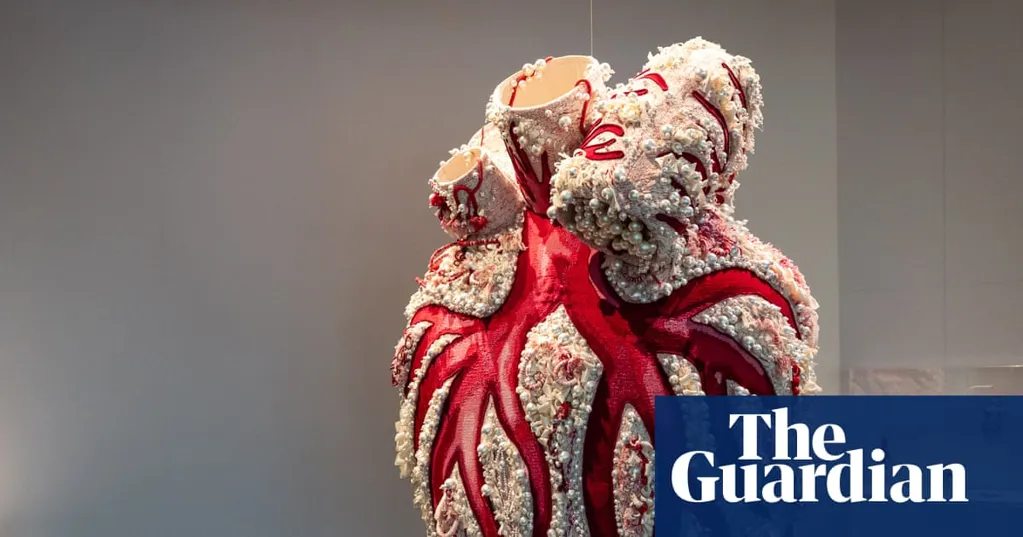
Even when this biennale embraces beauty and spectacle, it is underpinned by politics. Hearts of Absent Women (Tree of Family), Japanese Australian artist Ema Shin's humongous textile heart, embellished with satin ribbon and pearlescent and glass beads, is a firm retort to her own family tree, in which only the names of male family members and mothers of sons were recorded.
Canadian artist Kapwani Kiwanga's fragrant installation Flowers For Africa deploys elaborate floral displays, bouquets and boutonnieres to chart key moments of transition from colonial rule to independence across the continent. Nearby, occupying an 80 sq metre platform at the centre of the gallery, is the gargantuan Ngurrara Canvas II; painted by about 40 elders, it is a powerful expression of culture that was successfully used to assert the Ngurrara people's millennia-deep connection to Country (within the Great Sandy Desert of Western Australia) in their 1996 native title claim.
In Toni Morrison's novel Beloved, Sethe, a former slave, says: "If a house burns down, it's gone, but the place - the picture of it - stays, and not just in my rememory, but out there, in the world."
This biennale reminds us - in the face of past and ongoing destruction, trauma and loss - that the tools for a better world already exist, and are at hand.