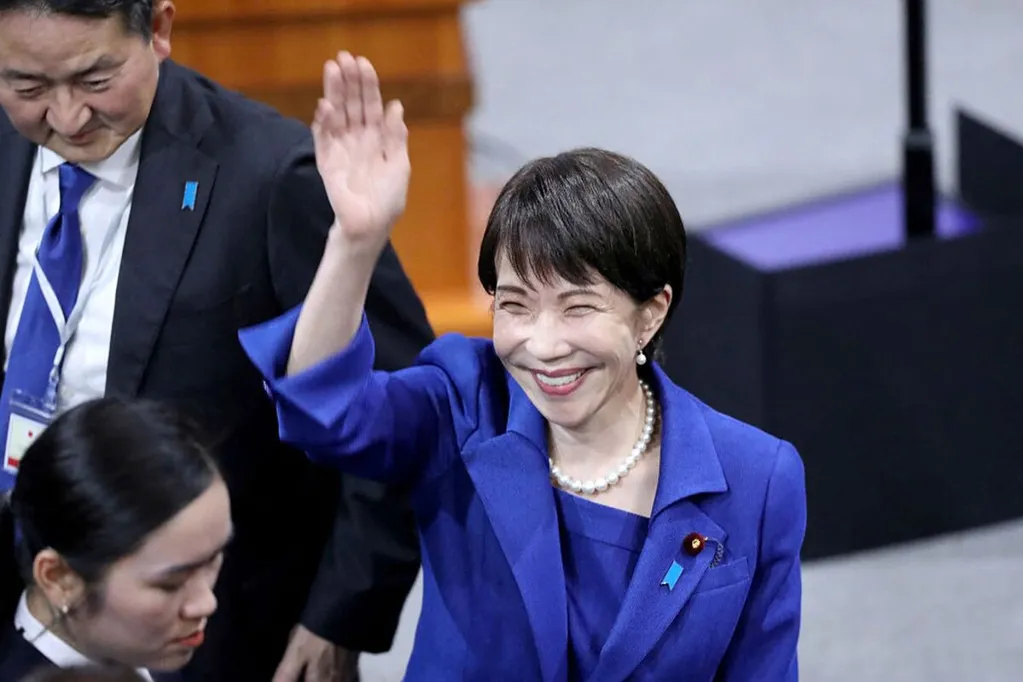
Japan's prime minister is set to arrive in Australia to strengthen ties with one her country's strongest allies as she seeks to build on an updated regional strategy laid out in Vietnam.
Prime Minister Sanae Takaichi is scheduled to touch down late Sunday local time in Canberra for the three-day visit, which will focus on defense, critical minerals and broader economic security. The two countries have grown increasingly concerned about the changing security and economic environment in the region, with Japan taking a more assertive military stance and looking to build economic ties and stable supply chains with nations such as Vietnam.
With the US focusing elsewhere and China becoming stronger, the two nations' militaries are holding frequent joint exercises and are now looking to share technology -- including Australia's decision to purchase Japanese naval vessels. The multi-billion dollar deal, which Japan sees as the potential foundation of exports to nations such as New Zealand or India, is the symbol of the relationship and shows how Japan's defense posture has shifted in the past 10 years.
The security environment in the Asia-Pacific region is "increasingly severe," Shinjiro Koizumi, Japan's defense minister, said last month. "We will pursue multilayered cooperation between Japan and Australia with an open mindset, not only in frigates, but also in areas such as unmanned systems, cyber and space, as well as joint production of defense equipment," he said while standing on the front deck of a Japanese warship in Melbourne.
"As uncertainty in our surrounding security environment continues to grow, the need for Japan and Australia to work together and pool our wisdom to contribute to regional peace and stability is greater than it has been at any point in the past 50 years," Koizumi said.
Koizumi will be in the Philippines this week to observe an exercise in which armed Japanese troops will participate for the first time since World War II, along with the Australian and US militaries. Tokyo will deploy 1,400 troops to join combat drills for the first time, with its navy using a missile to help sink a ship.
That exercise in the South China Sea, close to where the Philippines and China have clashed repeatedly over disputed territory, is a clear warning to Beijing.
Economic Security, Critical Minerals
As well as tight defense ties, Takaichi's visit will emphasize the close economic relationship, with Australia a critical supplier of energy, iron ore, food and other commodities, and Japanese firms now the second-largest investors in Australia.
Projects such as a massive liquefied natural gas hub run by Inpex Corp. are big drivers of this economic cooperation. Tokyo also sees Australia as a crucial supplier of critical minerals, with the government and companies jointly investing in resources such as rare earths or gallium for the past decade to reduce reliance on China, which has repeatedly used its dominance of these supply chains as leverage over other nations.
Most recently, Beijing has again limited shipments of rare earths to Japanese firms as relations between the two have deteriorated once more. That is reminiscent of China's attempts a few years ago to punish Australia by imposing punitive tariffs on exports after relations soured during the pandemic.
Takaichi's trip will include agreements on boosting economic security ties, according to a person involved in the planning, with the two nations to prioritize six commodity projects, including for nickel and rare earths, the Nikkei newspaper reported last week.