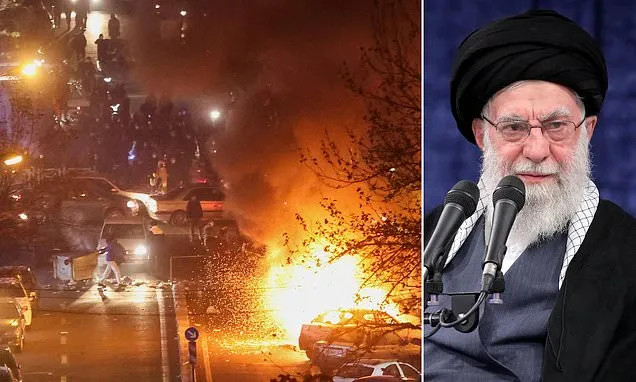
Leaders of Iran's regime last night claimed that the country was back under their 'total control' - after a brutal crackdown that has seen 648 confirmed fatalities and thousands more protesters feared dead.
Iranian foreign minister Abbas Araghchi said the republic had quelled the unrest which he alleged was intended to force a US intervention.
Araghchi vowed to 'hunt down' supposed foreign elements within Iran who he said had 'stoked and fuelled' the protests against the hardline Islamic government.
To present an image of normality in the religious dictatorship the Iranian leadership turned the internet - largely limited to state news and government websites - back on after a four-day blackout.
But with bodies piled up on the streets and hospitals and morgues full, human rights organisations indicated the death toll could be much higher. To add to the confusion, tens of thousands of pro-government demonstrators rallied in Tehran's Enghelab Square yesterday as the Iranian regime downplayed the protests.
It came as Norway-based Iran Human Rights (IHR) group suggested there was evidence more than 6,000 may have died.
IHR director Mahmood Amiry-Moghaddam said: 'The international community has a duty to protect civilian protesters against mass killings by the republic.'
'According to some estimates more than 6,000 may have been killed but with the blackout imposed by the Iranian authorities it is extremely difficult to independently verify these reports.'
Iranian Supreme Leader Ayatollah Ali Khamenei condemned the US and Israel for attempting to overthrow the regime, while Russia condemned 'foreign powers' for interfering.
A car burns in the street of Tehran on January 9 2026. Leaders of Iran's regime last night claimed that the country was back under their 'total control' - after a brutal crackdown that has seen 648 confirmed fatalities.
US President Donald Trump insisted last night that 'all options' including air strikes were still being considered by the White House. He also claimed that the Iranian government, fearing imminent US intervention, had been in contact to begin unspecified 'negotiations'.
But on the surface Tehran kept up its belligerent tone. The regime summoned the UK, French, German and Italian envoys to protest at the countries' so-called support for the protesters. In a tit-for-tat move, the European Parliament banned all Iranian diplomats and representatives from the assembly's premises.
Last night, UK Foreign Secretary Yvette Cooper spoke to Araghchi, calling on the Iranian government to 'immediately end the violence, uphold fundamental rights and freedoms and ensure British nationals are safe'.
Iran's Ayatollah Ali Khamenei condemned the US and Israel for attempting to overthrow the regime, while Russia condemned 'foreign powers' for interfering.
The regime appears to have been boosted - at least in the short-term - by Mr Trump's failure to follow through with a pledge to strike should protesters be killed.
With possibly thousands already lying dead, reports from the White House that Khamenei was looking to leave Iran - and that Russia could provide sanctuary - appeared to be unfounded.
Mass killings and economic impoverishment have characterised his 37-year rule, during which previous uprisings were violently quashed.
But in a move that indicated a US military intervention could still occur, France last night sent home non-essential staff from its embassy in the Iranian capital.
Last night, UK Foreign Secretary Yvette Cooper spoke to Araghchi, calling on the Iranian government to 'immediately end the violence, uphold fundamental rights and freedoms and ensure British nationals are safe'.
Mr Trump said he is considering what he termed 'very strong options' for a possible military response.
And White House spokesman Karoline Leavitt said: 'One thing President Trump is very good at is always keeping all his options on the table. And air strikes would be one of the many, many options that are on the table for the commander-in-chief.'
Iran remains crippled by US sanctions applied because it has refused to sacrifice its nuclear ambitions.
Meanwhile, Sir Keir Starmer last night refused to make it illegal to support Iran's Islamic Revolutionary Guard Corps in the UK because he believes proscribing the group will only make Britain feel 'better about ourselves'.
No 10 also said the Prime Minister 'utterly condemns' violence being used by authorities in Iran.
While there has long been opposition to the regime's strict Islamic ideology, the current unrest in Iran was sparked by dire economic conditions including food shortages.
Since protests began, 53 mosques and 180 ambulances have been set on fire. The regime claims ordinary Iranians would never target places of Islamic worship.