On March 3, 1994, the bodies of Marcellos "Cello" Anderson, his mother, Delois Anderson, and Frederick Tucker were found buried in a Memphis graveyard underneath a casket. They had been missing for a week after being kidnapped from Delois Anderson's home.
In the grave with the bodies was a "blanket-like cloth" with blood on it. Fingerprints were left behind at the house. Investigators were led to the grave by a man named Jonathan Montgomery, which led police to his brother, James Montgomery, and Tony Carruthers as suspects.
At trial, the state argued that Carruthers and his two co-defendants, James and Jonathan Montgomery, kidnapped Marcellos Anderson to rob him. Jonathan Montgomery was found hanged in his cell prior to trial. Carruthers and James Montgomery were tried together. Both were found guilty of three counts of first-degree premeditated murder and were sentenced to death in 1996.
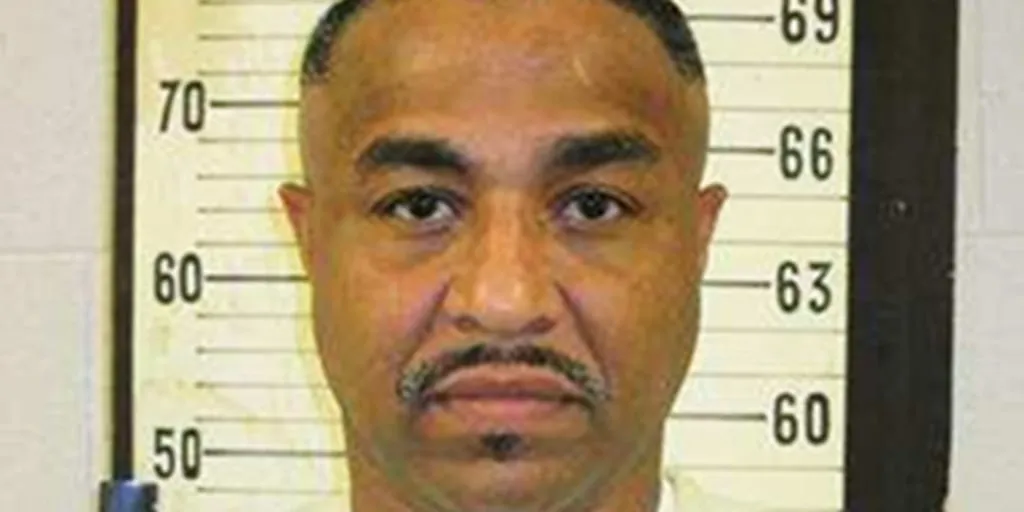
Tony Von Carruthers is set to be executed next month for the triple kidnapping and murder, but a new motion filed by the American Civil Liberties Union says crucial DNA evidence from the crime scene does not match with Carruthers and its retesting could prove his innocence.
The motion for post conviction DNA testing filed with the Tennessee Supreme Court in Nashville on April 9 seeks to have unmatched fingerprints and other DNA evidence in the case tested against an alternate suspect that was identified by Montgomery at his retrial.
"There has never been any physical evidence linking Mr. Carruthers to the crime and the case against him was built on testimony from jailhouse informants, widely known to be one of the leading causes of wrongful convictions," the ACLU said in a press release on April 9.
According to the motion, fingerprints collected at the crime scene excluded both Carruthers and Montgomery, leaving behind six unidentified fingerprints.
The motion says that the jury in Carruthers' case never heard about the fingerprint evidence because he was "forced to represent himself at trial." A 2000 state Supreme Court opinion recounts the reasons why Carruthers was "required to represent himself at trial," including threatening behavior toward some of his attorneys. Carruthers ultimately had six different attorneys before representing himself in a performance that his current attorneys described as "inept, ineffective and disastrous," pointing to an ongoing mental illness and saying he was "mentally ill, irrational, and incompetent to stand trial" at the time of his arrest.
Both Carruthers and Montgomery were convicted and sentenced to death. Later, an appeals court found that Montgomery was deprived of a fair trial because of Carruthers' self-representation. His conviction was overturned and he was granted a new trial.
According to the ACLU motion, Montgomery requested DNA testing of physical evidence from the kidnapping scene and grave site during his retrial.
"Testing did not reveal any DNA matches to Mr. Montgomery or Mr. Carruthers on the evidence," the motion said. "A majority of the samples were either too small to produce a profile under 2003 technology, were inconclusive, or matched the victims. However, there was one robust male profile on a white blanket that was buried with the victims."
That DNA sample remains unidentified, according to the motion.
The state offered Montgomery a plea to a reduced charge of three counts of second-degree murder.
The ACLU motion said that while serving out the remainder of his sentence, Montgomery gave a statement "exonerating" Carruthers and pointing to a different suspect.
"In 2010, co-defendant James Montgomery, while serving out his remaining sentence, gave a statement to an investigator with the Capital Habeas Unit indicating that he kidnapped Marcellos and Fred and that he dispatched Ronnie 'Eyeball' Irving to kidnap Ms. Anderson. He confirmed to the investigator that Mr. Carruthers was not involved in the kidnapping or the murders," the motion said.
Montgomery was released in 2016. Irving was murdered in 2002.
"His fingerprints and a DNA sample are on file at the medical examiner's office," the motion said. "To date, the unidentified physical evidence (the latent fingerprints or unknown male DNA profile) has not been compared to Mr. Irving."
"Mr. Carruthers anticipates that, if granted, the DNA testing itself will be concluded prior to his May 21st execution date, so this Motion for Testing, in and of itself, is unlikely to affect the timing of his scheduled execution. However, if the DNA results confirm Mr. Carruthers' innocence or cast doubt on the appropriateness of his death sentence, Mr. Carruthers will move to stay his execution," the motion said.
Along with the ACLU motion seeking DNA testing, Carruthers also sought fingerprint testing before the Tennessee Court of Criminal Appeals. The court denied that appeal this week.
"The Court does not find that a reasonable probability exists that the [P]etitioner would not have been prosecuted or convicted if the hoped-for results are obtained through the requested fingerprint analysis," the court wrote.
According to the Death Penalty Information Center, 34 people across 15 states have been exonerated from death row using DNA evidence since 1993. Most recently, The U.S. Supreme Court rejected an appeal from a man incarcerated on death row in Texas who said DNA testing could help prove his innocence.