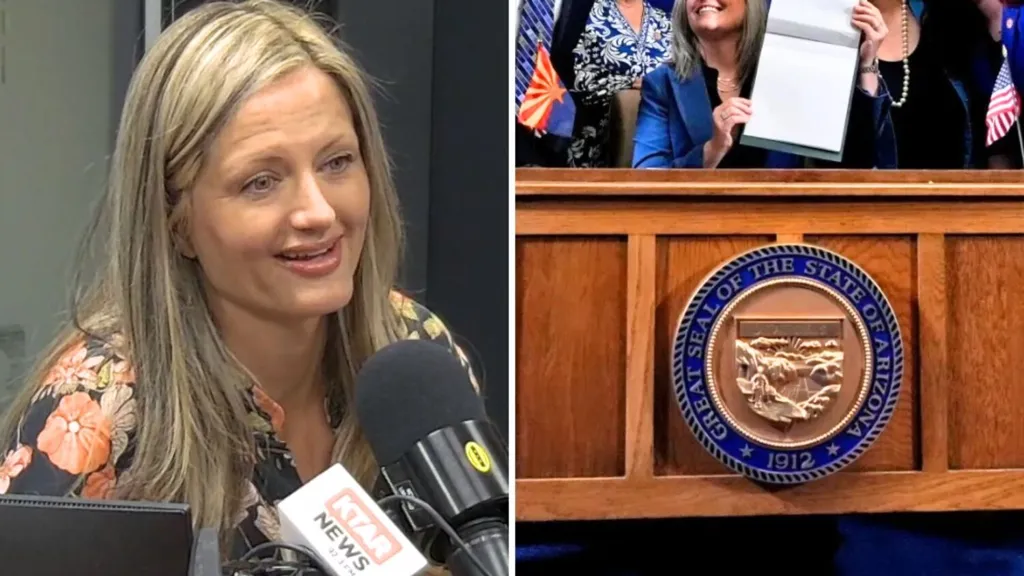
PHOENIX -- One of the two candidates running for Arizona governor under the Arizona Independent Party says her top priority would be rooting out corruption within state agencies.
"What's happening in Arizona is a level of corruption that is hurting a lot of people," Teri Hourihan told KTAR News 92.3 FM's The Mike Broomhead Show on Monday.
Hourihan, a licensed therapist and professional counselor, is competing in the party's primary against Hugh Lytle, founder and CEO of Equality Health.
"It's my opinion that I'm not accepted into the party once Lytle came in," she said.
Formerly known as the No Labels Party, the Arizona Independent Party holds primary elections for candidates who gather enough petition signatures. The signature threshold is lower for party candidates than for candidates who run without party affiliation.
The name change has been controversial, with critics arguing that using the word "independent" may confuse voters. Roughly one‑third of Arizona voters are unaffiliated -- lowercase‑i independents -- and not members of the party.
Arizona's 2026 primary elections will be held July 21. The general election is set for Nov. 3.
Hourihan said she is particularly troubled by the Arizona Department of Child Services' recent decision to raise the daily rate for licensed foster homes -- including kinship families -- by 50%. It is the largest increase since the agency was created in 2014 and is intended to encourage more family‑based placements instead of group homes.
"I find that a little alarming and scary," Hourihan said. "What I think we'll see is a system where we have families coming in to adopt children just for the money. ... I haven't heard of any guardrails that are coming into place regarding that."
While gathering petition signatures recently, Hourihan said she met a man named Thomas who lives at Central Arizona Shelter Services (CASS). According to her, he described dirty water, a lack of food and no internet access at the shelter.
Hourihan said her personal experience in recovery from drugs and alcohol "has fueled my passion in life to serve people." She said that experience gives her insight into what's wrong with the system.
"I call it the hamster wheel of a system. You get stuck in it, you're in it," Hourihan said. "I think what a lot of people don't understand is that these agencies and systems are underneath the governor, and so we have to we have to have somebody in there, i.e. me, who's going to actually fix these problems."