USA TODAY Washington Bureau Chief Susan Page dives into U.S. relations with the U.K. and what to expect as King Charles III visits Washington.
King Charles III may well be channeling his mother when he arrives in Washington April 27.
During her record-setting reign, Queen Elizabeth II met with 13 sitting U.S. presidents - more than any other person from anywhere, ever - and sometimes at moments when the "special relationship" between the United States and the United Kingdom was strained.
Now that is her son's task in his first visit to the former colonies since he was crowned, arriving amid rifts over the war in Iran and the future of NATO.
What are Elizabeth's lessons?
Today's troubles? Ignore them
A constitutional monarch doesn't have the power to negotiate the role of the United States in the Western alliance or the deployment of British forces in the Strait of Hormuz. Those are the problematic tasks of Prime Minister Keir Starmer.
So why get entangled in today's troubles?
Elizabeth arrived in Washington on her first visit as queen in the aftermath of Britain's effort to take over the Suez Canal, a misadventure that not only failed but also enraged President Dwight D. Eisenhower.
But there's no evidence the queen and the president talked about Suez during her visit. Instead, they fondly remembered old times -- when she was a teenaged princess and he was the U.S. general sent to London to help win World War II -- and they discussed the breaking news of the day, the Soviet launch of Sputnik.
That was a challenge to U.S. superiority in space on which their two nations were aligned.
Years later, in 2003, she greeted President George W. Bush to London amid massive protests over the war in Iraq, an issue that was consuming politics in both countries.
Would they have talked about that?
"No," a senior palace adviser said, startled at the very idea and adding for emphasis, "No, no, no, no."
No need for that. Leave it to 10 Downing Street.
Bring the bling
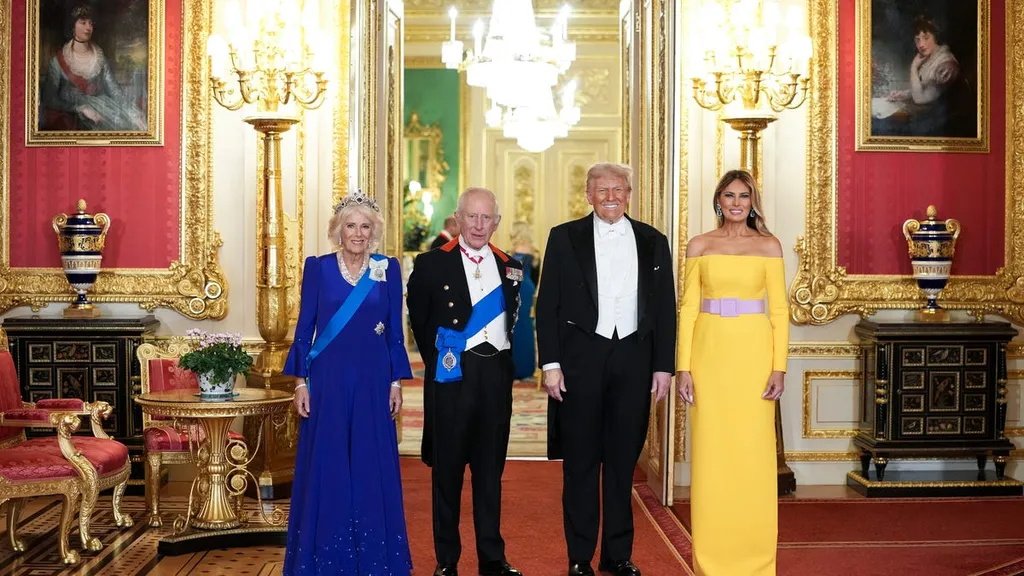
The regalia of royalty has long enchanted millions of Americans -- including Trump, who has added a palace-like layer of gold and gilt to the Oval Office. The huge new ballroom he has ordered built is poised to dwarf the grand dining halls at Windsor Castle and Buckingham Palace.
On her formal encounters with presidents and other foreign leaders, Elizabeth would bedazzle with her tiaras, earrings and necklaces, heavy with history and laden with priceless jewels.
Charles will be sporting medals, not gems, of course. But watch Queen Camilla to display some of the Crown Jewels.
The gifts the royal couple will present Trump and First Lady Melania Trump will be another opportunity to use the British store of treasures to impress.
Take the long view. Like 250 years
The king has the serendipitous timing of arriving as the 250th anniversary of the Declaration of Independence approaches. No one seems to mind that the Declaration was directed against his great-great-great-great-great-grandfather, King George III, who was denounced in it as a tyrant who had "destroyed the lives of our people."
Instead, that shared history gives Charles an opening to emphasize the shared language and values of the United States and the United Kingdom.
A half-century ago, Elizabeth had visited the White House during the Bicentennial celebrations.
For her, that was a chance to meet a new president, Gerald Ford, in the wake of the Watergate affair that had engulfed his predecessor, Richard Nixon.
Concern about the scandal and its repercussions had prompted the British to impose a certain diplomatic distance for a time. There was even a behind-the-scenes debate in London over whether the queen should visit during the Bicentennial, with the suggestion she might send son Charles instead.
That is, if Nixon survived. He didn’t, solving that problem.
If all else fails, wait. Another president will be along soon
Monarchs don't have terms or term limits, although Charles' reign will certainly be shorter than his mother's seven decades. He was 73 years old when he was crowned in 2022. Two years ago, he revealed that he was battling cancer.
In contrast, presidents do have sell-by dates, and the end of Trump's time in the White House is now two and a half years away. At that point, Charles or his heir will presumably still be ensconced at Buckingham Palace.
Elizabeth understood that. When President Lyndon Johnson rejected entreaties to visit London, she bided her time until a friendlier Richard Nixon was inaugurated. After a prickly relationship with President Jimmy Carter, she developed the closest presidential relationship she had with successor Ronald Reagan.
She was generally careful not to let her relationship with the current president create complications with whomever would be next in line.
The exception was when British officials searched their files for dirt on Bill Clinton, who had been a Rhodes scholar in Oxford during the Vietnam war. It was a not-so-subtle effort to help President George H.W. Bush defeat his Democratic challenger in 1992.
Clinton won and never forgot, although he insisted that he didn't hold a grudge.
When the queen visited in 1976, British officials discussed whether to invite Carter, then the likely Democratic nominee, to the reciprocal dinner at the British Embassy to meet her. But the White House made it clear Ford was against that idea, and they didn't.
This time, watch for Charles to reach out, however diplomatically, to Democrats.
Because presidents come and go. The British monarchy has been around for more than a thousand years—and counting.