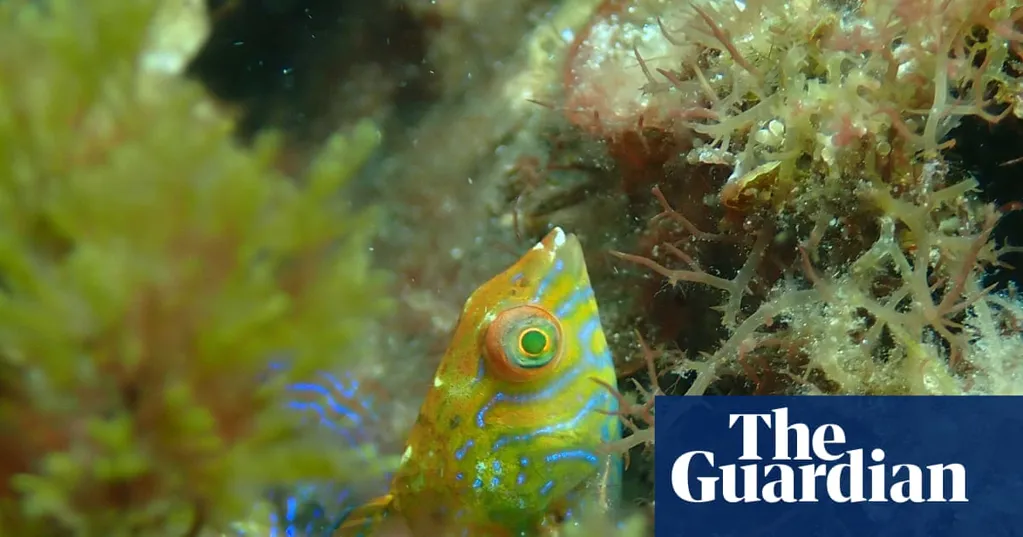
When marine biologist Océane Attlan saw the tiny Braun's wrasse, it was like 'recognising a familiar face, but you can't put a name on it'
The chances of encountering the rare reef fish were so far-fetched, it took marine biologist Océane Attlan a few seconds to clock what she was seeing.
"All of a sudden I saw this fish. You know when you recognise a familiar face, but you can't put a name on it. That's the feeling I had," she said.
The tiny iridescent fish, known as Braun's wrasse, had only been seen once since its discovery in 1996. It was last recorded in 2009 near Albany, at the southern tip of Western Australia, and hadn't been sighted since.
So when researchers from the University of Western Australia's Oceans Institute headed out to survey kelp forests in the area, the idea of spotting one seemed almost fanciful.
"We were kind of joking about it," Attlan said. "Keep an eye open in case we see this fish!"
The thrilling rendezvous took place on the final dive, on the last day of the four-day expedition.
"I got very excited," Attlan said. "But out of nine dives that happened to be the only one where I didn't have a camera on me, so I needed to find a buddy to quickly try to get some shots."
Luckily, her fellow researcher Dr Albert Pessarrodona was nearby and able to snap two photographs, before the fish disappeared back into the kelp.
Attlan said the Braun's wrasse was quite small - between six and seven centimetres - and beautiful, and brightly coloured, with lines around its eyes that radiated.
"It's a very cryptic, shy fish," she said. "It was just hiding amongst the seaweed."
The species has one of the smallest geographic ranges of any temperate fish in Australia.
Its home, on the rocky reef near Albany with its "luxurious kelp forest", is part of the Great Southern Reef, a gigantic ecosystem stretching 8,000km along Australia's southern coastline, from Kalbarri in WA to New South Wales, Attlan said. "This ecosystem has so many species that can't be found anywhere else in the world. That makes the ecosystem very precious."
The researchers later posted the two images to a platform that helped identify fish species, where two curators from the Western Australian Museum, along with the Tasmania-based researcher who last spotted the species in 2009, confirmed it was Braun's wrasse.
The sighting was particularly important, Attlan said, as it allayed fears that the species might have gone extinct amid recent marine heatwaves hitting Australia's south-west.
Spotting rarely sighted or undiscovered fish was always exciting, said fish ecologist Prof Culum Brown from Macquarie University, with hundreds of new species described around the world every year.
"I say this to my students and anyone I take snorkelling or diving with me: the more time you spend underwater, the more time you sit still watching and seeing what's going on, there's a really good chance that you're going to find something or see something that no one's ever seen before," said Brown, who was not involved in the survey.
"That's just because we know so little about the underwater world in general.
"I dare say this may spark a whole bunch of interest: divers spending more time specifically looking for this fish."