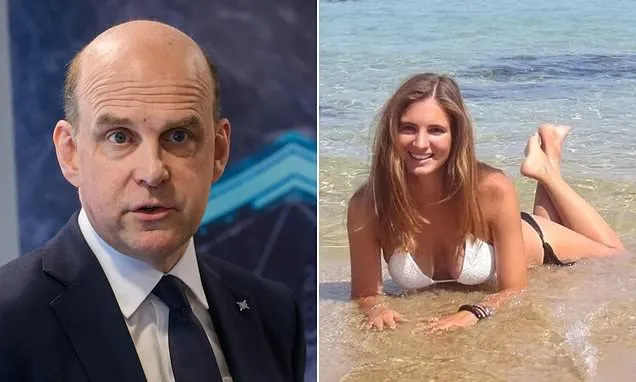
One day, perhaps, we will know what compelling magnetism drew the strikingly attractive Francesca Cortini into the arms and - it is said - the bed of Britain's middle-aged Nato ambassador Angus Lapsley.
It is somewhat easier to understand why the balding, flabby diplomat would be drawn to the glamorous Italian intern almost half his age, a woman not much older than his children.
Yesterday the deliciously indiscreet salons and high-end restaurants of Brussels were abuzz with gossipy stories of the envoy, his nubile lover and their trysts amid claims that the relationship had triggered a diplomatic incident.
Complaints were focusing on his allegedly improper use of the British residence in the Belgian capital, a stylish five-storey former hotel he shares with two colleagues.
Dame Caroline Wilson, the UK's ambassador-designate to the European Union, has reportedly stated that it was 'inappropriate' for the couple to be living together in the taxpayer-provided property.
And as it emerged that alarm bells had already been sounded about the promotion of the former mandarin - after he narrowly escaped the sack for apparently mislaying 50 pages of top secret defence documents at a bus stop in Kent, senior Tories suggested Mr Lapsley had been 'protected' by an 'old boys' network'.
Indeed, the extraordinary affair of the former Downing Street aide and his much younger mistress was last night threatening to overshadow the crucial Munich security conference where he was a key part of Prime Minister Keir Starmer's delegation.
The romance was already deemed serious enough to be brought to the attention of Admiral Sir Keith Blount, the most senior British military official in Nato.
To be scrupulously fair, news of the relationship has been received by former colleagues of Lapsley in a somewhat different light - something more akin to open-mouthed disbelief.
'Punching above his weight,' was among the more printable descriptions of the ambassador, a portly 55-year-old.
All agreed that the comely 29-year-old Ms Cortini possessed the kind of attributes that would, as that old cliche has it, make a bishop kick a hole in a stained-glass window.
Attributes that might or might not include her brilliant mind, A-grade political science studies and academic excellence at universities in Bologna in her native Italy and at Angers and Lyon in western France.
It is, of course, a story that is as old as time itself: a successful, mature man and the dazzling charms of a younger assistant.
Add in the rewards of an expense account lifestyle and an exciting overseas posting and all the ingredients are there for the headiest of romantic cocktails. What is often overlooked in such circumstances, however, is the domestic life that has been left behind.
In Mr Lapsley's case, that involves a wife and two sons, now aged 23 and 21.
So what is going on? According to briefings, the envoy had already separated from his wife Georgina - known as Gina - whom he met at Oxford University, before he moved to Brussels and met Ms Cortini, who was working as an intern at Nato headquarters.
Mrs Lapsley, 56, an English teacher from Canterbury, still lives in the marital home and, judging from her social media accounts, still follows the workings of the diplomatic service.
In one recent post, she approved of another senior diplomat's new appointment.
Although Mrs Lapsley appears to have reverted to her maiden name of Power, it is not clear whether or not she is now divorced. Figures close to her estranged husband and his lover in Brussels say the pair have made no attempt to hide their relationship.
It was an 'open secret' in the Belgian capital, a defence source was quoted saying. 'Angus used the residence as if it was his and [Ms Cortini] was there [for] Christmas and summer receptions.'
These same sources are also at pains to protest that, however uncomfortable the relationship might appear, it does not break Nato rules. For, unlike the British military, Nato does not bar romantic relations within the chain of command.
Relationships with subordinates in the British military are often a sacking offence. Only last year, Admiral Sir Ben Key, the former First Sea Lord was thrown out of the Royal Navy and stripped of his rank for having an affair with a junior officer. It has also been reported that Mr Lapsley told bosses about the relationship.
Nevertheless, it has caused consternation in Whitehall. And as the Daily Mail revealed yesterday, there was thinly veiled disapproval from Defence Secretary John Healey who dryly commented: 'The UK expects the highest standards of its ambassadors for this country.'
Whatever the technical rights and wrongs, it is hardly an edifying situation. Nor is it the first time Mr Lapsley's conduct has come under fierce scrutiny.
Five years ago, the diplomat - who was appointed UK ambassador last April - faced an investigation after an almost comical blunder while on secondment to the Ministry of Defence from the Foreign Office. He left some 50 pages of confidential documents behind a bus stop in Kent.
They contained the secret location of British special forces soldiers in Afghanistan as well as details of Royal Navy operations around Russian-occupied Crimea. At the time, a source said the files had fallen out of his bag as he rushed from Canterbury to work. They were later found, in a wet pile, by a member of the public.
The loss triggered a transatlantic row because the US feared it might put its own soldiers at risk. To the bafflement of veterans who demanded he be put on trial, there was no police investigation, although in a similar case in 2008 a senior civil servant was fined £2,500 after pleading guilty to breaching the Official Secrets Act when he left top secret documents on a train.
However, Lapsley's security clearance was suspended following the incident, before later being reinstated. Former Tory Defence Secretary Sir Gavin Williamson observed: 'Despite putting lives at risk he then proceeded to be protected and promoted.'
Sir Gavin also claimed that civil servants pushing for the envoy's promotion included Sir Stephen Lovegrove, one-time National Security Adviser, who went to fee-paying Warwick School with Lapsley where they were both head boys - indicative of what Sir Gavin describes as an 'old boys' network'.
'He [Lapsley] wasn't the best person for the job in my eyes but everyone was pushing for him,' said the former minister.
Similar anxieties were raised by another former defence secretary, Sir Ben Wallace, who claimed 'concerns raised by me and others' about Lapsley were ignored.
He was appointed to a planning role before succeeding Sir David Quarrey in the Nato top job as ambassador.
No one knows exactly when Lapsley and Francesca Cortini began dating, but they met two years ago when he was assistant secretary general for defence policy and planning and she was assigned to be his assistant.
Some have suggested that in the febrile and overtly masculine world of military procurement and international crises, Signorina Cortini was more than just a distraction. She is said to be an intelligent and effective communicator.
Did Cupid strike over strategy maps of the Western alliance? No matter, because it wasn't long before rumours began that the two were an item.
The British residence in Brussels that Nato ambassador Lapsley shares with his younger lover
Other diplomats were uneasy and raised the issue with Foreign Office bosses in the UK. One was reported to have said of Ms Cortini: 'She is almost the same age as his children.'
Nonetheless, after the relationship was reviewed internally, Lapsley was said to have made clear his wish to live with his lover in Britain's official residence, according to sources.
He shares the stylish house, which overlooks Brussels's Royal Park, with two other British ambassadors - one to Belgium and the other to the EU.
Lapsley's ascent of the greasy pole has been rapid, if not entirely smooth. By the time Francesca was taking her first steps at home in Forli, near Ravenna, close to Italy's Adriatic coast in 1997, Lapsley's high-flying civil service career was well under way as private secretary to former prime minister Sir John Major.
He made headlines when he wrote on Sir John's behalf to a ten-year-old boy who asked the then Mr Major to increase the prison sentence handed out to his father for the attempted murder of his mother.
A few months later, in September 1997, Lapsley was among the four-man team appointed by Tony Blair to oversee the plans for Princess Diana's funeral.
After a string of appointments with the Cabinet Office and postings in Paris - where his two sons were born - and the Balkans with the Foreign Office, he arrived in Brussels in 2015.
There, he spent two years as the UK's political and security ambassador to the EU.
During their time in Belgium, Lapsley's wife - who originally trained as a solicitor - did stints as a DJ and guest-presented on a social media show called Classic Album Sundays.
It was around this time that her husband's future girlfriend left school for university. Ms Cortini completed an Erasmus exchange course in France which trains students as future managers for the public and private sector.
By now she had - as she wrote on the LinkedIn site - 'developed a deep interest in the European environment' and had taken the opportunity to polish her 'intercultural communication skills and foreign languages'. Various internships followed before she finally arrived at Nato for the first time in 2021; where she had a string of administrative posts.
Not long afterwards,Lapsley;who had returned to Whitehall as director general at the MoD;was back in Brussels after escaping serious censure over the lost documents fiasco.
That is when the then 27-year-old Francesca came into his life.
What does the future hold for this most unlikely pairing?
They're certainly not without their critics. The influential Dame Caroline Wilson appears to be one figure unhappy about their shared use of the Brussels house. And as she will soon be in residence in the same property in the fashionable Rue Ducale, her views may carry considerable weight.
Neither Lapsley nor Ms Cortini have commented on their living arrangements and the Foreign Office said: 'It is longstanding policy not to comment on personnel matters.'
The history books are full of older men whose heads have been turned by younger women - but the intriguing question is whether in this instance there is a long-term strategy.
It's the kind of puzzle the brass hats at Nato are used to answering.