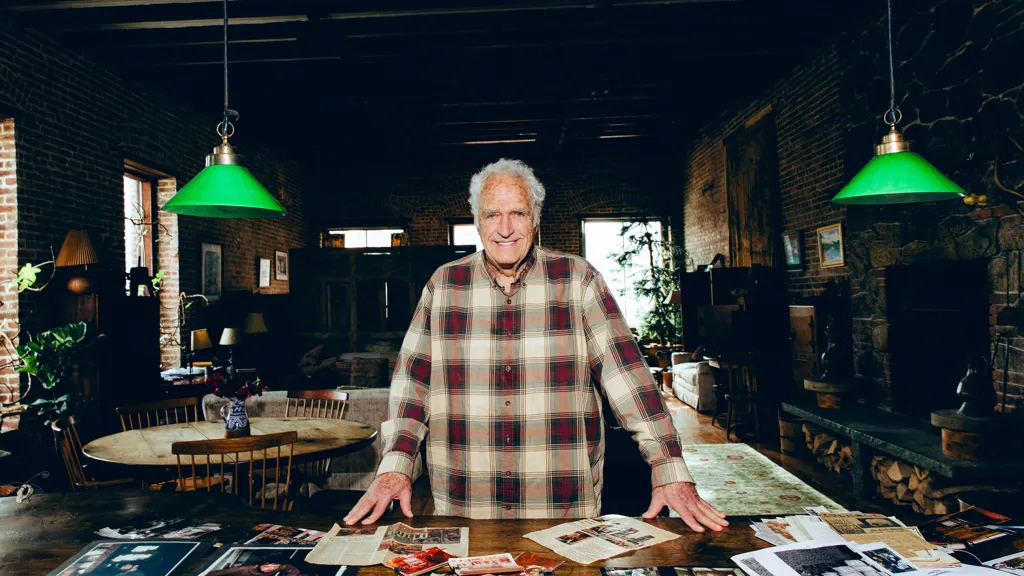
Charles FitzGerald said he had been living on St. Marks Place only a few weeks when his landlord offered him a deal. He could begin leasing his ground-floor studio and the adjoining commercial space for a bundled rate of $28 a month.
It was 1959 in Downtown Manhattan and the area, largely unpoliced and commercially undeveloped, was known for its dirt cheap rent for substandard accommodations. St. Marks Place between Second and Third Avenues, where Mr. FitzGerald lived, was boarded up, save for an umbrella shop and Gem Spa, a 24-hour corner store where locals bought egg creams and newspapers. Otherwise, an errant chicken bobbing along the street was more common than an "open" sign.
Regardless, Mr. FitzGerald accepted the deal. He was 24 and had moved to the city to teach English at a business school. But when money got tight, he threw open the window and started selling wooden kitchenware directly to passers-by, a peculiar hustle that fit right in on an odd street.
"I wasn't a planner," Mr. FitzGerald recently recalled, "but I was adventurous."
His portfolio would grow from one shop to seven. He'd buy one building and then two more. Over the next half century, the transplant with no real estate aspirations would come to play a central role in transforming the once-derelict street into an international curiosity. Today when tenants of the famous block reflect on why St. Marks remains an emblem of New York counterculture, they often point to Mr. FitzGerald.
"He saw potential where nobody else saw potential," said Ada Calhoun, a longtime resident of the street and the author of "St. Marks Is Dead," a history of the neighborhood. There are profound connections to the past all along the street," she added, "and Charles is one of them, in the flesh."
On a recent Friday evening, his fingerprints were visible up and down the block. Oak saplings he planted in 1974 now tower over the graffitied street. Students, tourists and locals in leather milled past SING SING Karaoke, Village Works bookstore and Andromeda, a tattoo parlor -- all businesses under Mr. FitzGerald's care.
Commercial gentrification, which has transformed much of the surrounding neighborhood, has long caused tensions for residents of St. Marks, where novelty stores and mohawked stoop dwellers abound. When a Gap opened on the street in 1988, many declared the block dead. Earlier this month, "coming soon" signs went up for a Sephora, which will anchor the ground floor of a new nine-story office building on the corner of St. Marks Place and Third Avenue. Buying a one-bedroom on the block now costs more than $1 million, and rent for one hovers near $4,000 a month.
Even though such changes are at direct odds with Mr. FitzGerald's life's work to keep the street eclectic, he harbors no resentment for the new developments. And at the age of 91, he has no intentions of slowing down.
"St. Marks is an evolving thing," Mr. FitzGerald said while speaking with his wife, Kathy Cerick, from his top-floor apartment along St. Marks Place, his home for more than 50 years. "I'm not sentimental about it. What's always interesting to me is the dynamism of the moment."
Mr. FitzGerald, strong-jawed and sarcastic, said by his own account that he was not especially good at running the finances, which often created stress for his family. "I'll go down as one of the rottenest businessmen ever," he said. But making money was never the point for him. "My art was solving problems and making this block come to life," he said, and "I picked a great block."
Before the vintage shops and tattoo parlors of today, the plot of land several miles north of the Battery had been many things: in the seventeenth century, Peter Stuyvesant's farm; in the eighteen-thirties, a home to the Manhattan developer Thomas E. Davis, who built a row of brick Federal houses and named the block St. Marks Place after the church around the corner; by the early twentieth century, it was a hardscrabble community of working-class immigrants.
When Mr. FitzGerald arrived in the 1950s, the block "was not hip," said Ms. Calhoun. "You would have seen Ukrainian immigrants sweeping their stoops, grandmothers leaning out of windows, children running through the streets."
The city had recently dismantled the Third Avenue El, opening a clearer path between Greenwich Village and blocks to the east. Young bohemians began migrating east and soon, Jewish, Ukrainian, Polish and Italian families were sharing their sidewalks with beatnik poets and artists. In the coming decade, clubs and performance spaces flourished and the block became a playground for Andy Warhol and Lou Reed; a stage for the Velvet Underground and The Stooges; and later, an incubator for artists like Keith Haring and Jean-Michel Basquiat.
"Charles was the original hippie in the neighborhood who really ushered in that world," Ms. Calhoun said.
For Mr. FitzGerald, the block was a "fertile ground for invention." He formalized the kitchenware storefront in 1961, calling it Bowl & Board, and then opened Grizzly Furs, where he sold raccoon coats for $20 that he purchased for $2 apiece from a warehouse in Brooklyn. "He started making money hand over foot because fur coats became the rage," said Mary Louise Delpierre, Mr. FitzGerald's first employee.
He eventually gave up his teaching job to concentrate on his expanding St. Marks empire. He opened a shop devoted to crushed velvet; one where he sold old Levi’s; another with imported treasures from Afghanistan. He also opened a bar and an art gallery. “I’d hit the deck at five in the morning. I would forget to put my shoes on,” said Mr. FitzGerald. “I’d be out there barefoot on the block, dealing with all these stores.”
Mrs. Cerick joined his operation in 1973 after meeting Mr. FitzGerald while working at one of his stores and marrying him later that year. They thrived on opening shops anywhere they saw a for-rent sign. “We could open a store in 24 hours,” Mrs. Cerick said.
This, Mr. FitzGerald said, was the most exciting period of his life. “Everything you can imagine happened on this block,” he recalled. He told stories of wresting a loaded gun from the hands of a drunken neighbor and of holding the door for a guy carrying clothes out of the building—only to later realize he’d abetted a robbery of his own apartment.
Even as the streets grew rougher in the '70s, Mr. FitzGerald’s storefronts and the culture they cultivated remained a constant.
"Charles put a lot of value on vibe," said Nick Velkov, who runs St. Marks Yoga out of one of Mr. FitzGerald's buildings. Chelsea Ainsworth, who has run a performance venue in the same building for more than a decade, described Mr. FitzGerald as a block curator rather than a conventional landlord. "He keeps people around who are energetic and have that St. Marks spunk," she said. During the pandemic, he halted payments for many of his commercial tenants, including her, allowing them to survive the shutdowns.
For the scale of what he built, Mr. FitzGerald recognizes that the operation was never managed well. Franchisees didn't pay. Merchandise went out the door uncompensated. Mr. FitzGerald estimates he probably swallowed as much as $600,000 in losses in one year. Kate FitzGerald, his 39-year-old daughter who lives on St. Marks, said whatever success the businesses had was largely because of her mother. "He's the ideas man," she said,"but so many would not have been possible without my mom."
Liane FitzGerald, Mr. FitzGerald's other daughter, said her father's bullheaded approach had created friction at times—particularly with his accountant who "is always fighting with him."
"My dad definitely makes business decisions based on feeling rather than sound advice," said Ms. FitzGerald. Still,she and her sister appreciate that his excitement for the work helped make St.Marks what it is today.
Rather than money,Mrs.Cerick said her husband cared about adventure,culture and trees.
Over decades,the couple raised funds for a dozen saplings that they planted along the street.
They also donated $2 million from two buildings’ sale to nature conservancy they created in Maine.
In recent years,the couple’s daughters have become concerned about their parents’ health,and expect to eventually take on larger roles in businesses.
Regardless,
Mr.FitzGerald still remains firmly in charge,hoping to see St.Marks cycle through its next incarnation.
"They think they're going to live forever," Liane FitzGerald said.
His latest contribution to the block is Village Works,a homey,art-filledbookstore that stocks only works on New York culture.
The shop stays open until 2 a.m.,selling more books after 11 p.m.
than it does all day,
according to Joseph Sheridan,
the owner,
who is known for yelling at customers to get off their phones.
Mr.FitzGerald subsidizes the rent,
more concerned with its presence on the block than its profit margins.
The mission of the store is to educate transplants to the neighborhood about the culture of New York,
Mr.Sheridan said,
“and maybe about what they’re replacing.”