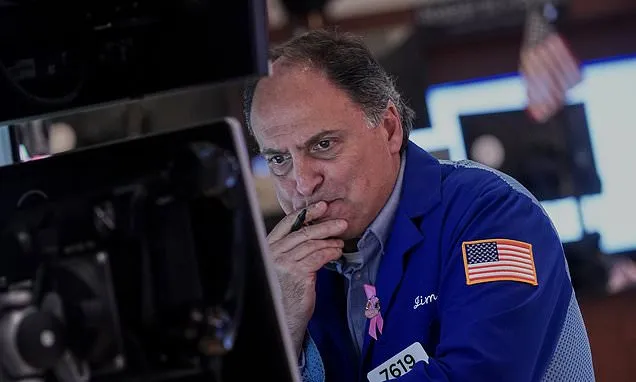
The man who spotted the 2008 crash before anyone else is worryingly starting to look right again. Nearly three months after Michael Burry (pictured) placed a $1 billion bet against Wall Street's hottest AI stocks, they are lower by as much as 33 percent - a huge plunge when the broader market is slightly up. Palantir and Nvidia - two of the biggest winners of the artificial-intelligence boom - have shed a combined $1 trillion in market value since Burry made his move in early November. Market watchers say the slide in AI stocks could be an early signal of a broader correction, raising fresh fears that losses could soon spread beyond Silicon Valley and into millions of Americans' 401(k)s tied to the S&P 500 and Nasdaq.
A high water mark
And the sharp declines have turned a trade that was mocked by Palantir boss Alex Karp as a '[expletive] crazy' into one that appears to be paying off. The bearish bets by Burry - by the investor whose story was later immortalized in The Big Short - were revealed in filings on the morning of November 4, a date that has proved to be a high water mark on the value of the two companies. The reaction was swift. Within three trading days, Palantir shares were down 15 percent and Nvidia had fallen 12 percent. But things have gotten much worse, Daily Mail analysis of Google Finance data shows. Palantir has been hit the hardest. From its November 3 closing price of $207, shares of the data-analytics firm have fallen by $69 - a drop of more than 33 percent as of the end of trading today (February 4). That slide has wiped roughly $161 billion off the company's market value, shrinking it from $494 billion in early November to $333 billion today.
The $5 trillion peak
Nvidia's decline has been less steep in percentage terms, but far larger in dollar terms. Shares of the chipmaker have fallen 15 percent from their November 3 close of $206.88, and ended today at $175.52. While Nvidia’s market capitalization remains enormous at $4.25 trillion, it peaked at above $5 trillion—the first and only time a company hit that level—right before Burry’s bet was revealed. Filing by Burry showed roughly $900 million in put options against Palantir and about $187 million against Nvidia—financial instruments that rise in value when a stock falls. In the 12 months leading up to November, Palantir shares had surged more than 250 percent, while Nvidia had risen roughly 180 percent as investors piled into anything tied to artificial intelligence. Those gains left both companies trading at valuations that assumed years of uninterrupted growth—the kind of setup that has historically left little room for disappointment.
Palantir's latest earnings only underscored the fear around AI stocks. The company posted blockbuster results earlier this week that initially thrilled investors, sending the stock jumping more than 7 percent on Tuesday. But the celebration didn't last. By the close today, Palantir shares had plunged 13 percent, wiping out the gains and dragging the stock back below pre-earnings levels. Burry has not been bearish across the board. He is betting that one-time meme-stock favorite GameStop will rise in value. 'I own GME. I have been buying recently,' Burry wrote in a Substack post two weeks ago, triggering a sharp rally that sent the stock jumping as much as 8 percent in a single day.
Who is Michael Burry and what was his role in The Big Short?
Michael Burry built his reputation by betting against the US housing market before the 2008 financial crisis. A former neurologist turned hedge-fund manager, he founded Scion Asset Management and correctly predicted that subprime mortgages would collapse, triggering a global meltdown. His trade generated billions for his investors and was immortalized in The Big Short -- first a best-selling book by Michael Lewis and later a Hollywood film. It starred Christian Bale as Burry, Steve Carell as fund boss Mark Baum (based on real-life investor Steve Eisman), Ryan Gosling as slick trader Jared Vennett (based on Greg Lippmann), and Brad Pitt as reclusive financier Ben Rickert (based on Ben Hockett). It also famously featured Margot Robbie explaining complex financial concepts - including subprime mortgages - from a bubble bath, in a series of scenes designed to make the crisis accessible to everyday viewers. Since then, Burry has repeatedly warned about speculative excess - from meme stocks and cryptocurrencies to post-pandemic tech rallies.
He famously slashed his portfolio in 2022 ahead of a market downturn, then returned as prices fell. Eisman also recently said he was 'concerned' by the stratospheric rise of big tech and artificial intelligence stocks. Shorting Palantir and Nvidia fits the same pattern of Burry's trades in 2008: a high-conviction bet against an industry riding hype. Palantir trades at eye-watering earnings multiples, while Nvidia’s valuation briefly rivaled entire national stock markets. To Burry, those numbers may look eerily similar to mortgage bonds in 2007. And if this sell-off continues, Wall Street may be forced to admit that the most uncomfortable voice in the room was right all along.