It's the wonder ingredient beauty insiders swear by and dermatologists broadly agree is effective for anti-ageing.
And every beauty brand is jumping on the retinol bandwagon, with Boots stocking 87 different kinds of retinol products and Space NK 82. Beauty guru Caroline Hiron's brand Skin Rocks is the latest to launch Retinoid 3, an advanced-level serum.
But do they deliver results? I spoke to experts to find out.
What are retinoids?
'Retinoids are an umbrella term for all vitamin A molecules and their derivative forms, including retinol, retinal, retinyl palmitate and retinoic acid,' explains Daniel Isaacs, director of research at dermatological skincare brand Medik8.
'When any type of vitamin A is applied to the skin, it has to be converted to its biologically active form, called retinoic acid or tretinoin, which the skin recognises and can use.
'The weaker the form of vitamin A, the more stages it has to go through to become active, making it less effective.'
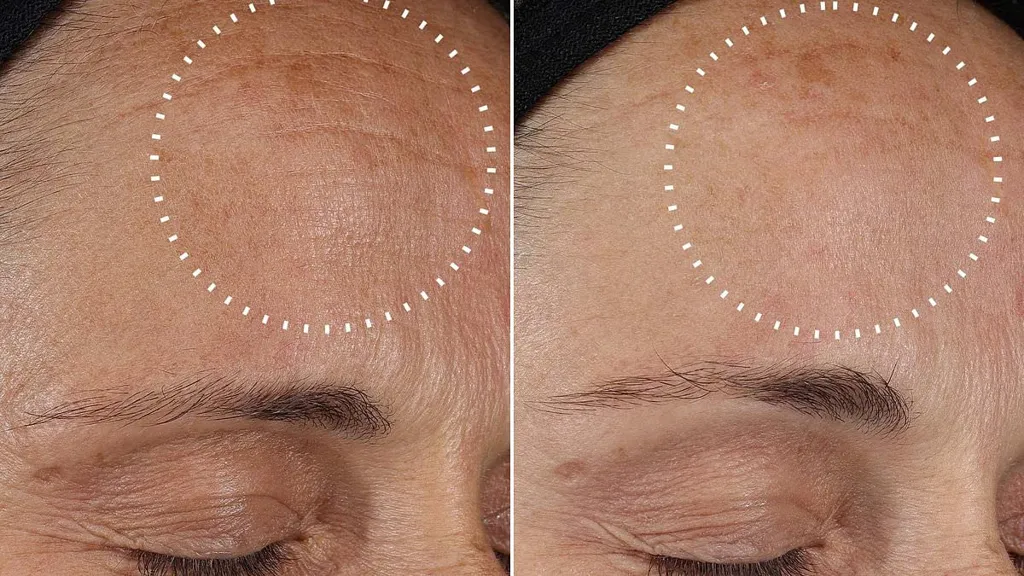
Before and after... how retinol can get rid of those lines and brown marks
Retinoids are an umbrella term for all vitamin A molecules and their derivative forms, including retinol, retinal, retinyl palmitate and retinoic acid
Retinol has to convert twice before it becomes an active form that the skin can use, from retinol to retinal to retinoic acid. Retinal products only have to convert once to become retinoic acid, while prescription retinoids are already in the active form.
What do retinoids do at a cellular level?
'Retinoids can help to increase skin cell turnover, which helps to fade pigmentation and unblock pores,' says consultant dermatologist Dr Justine Hextall.
'When you come into contact with things like UV and pollution, certain enzymes get upregulated, causing collagen to break down. Retinoids can suppress that process.'
Once retinol or retinal has converted to the biologically active form, the retinoids work by binding to and activating the retinoic acid receptors in the DNA of skin cells.
'Unlike some other topical skincare ingredients that sit on the surface, retinoids change how skin cells function from within,' explains Mr Isaacs.
'It tells the cells what they need to do, like make more collagen and increase cell turnover.'
But, Dr Hextall says that there is a ceiling on the benefits that you'll see in your skin thanks to retinoids.
'There are a limited number of retinoic acid receptors in the epidermis of the skin (the top layer) and in the dermis,' she adds. 'Once all these receptors are switched on, you can't switch them on further by using a stronger concentration of product.'
What mistakes do people make with retinoids?
'A mistake I often see is with menopausal patients,' explains Dr Hextall. 'Skin loses hyaluronic acid during this time, so it's often more sensitive, it's dry and it's prone to irritation.
'Patients reach for the strongest possible kind of topical retinoid, which then just causes more dryness and damage to skin.'
Dr Hextall recommends building a regimen that focuses on hydration, with products that contain hyaluronic acid and glycerin, then introducing retinoids at a lower strength.
Mr Isaacs agrees that people often use a retinoid that's too strong. Medik8 advocate for a 'slow and low' approach, which allows skin to adjust to any potential irritation. Results should be visible after 12 weeks of use.
Verdict?
A skincare powerhouse that it's worth trying for a brighter and smoother complexion.