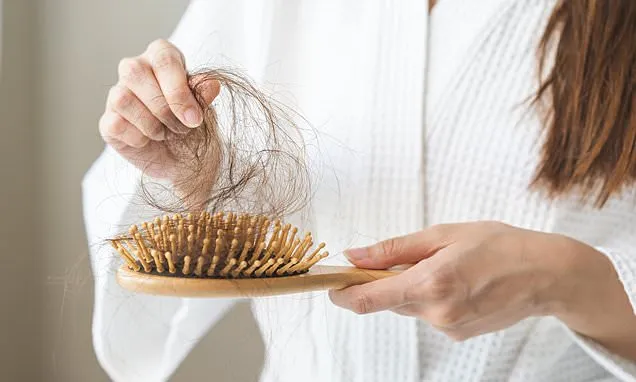
Whether it's handfuls of hair falling out in the shower or thinning temples from too many slick back styles, hair loss is something many women worry about.
And experts agree there has been a concerning rise in the number of women losing their hair, with stress often driving a seemingly never ending cycle.
But the good news is, there are several steps you can take to help prevent hair loss and treat the problem early - starting with diet.
Leading trichologist Hannah Gaboardi says one of the most common causes of hair loss she sees in her clinic is nutrient deficiencies, triggered by fad diets.
'Something we see time and time again in clinic is women suffering from an iron, or more specifically, a ferritin deficiency,' she says.
'Ferritin is a measure of your stored iron, which is needed for the function of every cell in the body, including hair follicles.'
Without sufficient vitamins and minerals, including things like zinc, iron and Vitamin C, the body prioritises critical organs and energy is lost from less vital cells, resulting in hair loss.
But the good news is most people can get sufficient levels to maintain their hair through their diet, the hair expert says.
It is estimated about eight million women in the UK experience some form of hair loss, particularly as they age.
For Gaboardi, this means eating red meat, alongside spinach tossed in lemon juice - to help boost iron absorption - and healthy fats such as salmon and pumpkin seeds.
She says: 'Women who have a period are also more prone to iron deficiency and this is something I'm really conscious of. I try and eat a good amount of iron and vitamin C, as well as having iron infusions to reach optimum levels for hair growth.'
'Vitamin D is also really important for the anagen phase of hair growth,' she added. 'So in the winter everyone should be supplement vitamin D too maintain their hair.'
Hair grows in a repeating cycle made up of four distinct phases.
It starts with the anagen phase, which is also known as the 'active' stage. This is when hair grows the most rapidly.
Cells at the root divide quickly to form new hair strands, which grow around half an inch per month. This growth stage typically lasts between 3-5 years, but naturally shortens with age.
This is then followed by the catagen phase, which signals the end of active hair growth, the telogen phase and finally exogen or the shedding phase.
During this final phase of the cycle, individual hairs are released from the follicle and naturally fall out, allowing new hairs to grow.
A lack of protein can also cause brittle hair, which can lead to breakage and split ends, Gaboardi says.
It is possible to eat to help maintain hair health, but once you start noticing your hair falling out its always best to consult your GP says trichologist Hannah Gaboardi, pictured
Foods to eat for healthy hair growth
- Red meat - rich in haem iron which can be easily absorbed by the body
- Spinach - rich in iron and Vitamin C which aids absorption
- Pumpkin seeds - provide omega-3 fatty acids which support scalp health
'Whilst you can't necessarily eat your way to better hair if you're experiencing severe hair loss and things like alopecia, healthy hair does start from within.'
'And this means getting enough of all the nutrients you need, including protein.'
Hair is mostly made up from a protein called keratin, Gaboardi explains. But the body cannot absorb keratin from food, because it can't break it down.
Instead, the body has to build it from the amino acids found in the protein we eat. And if there isn't enough protein in the diet, hair might start to thin or even fall out - known as telogen effluvium.
This type of hair loss isn't just caused by a lack of protein; telogen effluvium can also be caused by other nutrient deficiencies and stress.
Environmental factors such as heat damage and certain hairstyles, like constantly wearing your hair pulled back off your face in a slick back style can also cause breakage - known as traction alopecia.
If you notice your hair becoming drier, thinner and less lackluster, especially in terms of colour, Gaboardi suggests having a good look at your diet to make sure you're eating enough protein, healthy fats, iron and B vitamins to support hair growth.
But it's not just about upping your intake of certain foods to make sure you're hitting your protein goals.
'Eating too many ultra-processed foods with high levels of refined sugars can have a negative impact on hair growth by increasing inflammation, disrupting hormones and depleting essential nutrients needs by the follicle,' Gaboardi explains.
'Refined sugars can spike insulin levels, which may increase androgen activity and contribute to thinning in those prone to pattern hair loss,' she added.
Androgens are male sex hormones essential for normal male sexual development, sex drive and the regulation of hair growth in both sexes.
But too many of these hormones can cause hair thinning and even hair loss, shortening the hair's growing phase and lengthening the time between the shedding of the hair and the start of a new anagen phase.
The hair follicle itself may also change when hormones are disrupted, shrinking and producing a thinner hair shaft.
'Diets high in trans fats and deep-fried goods can also promote inflammation,' Gaboardi explained, 'which can impair scalp circulation and follicle function.'
And whilst drinking alcohol won't make your hair fall out, drinking too much can affect how nutrients and absorbed and used by the body resulting in a lack of folic acid, vitamin B12 and calcium - all of which are needed for healthy hair.
It is estimated around eight million women in the UK experience some form of hair life as they age.
Women commonly experience hair thinning as they age. This is because as oestrogen levels fall, it tips hair into having a shorter growth phase and more shedding.
And whilst eating a healthy diet full of vitamin D, iron and zinc won't reverse your hair loss, it can certainly help to stimulate hair growth and preserve your locks,Gaboardi says.