As the Olympic Games of Milano Cortina 2026 come to a close in Verona, the International Olympic Committee can look back on one of their most successful events to date, with a strong investment in digital clearly paying off in Milan.
From gambling big on broadcast technology, bringing the latest in cinematic equipment to the mountains for their 24 media rights holders, through to providing on-site social media coverage at every location, the Olympic Broadcasting Services (OBS) has led the charge in Italy.
The Games have captured the attention of spectators worldwide. Even beyond the viral moments, such as biathlete Sturla Holm Lægreid's spectacular declaration of love or figure skater Ilia Manin's dramatic backflip, viewers have become captivated by a human angle brought to the Games through the most advanced technology that has been seen at the world's largest sporting event.
Following NBC's $3 billion extension in broadcasting rights in a significant deal for the Games, as reported by The Guardian, the experience has surpassed expectations across the globe.
A revolutionary broadcast experience for the Olympic Games
Over 6,500 hours of broadcast coverage were produced by the OBS with 810 camera systems deployed. Of those, 32 were cinematic camers with shallow depth-of-field, seeking the kind of stunning shots which have become common in leading sports competitions with close-ups of athletes.
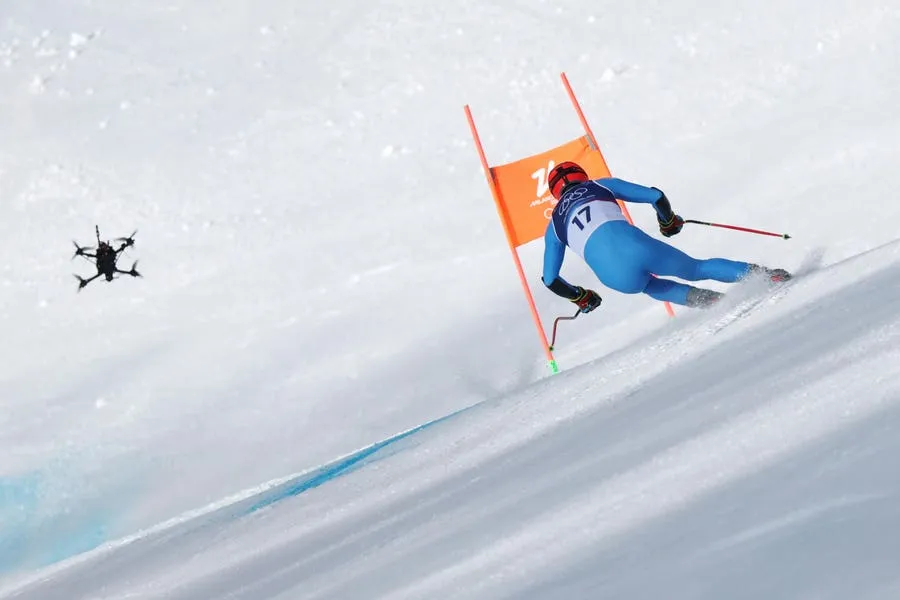
In addition, the OBS has deployed a fleet of 25 drones, headlined by 15 custom-built First-Person View (FPV) units. Far more than standard commercial photography drones, these drones weigh just 250-grams and are designed for racing, capable of hitting speeds of up to 75 mph to keep pace with even the fastest of athletes.
Deploying this technology is not easy. To ensure safety and capture the most technically accurate shots, the OBS has recruited drone pilots who are often former competitors themselves. For example, former Norwegian national team jumper Jonas Sandell has piloted many of the drones in the ski jumping coverage, using his experience to anticipate the exact moment of an athlete taking flight.
The OBS claims that, "the Milano Cortina 2026 Olympic Winter Games had averaged 24.1 million viewers on NBC, Peacock, NBCUniversal Digital Platforms and Versant's CNBC and USA Network", making it the most-watched Winter Games in the United States since Sochi 2014, and up 93% from Beijing 2022. The impact was global, with two out of three Italians having watched coverage, and more than 80% of the potential audience in Japan tuning in.
Yet despite the scale up, both in terms of technology and results, the International Broadcast Center in Milan is the smallest ever for a Winter Olympics. Producing more content than ever before, courtesy of a shift to cloud-based remote production, the power consumption on site is down 33% compared to Beijing, according to Viaaccess-Orca.
Investment in live social media coverage
The Milano Cortina Games have also become the first Winter Olympic Games to host dedicated social media creators at every venue. Tasked with covering the action in the trickiest of conditions amid freezing temperatures and heavy snowfall at times, the investment has paid off.
The total number of engagements generated on official Olympic social media handles have surpassed 10 billion, which is more than three times what was recorded at the last Winter Games in Beijing in 2022.
In addition, 8.7 million people have followed Olympic Games social media accounts, accounting for over 5% of the total audience of the games across their 172 million followers.
On-the-ground teams have been able to create heart-warming content, such as one video on Instagram of figure skaters cheering on their peers which has built up almost 400,000 likes. Elsewhere, series like the "what I see/what you see" have given behind the scenes access like never before.
The use of the Olympic Rings pasta, desgined by six-Michelin-starred chef Carlo Cracco has tied in with this, gifting boxes of the pasta to excited fans and joining leading athletes like Dutch speed skater Jutta Leerdam on a tour of the food in the athlete's village.
Softening of Rule 40 for athletes
The Olympic Games' Rule 40 has previously installed a blackout for athletes where they were unable to collaborate with individual sponsors during the period of the Games. Seeking to avoid athletes benefitting at the expense of the International Olympic Committee and its sponsors, there has been a significant shift in the handling of the rule for 2026.
This year, athletes have been given the chance to notify authorities through a central notfication portal. Providing the brand in question had applied for a waiver in the build up to the games, athletes and brands only needed to log in and place a notification of the event.
Additionally, sponsors of individual athletes can now congratulate their representatives during the Games, provided they follow guidelines to avoid the use of official Olympic Games branding.
In many cases, this has led to brands taking advantage of the event. For example, Leerdam’s decision to unzip her skate suit to reveal a Nike sports bra below could be worth as much as $1 million in endorsement value, according to ALM Corp.