Belvoir St theatre, Sydney
Actor deploys range and comedic skill in this gripping one-man show, which caused a sensation when it premiered in 1976 - and remains relevant today.
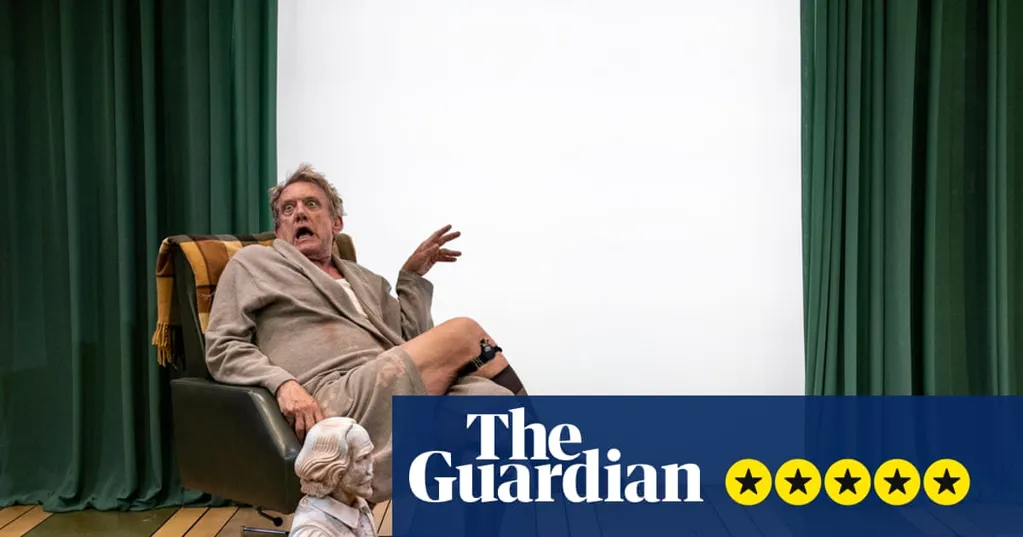
The play begins with Simon Burke's bare arse, facing the audience and bouncing side to side in time with David Bowie's The Jean Genie. In this new production of a queer Australian classic, the actor is playing 56-year-old elocution teacher Robert O'Brien in stockings and suspenders, rouge on his face, caressing himself before a poster of Mick Jagger.
While teaching, O’Brien wears a fusty green vest and brown suit and tie that blend with his living room furnishings; in private, cigarette in hand, he resembles Norma Desmond in cloth cap and dressing gown. Soon, he will search for his sanity as the state insinuates he’s a child abuser without granting him a trial, attacking his sexuality and gender expression.
When the late Adelaide-born Steve J Spears' single-actor play The Elocution of Benjamin Franklin premiered in August 1976 in Sydney's then Nimrod theatre, it caused a sensation for its full-frontal nudity and explorations of "transvestism".
Starring the late Gordon Chater and directed by the late Richard Wherrett, it toured Australia and London, San Francisco and New York, where it won three Obie awards for off-Broadway theatre. Fifty years later this revival, directed by Declan Greene, has come home, presented by Griffin Theatre Company in its temporary 80-seat performance space downstairs at what used to be the Nimrod - now Belvoir St theatre.
The first two acts are set in O’Brien’s living room - originally Melbourne’s Toorak; Sydney’s Double Bay in this version - and we see him telephoning his friend Bruce, a stockbroker and married father, promising to go out in public frocked up together, as soon as he can get a break from treating young stammerers and lispers at $8 a half hour.
One day O’Brien is phoned by a Mrs Franklin, asking him to fix the stammer of her son Benjamin. Giving the boy the namesake of a US founding father seems designed to show us O’Brien’s two-faced, bitchy character - “Guess what they named the kid?” he tells Bruce, before congratulating the mother on her “very imaginative” choice.
O’Brien describes Benjamin to Bruce as “this beautiful, beautiful 12-year-old boy who moves like a prince with this long, dark, curly hair”. Once an actor himself, O’Brien has designs on training Benjamin to become one, but comes to believe Benjamin wants to seduce him.
Benjamin is indeed sexually precocious; O’Brien at first assumes the boy is sleeping with women. The boy confides he is in fact having sex with a 16-year-old boy, and gives O’Brien photographic proof. Meanwhile, neighbourhood vigilantes get word that O’Brien is a “pervert”, seeing him wearing women’s clothing, and they smash the window of his home.
O’Brien is, of course, not cut out to be any role model. He offers 12-year-old Benjamin cigarettes; he jokes he will shoot another child: “There’s an awful lot of dead little girls buried in my cellar who didn’t practice ‘Naughty Nancy ate nine nice new cakes’.” Yet he commits no crime, telling Benjamin: “There is no way that I am going to touch you ... Try women. I was married to one. They’re fun. They’ve got tits. They’re nice.”
Greene tightly directs the comedy and tension here, aided by sharp lighting and sound design. Burke brings an extraordinary dramatic range and comedic skill, deploying a vast array of voices for when O’Brien mimics his young charges and their mothers, all the while gossiping and sobbing and mining the marrow of this character, who is haunted by his Catholicism.
The Elocution of Benjamin Franklin is particularly timely during this 48th anniversary of the Sydney Mardi Gras, with LGBTQ+ rights under attack globally. It is no coincidence that Larry Kramer’s play The Normal Heart is also getting a mainstage run in Sydney: a devastating polemic about young gay men in early 1980s New York facing death from a spreading disease only later identified as HIV.
Both texts stand as art but also provide renewed warnings of the political oppression and social isolation awaiting communities whose identities are marginalised and human rights denied. As The Normal Heart actor Mitchell Butel said during an artist talk this week, these are “scary times” for LGBTQ+ people in the US, and it “may not be long before we’re fighting similar fights”.
After O’Brien’s window is smashed, a police siren sounds and officers find O’Brien in a wig and frock, holding a rifle for defence, with the photos burning in his waste basket. The consequences are devastating. As I watched Burke play O’Brien facing threats to his safety, I thought of the anti-trans zealotry by rightwing politicians, gender-critical feminists and religious conservatives that fuels hate.
Yes, Spears’s play uses some dated language: O’Brien jokingly calls himself “The Transvestite Terror of Double Bay” and Bruce a “transvestite stockbroker” - a term trans and gender-diverse people do not typically use to describe themselves any more, and which is now generally seen as inappropriate or derogatory. Yet as a flamboyant creation talking back to us from 50 years ago, O’Brien’s curtailed freedoms feel contemporary, with the state fanning a moral panic over his “manner of dress”; and the force of government, legal and mental health systems ready to believe he is a child abuser resonating today with the unfounded conspiracy accusations of “grooming” thrown at queer people.
The final act features some very fine dramatic work from Burke, as O’Brien fights to save his mind so he can also save his soul. It’s gripping; having lured the audience with tight, campy comedy, the emotional gut punch endures.