Welcome to CityLab Weekly. Sign up here to get the newsletter every Friday in your inbox and send us your feedback. I'm Linda Poon, your guide to ideas, reporting and analysis from cities around the world.
The rainbow Pride flag at the Stonewall National Monument in New York City will soon fly again after the Trump administration agreed this week to reinstall it as part of a court settlement. Civil rights groups sued the US government in February after officials, citing a federal directive, removed the flag from the first national site honoring the country's gay rights movement.
School bus bust?
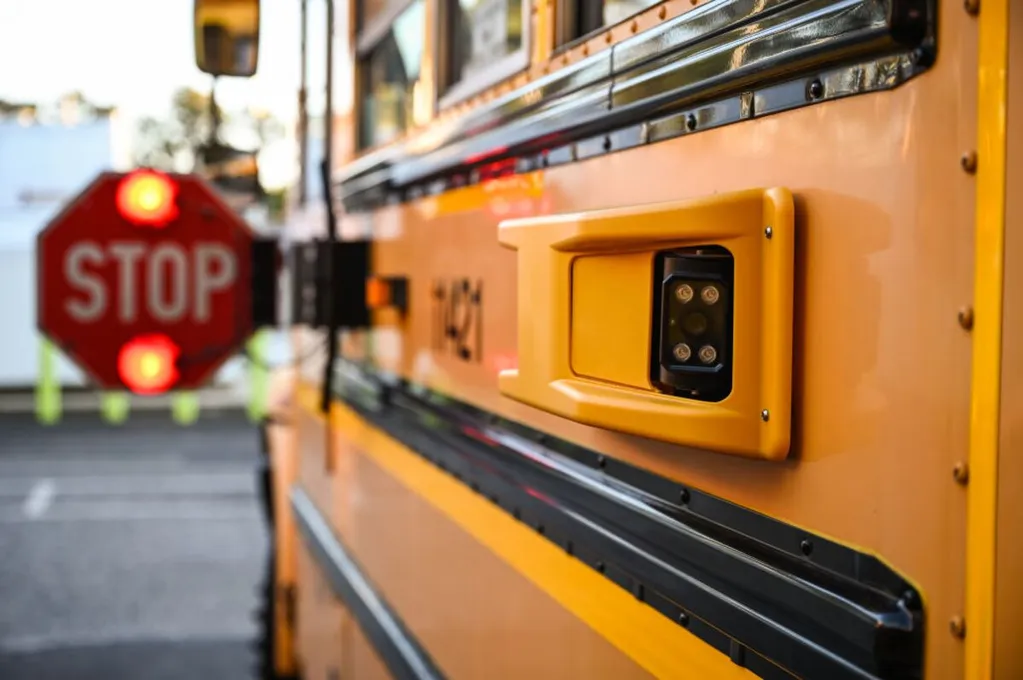
Pedestrian deaths remain high in the US, and for kids, getting to school can be dangerous as drivers -- and self-driving vehicles -- sometimes ignore laws requiring cars to halt for school buses that have flashing stop signs (or stop arms) extended. For school districts trying to curb such risky driving behavior, the company BusPatrol has made a convincing sell: Their AI-powered cameras can help enforce the law at virtually no cost to taxpayers.
It works like this: The cameras are installed on school buses free of charge, and when they record violators, the footage is reviewed by local police who decide whether to issue tickets. Part of the revenue is used to recoup the cost of installation.
The company has attached its cameras to about 35,000 buses in 24 states and more than 350 school districts. But critics say these municipalities are getting a bad deal, writes Byard Duncan in Businessweek. In Montgomery County, Maryland, for example, the bulk ($21 million) of revenue collected from the tens of thousands of tickets issued between 2016 and mid-2019 went to BusPatrol (and a previous vendor acquired by the company). BusPatrol's revenue splits with other government partners vary.
Stop-arm violations, meanwhile, continue to be high -- including at some of the most ticketed stops. In fact, citations levels have stayed high -- or have even gone up -- in several municipalities that contract with BusPatrol. And many US drivers say they are unclear about the specifics of stop-arm laws -- particularly when it comes to passing school buses while traveling in the opposite direction.
An arch fit for a monarch
Trump is one step closer to getting his own (bigger) version of Paris' Arc de Triomphe in Washington, DC -- a 250-foot-tall arch with a 60-foot-high gold-plated statue. With criticism over its size and gaudiness, the monument did not win the fast-tracked approval that the White House ballroom received.
These streets were not made for walking
Whereas other rich nations saw pedestrian deaths decline between 2013 and 2022, fatalities rose by half in the US. A leading researcher has some surprising reasons why America's transportation safety crisis has been so unrelenting.
Where cyclists need more than bike lanes
Many low-income commuters in developing cities rely on bicycles, even if it means navigating a competitive street hierarchy with few protections in place. A survey of cyclists in Delhi, Dhaka and Accra in Ghana highlights how governments can provide better support.
The price of power
The costs to keep the lights on have surged in the US, and some voters say they're taking their frustration to the polls. From Pennsylvania to Michigan, electricity prices (and data centers, which have been largely blamed for rising bills) are playing a not-insignificant role in some of the most competitive races in this year's midterms -- and they could help tip the balance of power in Washington.
Whatever happened to...
The DC Streetcar: After a decade ferrying locals and visitors alike across the H Street commercial corridor in Washington, the DC Streetcar shut down for good at the end of March. The 2.2-mile line drew mixed reactions even before it debuted in 2016 as part of a grand vision for a citywide network, and as part of a national wave of experiments to revive the American streetcar. DC's full network never materialized, while criticism for the lone route mounted over both its $200 million price tag and its lack of efficiency at moving people. Residents poked fun at its tendency to get stuck behind double-parked cars and sluggish speed, as local runners staged an annual race against the vehicles.
Yet as Justin Fox writes, DC's streetcar has actually seen bigger ridership than other experiments. The streetcar featured easy boarding for those with walkers, strollers or other wheels, and many fans of the dinky line packed its trolley cars on March 31 for a festive but bittersweet last ride.
What we're taking in
- A Ukrainian city hit by Russian missiles is bouncing back after being adopted by Denmark. The Danish government has contributed more than $250 million to rebuild Mykolaiv, using the city as a test bed for country-to-country assistance policies that contrast with the Trump administration's push for a more business-focused plan. (New York Times)
- A scorecard for Zohran Mamdani's first 100 days as NYC mayor monitors his progress on the small- and medium-bore management improvements needed to "unstick the gears of government." (Vital City)
- Starting in 2015, New Orleans saw an alarmingly high number of crashes involving 18-wheelers and passenger cars each year along Interstate 10. The cases shared strikingly similar characteristics, and as lawyers later learned, plaintiffs suing for injury compensation appeared to all link to one man. A deep dive into a wild car-crash conspiracy. (New Yorker)
- Maine passed a temporary statewide ban on large data centers this week, the first to do so in the US amid growing pushback against the industry. Lawmakers say the bill will give the state time to put a comprehensive framework in place for considering such projects. (Bloomberg Law)
- Police in Japan began fining cyclists for traffic violations this month under new rules aimed at regulating two-wheelers -- with more than 100 infractions including riding with a parasol and wobbly steering. One of the more controversial rules requires cyclists to ride on the road instead of the sidewalk, despite the country's limited bike infrastructure. (Financial Times)
More from Bloomberg
- Green Daily for the latest in climate news, zero-emission tech and green finance
- Hyperdrive for expert insight into the future of cars
- Design Edition for CityLab's newsletter on design and architecture -- and the people who make buildings happen
- Management & Work analyzes trends in leadership, company culture and the art of career building
- Nordic Edition for sharp analysis and new perspectives on the forces shaping business and finance in the Nordic region