Last week, Ukraine fired a commander after relatives said soldiers from the 14th Separate Mechanized Brigade had spent months near Kupiansk without reliable food, water or medicine, and posted photos of them on social media looking emaciated. The problem wasn't capacity, it was getting supplies to the front line. A Ukrainian military spokesperson said: "Everything is done by drones. The Russians pay maximum attention to the deliveries of food, ammunition and fuel. They intercept and shoot down as much as possible. Sometimes they are not so interested in our military equipment as in logistics, actually."
That dire situation for some Ukrainian forces points to a hidden revolution now underway in Ukraine. The country's defenders are not only using machines such as drones to replace soldiers. They are using machines to keep soldiers supplied, evacuated and alive long enough to keep fighting. Kyiv expects to contract 25,000 unmanned ground vehicles in the first half of 2026, more than double the 2025 total, while Defense Minister Mykhailo Fedorov has set the goal that 100 percent of frontline logistics be performed by robotic systems.
The comforting version is that robots are making war less dangerous. President Volodymyr Zelensky has called Ukraine's unmanned systems "high technology protecting the highest value -- human life," after saying Ukrainian forces had run more than 22,000 unmanned missions in three months.
That view has a civil libertarian reflection: let machines do the drudgery and absorb risk, but do not let them make life-and-death decisions. Human Rights Watch has argued that weapons selecting and engaging targets without meaningful human control are "unacceptable," while the Stop Killer Robots campaign says states should reject "the automation of killing" and preserve meaningful human control over force.
The hawkish version is less sentimental: robots are a force multiplier. A Defense News report on Ukraine's machine war quoted one drone commander saying, "More drones, more Russians killed," and another operator summing up the new doctrine: "We do drones. We kill with drones. We save with drones. We liberate with drones."
The Iran war under President Donald Trump adds the data layer to the hardware layer. Admiral Brad Cooper, the U.S. commander leading the war in Iran, has confirmed the use of "a variety of advanced AI tools" to sift large amounts of data and help leaders make "smarter decisions faster than the enemy can react," reducing some processes from hours or days to seconds.
So the argument is not "killer robots are here," nor "robots will save us from war." The first rule of robot war is more prosaic and more disturbing: keep the humans fighting.
The killer data point is not 25,000. It is 70 percent. That is the share of frontline logistics that Ukraine's 28th Brigade has already shifted to robotic systems. The breakthrough is not that machines can finally replace soldiers. It is that they can increasingly do the hauling, and modern battlefields have become so transparent to drones that hauling may be one of the most lethal jobs left.
Ukraine's official numbers point in that direction. Its Ministry of Defense says unmanned ground vehicles completed more than 9,000 combat and logistical missions in March, compared with more than 2,900 in November 2025 and more than 7,500 in January 2026. Across the first quarter of 2026, Ukraine says UGVs completed nearly 24,500 missions, while the number of units using them rose from 67 in November to 167 in March.
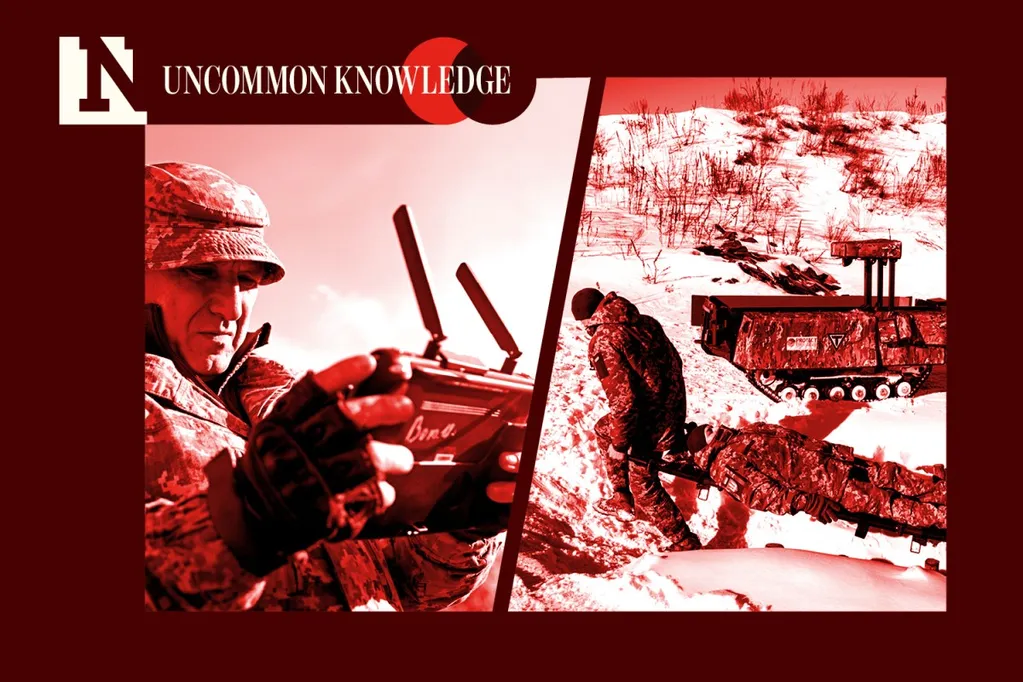
Ukraine's new Bizon-L robot can carry up to 300 kilograms, travel up to 50 kilometers, move at up to 12 km/h and operate over marshland, snow, ice and rough terrain. Its mission begins with transporting supplies and ammunition and evacuating casualties. It can also carry weapons, mining equipment, relays and electronic warfare equipment. That makes the Bizon-L less a robot infantryman than a mule.
The United States is watching the same problem. This month, the U.S. Army said it wants a "last mile" unmanned ground vehicle for resupply and casualty evacuation because persistent surveillance and rapid fires make movement to and from the forward line highly vulnerable. The Army wants a vehicle able to haul enough cargo for a rifle platoon and company headquarters, evacuate at least two casualties, operate on and off road, and function without GPS.
Medical planners are thinking the same way. A U.S. Army article published in 2025 argued that, as air superiority becomes less assured, uncrewed ground vehicles could support casualty evacuation, logistics and reconnaissance. The Army's Combat Casualty Care Research Program says its Autonomous Care and Evacuation portfolio is developing AI, virtual health, medical robotics and autonomous systems to "return Warfighters to the fight."
Iran shows how the same approach from the data side. Project Maven, the Pentagon's flagship AI program, uses satellite imagery, radar, social media and other data sources to identify targets, while also speeding the "kill chain." One official credited the technology with helping move from hitting under 100 targets a day to 1,000, and potentially up to 5,000.
Put the cases together and the pattern is clear. Ukraine is the hardware layer: robots carry supplies and evacuate casualties. Iran is the targeting layer: AI simplifies sensing, sorting and decisions.
That undercuts both ideological daydreams at once. The optimistic technocratic view is too neat because while robots may spare some lives, they do not dissolve the human core of war. The hawkish view is too eager: machines can be armed, certainly, but the first mass substitution is happening in logistics, evacuation, and targeting, not in the human work of attacking and holding ground.
The future is not a robot army marching in place of humans. It is humans staying in the fight because a machine brought the shells, an algorithm found the next target, and a machine evacuated the casualties. The human battlefield is not being abolished. Its reach is being extended.