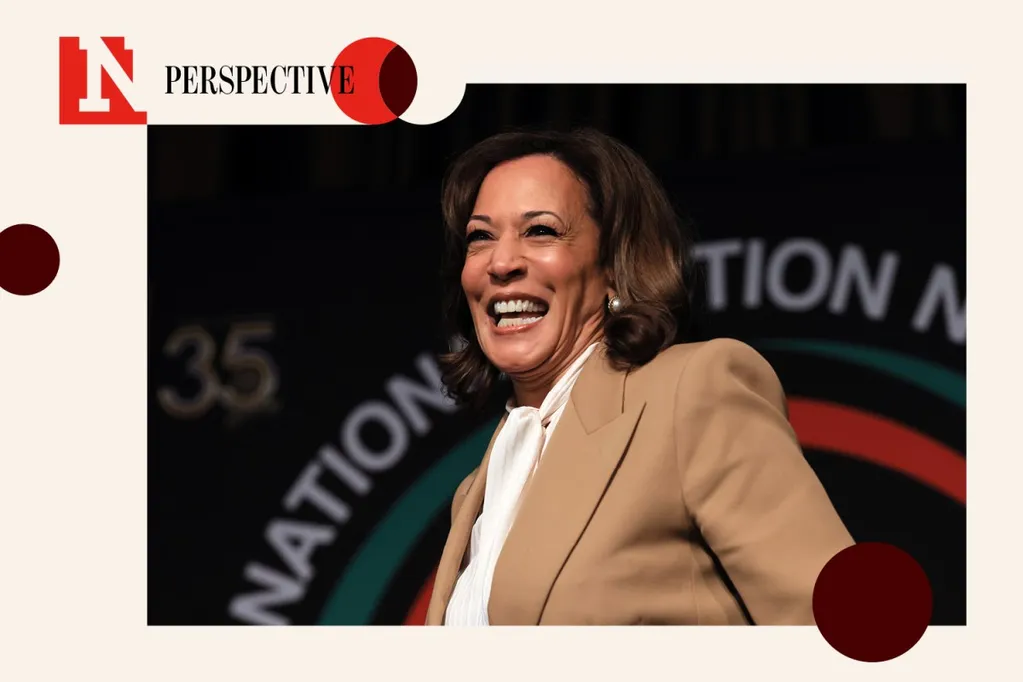
Kamala Harris was speaking. And now she might be running. Again.
It's more than pure speculation that 2024's loser is vying to become 2028's winner. Harris heavily suggested she would run in a recent appearance with the Reverend Al Sharpton, saying she "might" and was "thinking about it."
The former vice president is riding high in some Democratic presidential polling. Some surveys put her at the top of the list and she led with 50 percent support in this week's Harvard/Harris Poll after a surge. But here's where the insanity theory kicks in.
There's an oft-misattributed pearl of wisdom about the definition of insanity, erroneously pinned on Albert Einstein, who never said it, and who died decades before it was ever put into print.
You'll have heard it before, no doubt: The definition of insanity is doing the same thing and expecting different results. In Harris, both as an individual and a broader category of politician, Democrats risk living up to the cliche.
There's a case for Harris to stand again after she declined to run for California governor, the state where she has been a U.S. Senator before entering the White House with President Joe Biden in 2021.
Her 2024 campaign and affiliated Democratic groups raised more than $1 billion, which shows she could draw money and infrastructure to mount a serious run.
She also started on a weaker foot than is usual, entering the race abnormally late after Biden dropped out when accusations grew louder that he was now too mentally and physically frail to run, let alone serve for another four years.
Biden also handed Harris a record that many voters had already soured on. Pew found that Biden's approval had been more negative than positive since late 2021, and the Afghanistan withdrawal was one of the first major shocks to his standing.
Pew also found that voters' view of Biden as mentally sharp declined steadily during his presidency.
Perhaps most damningly for Harris was the Biden administration's record on inflation. Most voters check their pockets before marking their ballots. The Trump campaign hammered the cost-of-living message hard, and it worked because it was largely true.
ABC News exit polling found that 45 percent of voters said they were worse off under the Biden administration, the highest share recorded in presidential exit polls asking that question.
Researchers at Syracuse's Maxwell School found that priming voters on inflation reduced approval of the Biden-Harris administration and lowered confidence in Democrats' economic management.
When Sunny Hostin asked on "The View" what she would have done differently from Biden, Harris said, "There is not a thing that comes to mind." It's a line that stuck to her like wet muck on a dry shoe.
Harris therefore carried both the concrete burden of incumbency and the symbolic burden of a party that seemed reluctant to admit how much had gone wrong. She became the continuity candidate when voters wanted distance from the Biden years.
A 2028 Harris campaign would need to design a whole new persona that made her distinct from Biden and also shed the baggage of those years. That's not an easy task.
She didn't lose in 2024 -- both the Electoral College and the popular vote -- because voters had never heard of her. They knew full well who Harris was by then.
Harris had been in the Biden White House for nearly a whole term, and to little obvious effect on a policy level.
They'd seen her abrasive style on full display in the debates with Trump, where her dismissive, and some would say patronizing, approach confirmed many voters' concerns about condescension from a liberal establishment elite.
And they still remember now. To many voters, it may look like a rerun of a campaign they already rejected.
The easiest Democratic argument for Harris is that buyer's remorse may now be real. A Reuters/Ipsos poll conducted April 24 to April 27 found that a rising share of Americans said the national economy was on the wrong track.
There are also signs of rising regret among one-time Trump voters, and softening confidence among his firmest of supporters.
A University of Massachusetts Amherst Poll in March 2006 found 5 percent of one-time Trump voters expressing regret, small but up from 1 percent a year before. And we're not even halfway through Trump's term.
Secondly, there was a 12-point decrease in confidence among Trump voters over the year, down to 62 percent who still felt "very confident" in their vote.
And there are multiple polls showing Trump's overall approval rating sliding, down to historic lows, compounded by unease over Iran, inflation, immigration, and more.
Those numbers explain why Democrats may be tempted to offer Harris as the quickest way to reverse 2024. Buyer's remorse? Here, have another go.
But Trump's unique presence will not be the same 2028 force that it was in 2024. He's not running again. Republicans may yet choose a more unifying or moderating figure who can heal the fractures within MAGA and the broader conservative movement.
Democrats who nominate another establishment figure -- be it one roundly rebuffed before, or fresh old blood as it were -- chiefly because Trump is unpopular, would make a risky bet.
Can a voting coalition built on rejection survive the removal of its central antagonist?
Some Democrats appear to be looking adoringly at California Governor Gavin Newsom, who is very likely to enter the 2028 race and is among the most favored to be the Democratic nominee.
But Newsom is not a clean escape from the Harris problem because he is another establishment liberal Democrat with national ambition and a long record Republicans would eagerly mine, including a focus on the crime numbers and homelessness in his state.
Yet Newsom has at least recognized the shape of the challenge. He has attempted to engage meaningfully with his political opponents, including through his own podcast, including one memorable and good-humored clash with the late Charlie Kirk.
Interviews like that angered many Democrats but allowed Newsom to test a less predictable posture than the ivory tower liberalism that has held the Democratic Party back in recent years.
He has shown flexibility and openness to shift beyond the progressive taboos on issues such as trans rights, trying to walk a tight line between tolerance and acknowledgment of concerns about issues like fairness in women's sports.
Newsom may not be the answer, and early polling reveals how unsettled the next Democratic field remains.
But he exposes the insanity theory's real target: not Harris alone, but a Democratic reflex to elevate candidates who sound like institutional continuity after voters have repeatedly rewarded disruption.
Harris can run again, and she may begin with advantages most rivals envy. Still, it she is a risky choice for Democrats who seem near-destined to repeat the same mistakes. Newsom too.
Trump emerged from outside of the Republican Party's establishment. He tore through his rivals and reshaped the entire party, turning it into an election-winning force that, when Harris last won, secured the trifecta.
Whatever Democrats think of Trump, he can teach them at least one thing there: outsiders prosper when voters are primed to punish establishment candidates. It's their party's to win in 2028 on the current track. But it's theirs to lose too.