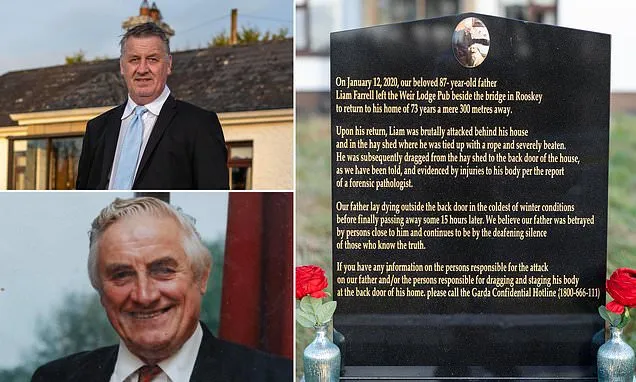
LIAM Farrell's son Brendan will never forget the afternoon his dad was found lying dead at the back of his rural home, covered in bruises and blood.
The 87-year-old father of five was found by daughter Anne with abrasions and lacerations to his face and body, with a broken watch, an injury to his left eye, and blood splattered over the back door and wall of his house near Rooskey, Co. Leitrim on January 12, 2020.
Apart from his horrific injuries, the long-time widower's clothing was in an even stranger condition - his shoes and socks had been removed and his blazer and overcoat had been taken off and tucked under his body.
His tie and a towel were found close by, both covered in blood, and the keys to the house were still at the front gate, while the back door, where Mr Farrell's body was found, was still locked.
To the Farrell family, the case immediately appeared to have been a violent assault on their gentle and good-natured father.
The house, where Mr Farrell had lived for 73 of his 87 years, was designated a crime scene by gardaí and a postmortem ruled that he had died of a heart attack.
More than six years on, the family believe they are now one step closer to finding out the truth of Liam Farrell's death after years of campaigning and disputing the original postmortem.
It was announced on Thursday that Minister of Justice Jim O'Callaghan had authorised the exhumation of Mr Farrell's remains by the Garda Serious Crime Review Team (SCRT) so that a new postmortem can take place in the coming weeks.
The latest development comes after the Farrell family met with Mr O'Callaghan last autumn and a review by the SCRT was announced.
Brendan Farrell told the Irish Daily Mail after the cold case review was announced last October that the news had come as a 'big relief' but that the family could never get closure.
'This is a positive move in the right direction. It's been a difficult almost six years since we found Dad. The hardest part is missing him. The way we found him was horrific and it's hard to think that he was lying there without us,' he said.
Brendan added that the day his father's body was discovered was 'the worst day of our lives' and that he doesn't think the family 'will ever have closure but we'll always keep fighting for justice'.
And speaking to RTÉ yesterday after the exhumation announcement, he said that his family are grateful for the new developments in their father's case.
'It's very difficult for us as a family to have to go through this, but anything that can help the investigation into the death of our father is very welcome,' Brendan said.
'We're very thankful to the Serious Crimes Review Team for their ongoing work and their live investigation into our father's passing.'
'Also, we're very thankful to the Garda Commissioner, Justin Kelly, for his work in light of our father's case,' he added.
'We would appeal to anybody out there who has any information, look deep into their hearts and if they can, come to the SCRT with that information.'
Mr Farrell had lived alone since 2002 when his wife Maureen died, and at the time of his death, two of his five adult children were living in the United States.
The grandfather of 18 was seen going about his usual Saturday night routine the night before his death, visiting two pubs in his local village where witnesses recalled that he was a pleasant, kind man who seemed in good form when he left to walk home.
Not only was he later found with unexplained injuries and items of clothing removed, but blood was discovered on a mop and in a mop bucket at the scene.
Mr Farrell's body was removed to Sligo University Hospital for a postmortem and gardaí sent a file to the DPP, but no prosecution was directed.
Consultant pathologist Professor Paul Hartel did the postmortem and determined that Mr Farrell had died from a heart attack related to severe coronary heart disease.
However, after Mr Farrell's family pushed for years for an inquest, new elements of the case came to light.
A view of an outside shed at the home of Liam Farrell near where his body was found
Prof Hartel told the September 2024 inquest that he was not informed that Mr Farrell's body had been found in suspicious circumstances, and that had he known this, he would have insisted that a forensic pathologist be called in to do a more detailed postmortem instead.
In respect of the injuries that Mr Farrell sustained, Prof Hartel said it 'would be inappropriate for me to speculate how those injuries were obtained'.
Chief State Pathologist Dr Linda Mulligan later reviewed Prof Hartel's report as part of the inquest and said that she agreed with Prof Hartel that the ultimate medical cause of death was a heart attack.
However, she stated that there were two possible scenarios that led to Mr Farrell’s death.
She believed Mr Farrell might have suffered a heart attack and obtained his injuries by falling in a confused state, or that there was another party involved that caused Mr Farrell to have a stress-induced heart attack.
Dr Mulligan’s report found that the ‘pattern of injuries on the face and hands’ of Mr Farrell raised some concerns that he might have obtained defensive injuries, and she added that ‘the involvement of another party cannot be ruled out based on the original autopsy report’.
The Farrell family appointed former state pathologist for the North of Ireland, Professor Jack Crane, to review the first postmortem.
Professor Crane said he thought the injuries in themselves were not serious enough to cause death, but said it was likely they added to an already compromised cardiac position.
'My opinion is this man was confronted by an intruder outside of his home and he was struck in the face,' he said.
'It would appear he attempted to make a way back into his home,' he added.
When questioned by Patrick McCullough, barrister for the Farrell family, Professor Crane said the 'eye injury was typical to a punch on the face'.
Sinn Féin TD for Sligo-Leitrim Martin Kenny told the Irish Daily Mail last October when the review of Mr Farrell’s death was announced that he believed precious time had already been lost and claimed ‘Gardaí didn’t do a lot of things properly’ in the first instance.
‘It’s positive that the cold case team is involved but this should have happened a long time ago. From the very outset everyone knew that something was wrong when they saw the scene.’
‘It’s definitely suspicious the way that Mr Farrell was discovered, with his shoes and socks taken off and lying on his jacket with severe injuries, as if he did this himself after suffering a heart attack.’
A Garda spokesman stated yesterday that the review into the case is 'active and ongoing'.
'The Garda Commissioner has tasked the Serious Crime Review Team, Garda National Bureau of Investigation, with carrying out a review of the investigation into the death of Mr. Liam Farrell.'
'Initial actions have involved engagement by the SCRT with Liam Farrell's family and the Garda investigation team,'