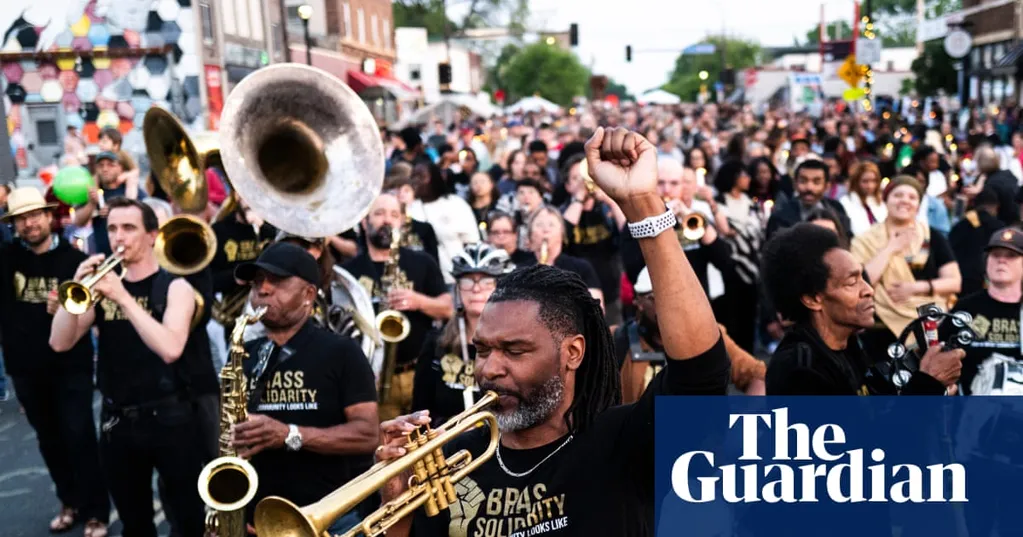
Brass Solidarity was formed after George Floyd's murder, and now also marks the deaths of Renee Good and Alex Pretti at its weekly meetup.
A week after a federal officer shot Renee Nicole Good in Minneapolis, a troupe of brass players, percussionists and singers gathered at the site of the killing, to play a blaring, defiant rendition of the O'Jays' Love Train.
Trumpeters, trombonists and sousaphonists had lined up along the ice-slicked sidewalk or were balancing on the snowbanks, blowing up clouds of condensation.
"People all over the world, join hands!" Alsa Bruno, one of the band's lead vocalists, sang out. "Start a love train, love train."
The group of mourners and neighbors who had gathered around the memorial obliged, forming a train. Some sheepishly giggled as they joined the chain, shuffling and swaying, singing, jumping.
It was a moment of joy in the face of profound grief - brought about by Brass Solidarity, a band that has come to soundtrack the movement against the Trump administration's massive federal immigration operation in Minnesota.
The band has its roots in resistance: it was formed by musicians in 2021 in the aftermath of the murder of George Floyd at the hands of a Minneapolis police officer. For more than five years, the band has been gathering once a week at the site of Floyd's murder, to play a set of mostly civil rights-era songs - A Change Is Gonna Come, This Little Light of Mine - as well as songs from other eras that fit the moment. Their tagline: "a sonic occupation for Black liberation".
The band now includes about 150 members and extends an open invitation to any musician who wants to join. Over the past several weeks, these musicians have taken up an urgent new role.
After a federal agent killed Good - just one mile from where Floyd was murdered - the band started playing in her memory as well. Later, they also started to play at the site where Alex Pretti was gunned down by immigration officers. They led a song and chant at an "ICE Out" protest on the frozen surface of Lake Nokomis and played When the Saints Go Marching In at a demonstration at the Target Center in Minneapolis, where protesters demanded the retailer do more to protect employees and shoppers from ICE.
The music is also, in a way, a service and an offering for a community under duress, said Tony Randazzo, a sousaphonist. "This is a community suffering from trauma - not only past trauma but also ongoing trauma."
It's an ongoing trauma, he added - one that residents of the Twin Cities will be carrying for years. The Trump administration claimed this week that it would be drawing down its operation in the region. Even if they keep their word, Randazzo said, many people in the cities have only begun to grapple with what they have experienced.
The music has been a way to process the hundreds of violent arrests across the Twin Cities, the grief of losing neighbors and friends who have been deported by the administration. Members of the band have been harassed and detained by ICE as well, said Randazzo - not while performing at protests but in their communities where roving patrols of federal agents have been stopping people en route to work outside grocery stores and at bus stops.
"ICE has been taking people like chits, like trading cards," said Bruno. "So many people just aren't leaving their homes because they are worried about being targeted."
Sometimes, just a handful of members show up. Other times, it's dozens. Protesters, bystanders, neighbors also turn up, with varying levels of musical expertise, with formal and informal instruments.
All are welcome, said Bruno, who doesn't play a brass instrument, so initially started showing up with a kazoo and a harmonica before taking up vocals. "If you come to the band and all you brought is an egg shaker, that shake matters," he said.
The band's ethos embraces the Twin Cities' DIY, collaborative arts scene. Puppeteers have joined the movement, as have formally and informally trained dancers and percussionists. The band has a repertoire of songs depending on who shows up. A few of the more experienced musicians help lead arrangements, calling out certain players for solos.
"In a moment when you would want to fight, to scream and shout and kick," said Jordan Powell-Karis, who plays the bass drum,"we have this creative expression,a gesture of love and compassion and connection."
In recent weeks, that gesture has been received with gratitude and support by people not only in Minnesota but across the US and abroad. Instagram videos of the band playing at vigils and protests in subzero temperatures have been shared tens of thousands of times.
"We're using songs from the civil rights movement because Black artists before, our ancestors before, used these songs to sing out our freedom," said Bruno.
Residents who have been unable to leave their homes have written to the band that they have been watching videos of their performances on Instagram or listening from inside as the musicians paraded through their neighborhoods.
"I saw one of our videos on social media had, like, a million views and I was baffled," said Powell-Karis. "But I think when people see us playing, showing up, it gives them a little sparkle, a little shine, something to hope towards."
On the Monday after Pretti was killed, Randazzo had tried to contain his tears, to try to keep his focus on the music and his singing. Then, he started to sing Gnarls Barkley’s Crazy.
As he sang the lines: “I remember when I lost my mind / There was something so pleasant about that place,” he remembered the moment he found out about Good being shot. He had been up the road, at a school where he was running a musical education program. He thought about the contrast: of this pleasant neighborhood, and the horror that had occurred there.
“The song ends and my face is wet,” he said. “I didn’t even realize how hard my body was feeling all these feelings.”