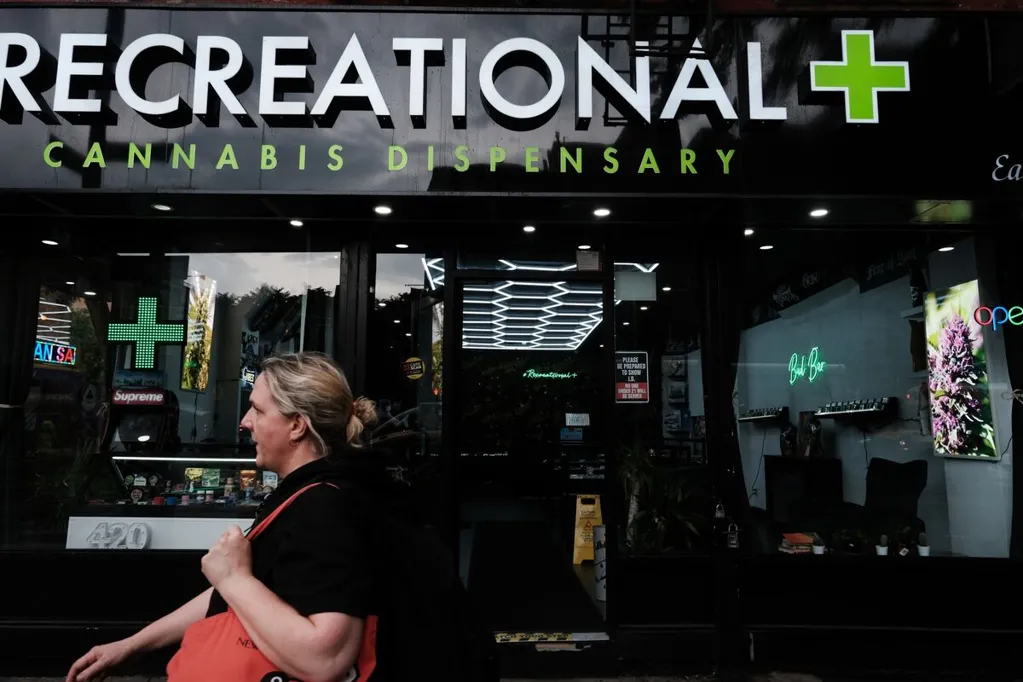
The justices discussed the difficulty of drawing a historical analogy between today's cannabis users and 18th-century laws that allowed punishment of habitual drunkards, with some questioning whether Congress can ban gun ownership for users of certain substances.
The 17.7 million Americans who use marijuana daily or near-daily can relax: The Supreme Court appears poised to hold that Congress can't prohibit them from owning firearms. More significantly, the argument revealed that the Supreme Court's originalist doctrine on gun laws has made it increasingly difficult for Congress to bar almost anyone from owning a gun.
The oral argument before the justices on Monday in US v. Hemani focused on whether there is a historical analogy between today's cannabis users and the habitual drunkards who could be imprisoned or fined under 18th-century law.
The case involves a Texas man, Ali Danial Hemani, who was charged with violating a federal law that bars users of illegal drugs from possessing a firearm. In 2022, FBI agents found a gun, marijuana and cocaine in Hemani's home, and he admitted that he used marijuana regularly.
There were some priceless moments in court, including an extended colloquy between Justice Elena Kagan and Hemani's attorney about a hypothetical statute that Congress might pass to disarm users of the psychedelic drug ayahuasca.
The legal background for Hemani's case was set by the Supreme Court in two recent cases: New York State Rifle & Pistol Association v. Bruen (2022) and US v. Rahimi (2024). In Bruen, the court, in an opinion by Justice Clarence Thomas, held that gun laws must be consistent with historical practice and tradition to be constitutional under the Second Amendment. In Rahimi, an 8-to-1 decision written by Chief Justice John Roberts, with Thomas' dissent, the court modified the Bruen test.
Emphasizing that the law must not be "trapped in amber," Roberts wrote that Congress could ban gun ownership for people deemed dangerous in ways analogous to historical determinations of public dangerousness.
Although Rahimi was certainly an improvement over the categorical Bruen, the Hemani case demonstrates how difficult it still is to draw a historical analogy even under Rahimi.
The federal law in question makes gun ownership unlawful for anyone who is "an unlawful user of or addicted to any controlled substance." Hemani was charged on the theory that he was a marijuana user, not an addict. At oral argument, the lawyer representing the Department of Justice said that the government would apply the law only to people it deemed habitual users. But when pressed on the fact that many states now permit marijuana use -- and that even the federal government rarely enforces its law against users -- she largely sidestepped the question.
To win, the government has to convince the justices that there is a historical analogy between the current federal law as applied to marijuana users and founding-era laws that allowed the fining or imprisonment of habitual drunkards. The main problem with that analogy, as Hemani's lawyer, Erin Murphy, pointed out, is that 18th-century laws didn't allow punishment of habitual drinkers -- only habitual drunkards. In contrast, the Trump administration didn't claim that Hemani was anything more than a habitual user of marijuana.
Justice Neil Gorsuch set a lighthearted tone by noting that "the American Temperance Society back in the day said eight shots of whiskey a day only made you an occasional drunkard." When that got a laugh, Gorsuch went on a brief tour of the drinking habits of the Founding Fathers:
John Adams took a tankard of hard cider with his breakfast every day. James Madison reportedly drank a pint of whiskey every day. Thomas Jefferson said he wasn't much of a user of alcohol; he only had three or four glasses of wine a night, okay? Are they all habitual drunkards who would be properly disarmed for life under your theory?
As the author of a biography of James Madison, I can tell you that the "reported" account of Madison is wrong. As I put it in my book, "Madison would provide his guests ... with the best wine he could afford, but he himself never took more than a glass at meals, and he never drank hard liquor."
Still, Gorsuch was absolutely correct to point out that the quantities of alcohol consumed by most people at the founding, not to mention through the 19th century and even the middle of the 20th century, were staggering by today's standards. A drunkard wasn't simply someone who drank a lot. It was someone who habitually walked around blind drunk in public thereby creating a nuisance for others. That's extremely far from someone who occasionally uses pot.
The argument grew more animated from there. Justice Amy Coney Barrett asked whether the government could disarm someone who took his wife's prescribed Ambien several nights a week to help him sleep. She then raised the example of a college student who took his roommate’s Adderall to study for an exam.
If these hypotheticals suggested that Barrett wasn't a complete stranger to the concept of illegal-but-maybe-not-a-danger-to-the-public drug use, Kagan's psychedelic question to Murphy was more outré. She prefaced it with a disclaimer: "I'm going to say I don't know a lot about this drug; I'm assuming you don't know a lot about this drug; so what I'm going to tell you about this drug; let's just assume is the truth about this drug."
With the courtroom's curiosity well piqued, she continued:
So it's -- the drug is Ayahuasca, and it’s a very, very, very intense hallucinogen, and the ... episode lasts a very long time. But it’s not, let’s say, an addictive drug. You know, you can choose when to take it. But, when you’re in its grip, like, you basically -- reality dissolves, all right? And I’m assuming that Congress has a good reason for saying, when reality dissolves, you don’t want guns around.
Kagan asked whether Congress could ban gun ownership by ayahuasca users during the time they weren't on the psychedelic. Murphy said no: If a person took ayahuasca once every two weeks and wasn’t under its influence 13 days out of 14, that would not be analogous to a habitual drunkard. Roberts then interjected, “I think it could be used ... every week, not just every third week or every other day.”
The transcript reflects no laughter in the courtroom regarding the hypothetical every-other-day ayahuasca user, which certainly suggests the limits of the justices' understanding of its effects.
(Believe it or not, this wasn't the first time the Supreme Court has addressed ayahuasca. In an important 2006 case, the justices held that the Religious Freedom Restoration Act created an exception to the federal prohibition on the drug -- which the court called "hoasca" -- for sincere religious believers using it as a sacrament.)
The takeaway from the oral argument is that the Rahimi framework is hard to apply in practice. That's one reason originalism isn't a very useful legal framework for majority opinions.
(Michael Bloomberg, founder and majority owner of Bloomberg News parent Bloomberg LP, helped found and is a current supporter of Everytown for Gun Safety, which advocates gun-safety measures.)