You're reading the Odd Lots newsletter.
You're reading the Odd Lots newsletter.
You're reading the Odd Lots newsletter.
Subscribe now to get Joe and Tracy's daily newsletter on the newest market crazes.
Subscribe now to get Joe and Tracy's daily newsletter on the newest market crazes.
Subscribe now to get Joe and Tracy's daily newsletter on the newest market crazes.
Hello and welcome to the newsletter, a grab bag of daily content from the Odd Lots universe. Sometimes it's us, Joe Weisenthal and Tracy Alloway, bringing you our thoughts on the most recent developments in markets, finance and the economy. And sometimes it's contributions from our network of expert guests and sources. Whatever it is, we promise it will always be interesting.
If you like chatting with us, check out the Odd Lots Discord, where you can hang out and talk with us and with other listeners 24/7.
Here's what Tracy's thinking about...
We just got consumer confidence for March from the Conference Board, with the index unexpectedly rising 0.8 points to 91.8, but still hovering close to record lows:
I'm sure there'll be a lot of commentary from now on about what the Iran situation means for overall consumer vibes and spending, given that high gas prices tend to be center stage in headlines, budgets and inflation expectations.
But one question that immediately comes up is just how informative these surveys actually are, given that Americans keep saying they feel terrible, yet broadly continue to spend. There is also the issue of polarization and the huge partisan split that's developed between Republicans and Democrats, and which arguably makes the aggregate sentiment figure far less useful.
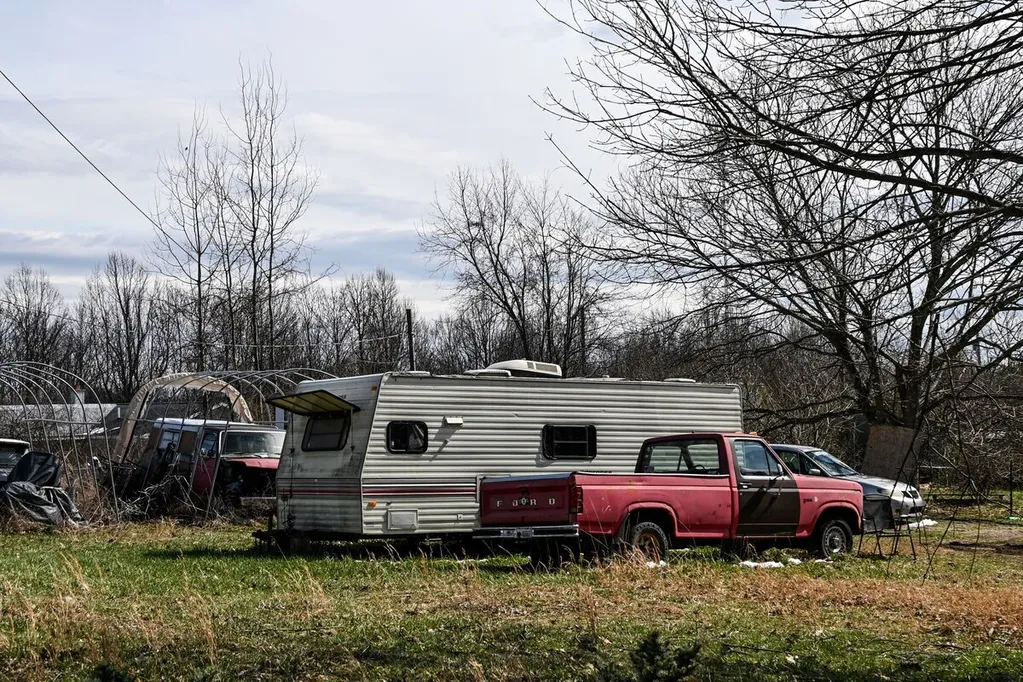
On that note though, I want to focus on one representation of the relationship between vibes and oil for one particular type of consumer -- call it the Rural Retiree class. These are mostly baby boomers with time, space, some money to spend, as well as a tendency to lean Republican.
The propensity for marginal spending by the Rural Retiree is perhaps best measured by stocks such as Camping World (which makes RVs), Brunswick Corp (which makes boats and boat engines), and of course, the classic Harley Davidson (which makes hogs. No, not that kind). These are big ticket items that depend on the three 'Cs' -- cash, confidence, and cheap gasoline.
All three of those charts don't look very promising right now. I've inverted the gasoline price on the below and added in Trump's approval rating. This isn't a scientific exercise by any means, but the charts line up in a kind of neat way.
Interestingly, you can see that Harley Davidson has ticked up a bit recently -- a move that seems to be mostly about speculation that the company might monetize its sizeable pension assets (which is rather boomer-y in and of itself; using retirement capital to juice a company largely driven by retiree spending).
But broadly, the consumer vibes remain pretty fractured and polarized, varying enormously depending on which group and survey you look at. Overall, it's pretty hard to gauge what sentiment means for actual spending. Looking at the above trio of stock prices however, expectations for Rural Retiree purchases don't seem that great.
What Joe is thinking about today
Once again, here are a few random things on my mind today.
- In the early days of the war, there was talk about how Trump might TACO, given the pain at the pump being caused by the disruption. Then starting in early March, it slowly dawned on everyone that it's not so easy. Iran gets a say as well, particularly when it comes to reopening the Strait of Hormuz. TACOing a war isn't so easy. Yet today's market rally basically asks the question: but what if it is? We're seeing a pretty big surge in risk assets that started yesterday evening when the WSJ reported that Trump might be willing to end the hostilities even if the Strait remains under Iranian control.
- We have an episode coming out tomorrow (by popular request) with Javier Blas of Bloomberg Opinion who says it’s hard to imagine anyone being happy with a situation in which Iran suddenly becomes the tollbooth operator for the entire region. But in an environment where no oil is getting out, and various economies around the world are in crisis for lack of energy, maybe people do learn to live with it.
- I think it’s pretty dangerous to draw analogies between this crisis and market environment a year ago around Liberation Day. But one thing that strikes me about that time is that after the acute phase of the crisis dissipated, US stocks performed quite well again for awhile. But relative to the rest of the world they never got back to their peak right around the end of 2024. Then that relative performance started to fade. Meanwhile the war in Iran has caused a brief jump in US stock market outperformance again. But if the end result is a further degradation of American power and economic might, then you have to wonder whether the two-year downtrend continues.
On the podcast
NASA is getting closer to a return trip to the moon, with the imminent launch of the Artemis II. But what are the economics of space exploration? Why do we do it when the payoff is so ambiguous? And when it comes to space, how should we think about the growing handoff to private industry, as seen through the likes of SpaceX? On this episode we speak with Alexander MacDonald, who served as NASA's first chief economist and is now a senior associate at the Aerospace Security Project at CSIS. We discuss why NASA even had a chief economist, in addition to getting answers on all of the above.
More from Bloomberg
Enjoying Odd Lots? Check out these newsletters:
- Markets Daily for what's moving in stocks, bonds, FX and commodities
- Going Private for coverage of private markets and the forces moving capital away from the public eye
- CFO Briefing for what finance leaders need to know
- Deals for transactions and analysis, from IPOs to startup investing
- Money Stuff for Bloomberg Opinion's Matt Levine's daily newsletter on Wall Street and finance
You have exclusive access to other subscriber-only newsletters. Explore all newsletters here to get most out of your Bloomberg subscription.