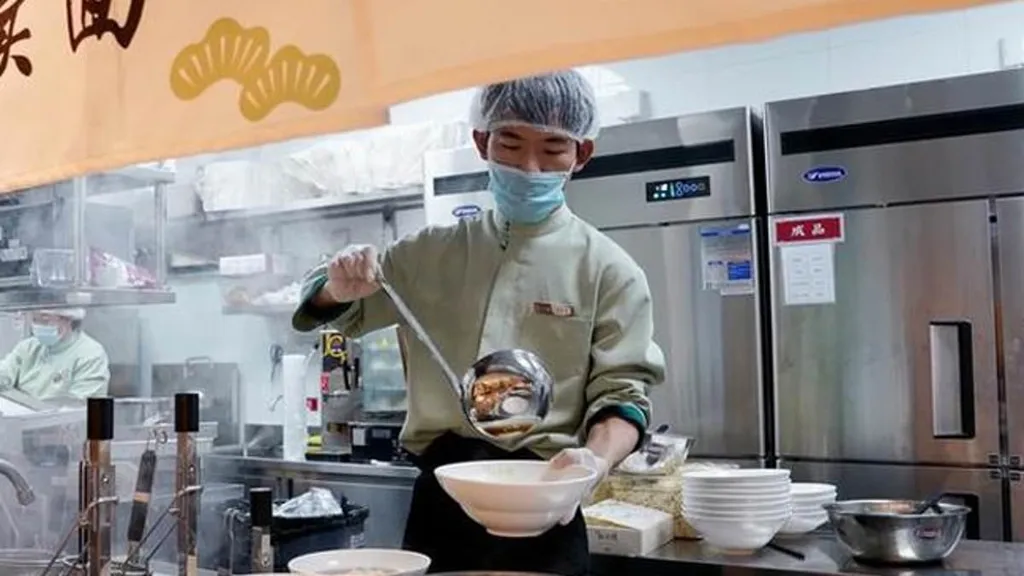
Noodles are a Chinese culinary classic that have gained a cult following around the world - not least here in Britain.
You'll almost certainly have enjoyed a bowl at some point. But once you learn about their incredible history and cultural importance in China, you'll never look at them the same way again.
And don't just take it from us! Here's French chef Corentin Delcroix, who now calls China his second home after falling in love with its food scene.
'Noodles are definitely one of the best representations of Chinese cuisine, as they vary from north to south, east to west; in shape, crafting, texture and topping,' he says in fluent Mandarin.
A food vlogger and online celebrity, Delcroix has spent the past three years showcasing nearly ten varieties of noodles on social media.
'Almost every region has its own signature noodle dish, one that tells the story of its local culture and heritage,' he says.
This culinary tradition, Delcroix believes, merits a deeper look. So join us for our guide to the history and culture of Chinese noodles, from ancient times to the present.
The birth of noodles
Archaeological research suggests China is home to the world's oldest noodles, dating back some 4,000 years.
They were unearthed at the Lajia ruins in western Qinghai Province, an ancient buried settlement known as the 'Oriental Pompeii'.
While China is widely regarded as the birthplace of rice, its vast landmass - with its complex terrain and varied climate - has also given rise to a wide range of flour-based foods, including noodles.
Traditionally, noodles are served on many important occasions. People eat 'longevity noodles' during birthday celebrations in the hope of enjoying a long and healthy life, while noodles are also used to welcome family members returning home.
Noodles play a role in weddings too, where they are served to couples as a blessing for lasting love and a harmonious marriage.
In fact, noodles are so symbolic that they have even featured on the menus of China's state banquets.
During his visit to China, US President Barack Obama watched a live demonstration of making Dragon Beard Noodles (Longxu Mian) and enthusiastically quizzed the chef.
And in 2011, then US Vice President Joe Biden ordered noodles with soybean paste at a restaurant in downtown Beijing, turning the so-called 'Biden Set Meal' into a viral sensation.
Over millennia, noodles have developed their own regional variations, with southwestern regions favouring spicy flavours and eastern areas leaning toward milder tastes. In Yanji City in northeastern China, ethnic Koreans enjoy cold noodles, while the residents of Lanzhou City in Gansu serve up noodles in a steaming beef broth.
In the years of scarcity when residents were issued ration coupons to buy grain, a simple bowl of Yangchun noodles in clear soup was a treasured moment for many Shanghai residents, who saw the white noodles and green spring onions as symbols of purity and refinement.
Shanxi Province in northern China is often called the 'kingdom of noodles'. The region has more than 200 types of boiled noodles alone, with each shaped by varying production methods, ingredients and toppings.
Dough is pulled, cut with scissors, sliced, hand-rolled or pressed from flours such as wheat, oat, buckwheat, soybean, corn or sorghum into a wide variety of shapes.
Liu Dangcheng, a senior master chef with the China Cuisine Association, credits Shanxi's love of noodles to its scarcity of rice, with arid conditions providing insufficient rainfall to support production.
Instead, the region produces wheat and a wide variety of cereals including oats and millet.
'In the 1950s and 1960s, when China faced grain shortages, people in Shanxi mixed starch from potatoes or sweet potatoes into corn flour to make noodles,' Liu explains.
'The noodles turned out unusually chewy and firm, earning them the nickname 'steel wire noodles''.'
Modern developments
After the reform and opening up in the late 1970s, China's rapid economic growth sped up the pace of life, turned the country into the 'world's factory' and prompted a boom in fast-food restaurants.
At the same time, China's noodle tradition took on a modern, consumer-oriented twist, catering to a growing appetite for global flavours among Chinese diners.
In the early 1990s, restaurants serving 'California beef noodles' sprang up across major Chinese cities. It was only years later that people realised there was no such thing as California beef noodles - what had drawn them in was not the noodles themselves, but their curiosity about the wider world.
International varieties of noodles have found their way into the Chinese market, from Japanese ramen and Italian spaghetti to Vietnamese pho - each attracting diners eager to explore new flavours. Popular noodle chains expanded rapidly, with Ajisen Ramen, a Japanese ramen franchise, operating nearly 800 bustling stores across China at its peak.
Instant noodles also became increasingly popular and were even considered a luxury, prized for their variety of flavours and convenience.
In the early years, instant noodles from Taiwan, such as Uni-President, opened up a new world of tastes and convenience and gained a significant share of the market, particularly among office staff and migrant workers.
Instant noodles have long been valued for their ease of preparation. Yet, as people have become increasingly health-conscious, more alternatives have emerged.
'In the past, people ate noodles primarily to fill their stomachs, and restaurants competed on generous portions and low prices,' says Gao Xiang, 42, a restaurant owner in Jinzhong City who specialises in healthy meals.
He adds that noodle-making has now been elevated into a visual performance designed to attract customers.
The ingredients used to make noodles have also changed. Around 25 years ago, wheat flour noodles were the main option; today’s noodles made from oat and bean flour are gaining popularity—especially among health-conscious urban professionals who prefer low-glycaemic diets.
Over the past winter, the most sought-after dish at Gao's restaurant has been mutton and Poria cocos buckwheat noodles. In southern China, rising living standards are most visibly reflected in the diversity and quality of noodle toppings.
Shen Jialu, a renowned food connoisseur in Shanghai, documented this transformation in his book Old Flavors of Shanghai.
'As life gradually improved, the basic Yangchun noodles were upgraded,' he wrote, listing a wide array of toppings including pork ribs, spicy sauce, pickled vegetables, shredded pork, braised pork, smoked fish, eel paste, shrimp, mutton, curry beef.
'When entertaining guests, simply opt for a double topping,' he added.
On the other hand, local noodle sellers have evolved from humble 'mom-and-pop' shops into a dazzling array of corporate brands.
Some have even gone public, including Xiao Noodles, a chain built on the fiery appeal of Chongqing's signature Xiaomian, oily, spicy noodles served with mashed yellow peas and minced pork sauce.
Going global
Over recent years, the growing global interest in Chinese culture has seen noodles garner a major international following.
Chefs from Italy and Spain now come to Shanghai to visit local restaurants - from iconic skyscrapers like the Shanghai Tower to hidden alleyway eateries - to learn about traditional Chinese noodle-making techniques.
They then skillfully combine these methods with Western innovations, creating fusion dishes that resonate across cultures.
Meanwhile, traditional Chinese noodles are steadily making their way into major foreign markets.
Last year, a Chinese vendor in Belgium selling noodles with peas and meat sauce went viral on social media, generating substantial daily revenue. In Germany and Britain, Lanzhou beef noodle restaurants saw crowded lines of local residents eager to taste the authentic Chinese dish.
Guo Zhanglong, 38, lives in France and was visited by his mother-in-law in 2020. A native of Shanxi's Datong City - the home of knife-sliced noodles- she impressed local Parisians by skillfully wielding a knife to cut noodles directly into a boiling pot.
'Does every Chinese know Kung Fu?' they asked in astonishment.
In 2022, Guo and his family began selling sliced noodles at a humble outdoor market booth, a venture that quickly grew into a full-fledged restaurant. By October 2023, 'Kongfu Pate' officially opened in downtown Paris, and within six months, a second outlet had launched near the Louvre Museum.
'Good food knows no borders,' Guo says, adding that he blends authentic traditional flavours with dishes that charm French diners. During local festive occasions, patrons are often seen sitting, squatting or standing as they savour the noodles.
For many, these noodles are more than just food: they serve as a gateway to Chinese culture.
'This is particularly true amid the recent ''Becoming Chinese'' trend,' says Liu Dangcheng, who has noticed an increase of international tourists in local noodle restaurants.
Guo was delighted to know that some customers were so inspired that they later travelled to China, exploring Shanxi and other regions for themselves.
'We are proud to contribute to the exchanges between people in France and China,' he says. 'With increased communication, there is bound to be more understanding among everyone.'