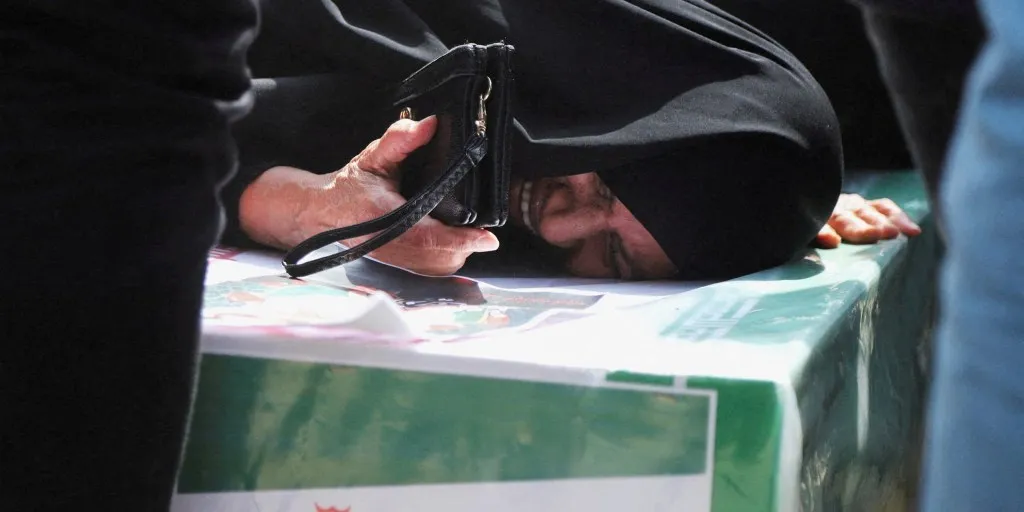
TEHRAN -- Nearly a week after airstrikes hit an elementary school in southern Iran, killing more than 170 people and leaving witnesses to find the severed limbs of children in the rubble, there have been increased international demands to know who was responsible and how the tragedy could happen.
The strikes, in the town of Minab, came in at the very start of the U.S. and Israeli bombing campaign on Saturday. The United States was targeting that area, where the boys and girls school, Shajareh Tayyebeh, was struck, Trump administration officials told members of Congress in a closed-door meeting this week, according to two U.S. officials. The administration officials also said their military partner, Israel, was not responsible for the school's bombing.
The U.S. has not claimed responsibility for the strikes, but the Trump administration's preliminary findings show it is increasingly likely that a U.S. munition was used in the strikes, according to a U.S. official and a person familiar with the investigation. The U.S. is still looking into whether the strikes were the result of bad intelligence or poor targeting, the sources said.
The administration did not offer an alternative theory to Congress members on who was responsible for the death and destruction, the two U.S. officials said. An American military investigation is ongoing.
"We need this to happen very quickly and we need to also make sure that there is accountability as well as redress for the victims," United Nations High Commissioner for Human Rights, Volker Türk, said Friday in Geneva.
New satellite imagery shows the school and several nearby buildings before and after the strikes. Witnesses and an education ministry official said that the school was located on a compound that was a base for the Islamic Revolutionary Guard Corps until about 15 years ago.
Gen. Dan Caine, the chairman of the Joint Chiefs of Staff, said in a news conference on Wednesday that U.S. forces had been carrying out strikes along southern Iran, sharing a map appearing to show the area of Minab being targeted. He noted that Israeli forces had mainly been operating further north in Iran.
Defense Secretary Pete Hegseth said Wednesday that the U.S. was still "investigating" the incident, adding: "We, of course, never target civilian targets, but we're taking a look and investigating that."
And Secretary of State Marco Rubio told reporters on Monday that U.S. forces "would not deliberately target a school."
Speaking in an exclusive interview on Thursday with NBC News' Tom Llamas, Iran's Foreign Minister Abbas Araghchi said it was "clear that the missiles were -- the school was hit by Americans," though he did not share any evidence.
Asked to address whether there was any chance a "wayward Iranian missile" could have played any role, Araghchi said "no."
The U.S. military and Israel launched its attack on Iran, called Operation Epic Fury, around 9:45 a.m. local time on Saturday, deploying B-2 stealth bombers, fighter jets, missiles, rockets and other weapon systems. The strikes targeted Iran's navy, missile sites, command and control headquarters and air defense systems.
Three witnesses -- Ahmad Kalami Pour, who said he served as the school's first principal of the school from 2015 to 2017; Jafar Qasemi, a first responder who saw the aftermath; and Zahra Monazah, the mother of a 7-year-old who was killed in the strikes -- told NBC News that the strikes on Shajareh Tayyebeh occurred mid to late morning on Saturday. They said a second wave happened hours later.
Planet Labs images captured at 10:53 a.m. local time on Saturday appears to show that the area had not yet been impacted by strikes.
The company next captured images on March 4 showing impact sites on the school and adjoining former IRGC base, with a total of seven buildings damaged or destroyed.