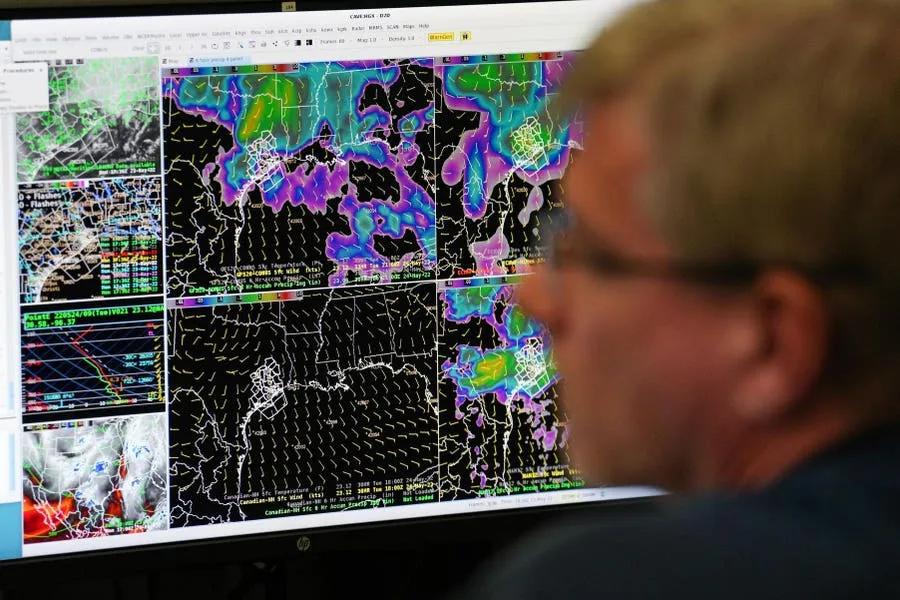
I have been a senior contributor to Forbes.com for a long time. I write about weather and climate. I never thought that this piece would be needed, but here we are. Mark Fox is meteorologist-in-charge at the National Weather Service in Norman, Oklahoma. Last week, he posted a surprising message on the social media site X. He tagged popular meteorologists such as James Spann and The Weather Channel with a surprising request. He wrote, "Spread the word that calling (on phone) NWS offices with radar interpretation only adds to the fog of an already dynamic situation. Speaking for myself." So what is going on?
At the time, Fox and colleagues were dealing with an evolving weather situation. Yet, people were calling with their own opinions or interpretations of what is going on. "Calling a National Weather Service office to ask 'are you seeing this on radar' isn't helpful, but harmful," wrote Birmingham-based meteorologist James Spann on Facebook. He said, "On active days they are fully staffed with professionals looking at every radar product available. They don't need to be dealing with those kind of calls during a very stressful situation." Candidly, such calls could also block more urgent or relevant communications too.
Dunning-Kruger Effect
I have often written about how meteorology differs from many other sciences. People are fascinated by the weather. They experience and observe it. Most weather models, radar images, and satellite observations are available at the touch of an icon on our phones. This has led to a "Dunning-Kruger Effect on steroids" in the weather community. "The Dunning-Kruger effect occurs when a person's lack of knowledge and skill in a certain area causes them to overestimate their own competence," according to the Decision Lab website.
When I tell someone that I am a meteorologist, it is not uncommon for them to launch into a narrative about the quality of weather forecasts, climate change, or the latest weather app. Something tells me experts in nuclear engineering or cardiology don't pick up tips on their profession while standing in line at the mall. Yet, a professional meteorologist at the National Weather Service felt so overwhelmed by phone calls that he took to social media to swat it down. Whatever people were calling about, I am sure the degreed meteorologists in the office saw it too.
Volunteer Networks and Storm Chasing
To be fair, there are other factors behind this new reality. The NWS promotes a volunteer program. "SKYWARN® is a volunteer program with between 350,000 and 400,000 trained severe weather spotters. These volunteers help keep their local communities safe by providing timely and accurate reports of severe weather to the National Weather Service," according to its website. The program was started in the 1970s, and volunteers must participate in a training program.
In the Great Plains and elsewhere, an array of storm chasers have also emerged as information providers. A quick web search of the words "storm chasers" yielded quite a few options and providers. It is a bit of the "Wild West," but there is certainly value when trained chasers provide verification of a tornado, significant hail or other hazards. There is, however, quite a bit of noise-to-signal. Perhaps the storm chaser culture has added to information overload NWS offices are now experiencing.
Equalization Of Weather Data Access
The proliferation of online access to weather model output and apps has led to what I often call "black box" meteorology. In my meteorology classes, I caution students that reading output from weather prediction models or radar imagery does not make you a meteorologist. The physical understanding of the dynamic, physics-based evolution of the atmosphere and its nuances are hallmarks of a good meteorologist. Having said that, there are undoubtedly people without formal training who can decipher weather patterns, radar signatures or a satellite image. The folks at the NWS can too. They don't need to know your perspective during a life-threatening weather scenario.
Equalization of weather data access does not mean equalization of expertise. Yet, a 2025 study published in the journal Research in Organizational Behavior tells a different story. The study was entitled, "Beyond professional experts: The rise of lay, counter-, and neo-experts as alternative claim-makers." The authors discussed how opinions about oddly-contentious topics like vaccines, the rise of social media, and mistrust narratives towards established institutions shape consumption of alternative "experts," grey literature and online influencers. A few years ago I wrote a guide about proper consumption of science information online because I saw this reality coming.
I have been a weather geek since my childhood years. I had the audacity to do a science project entitled, "Can a 6th grader predict the weather?" I went on to get three-degrees in meteorology, develop weather satellite missions for NASA, preside over the American Meteorological Society, host the Weather Channel's podcast Weather Geeks, and direct a major university's atmospheric sciences program. Not once have I thought it was a good idea to call the NWS Atlanta phone line during a weather event. I have, however, provided verification information during or after weather events, and they are generally appreciative of such information.
The past year or so has been tough for our NWS colleagues. They are patriotic heroes. At times, many have worked in understaffed offices or under unfavorable backdrops due to policy uncertainty, retirement offers, government shutdowns, and other disruptions. They just keep doing their jobs. Let's allow them to do so without whimsical or perhaps even well-meaning interruptions.