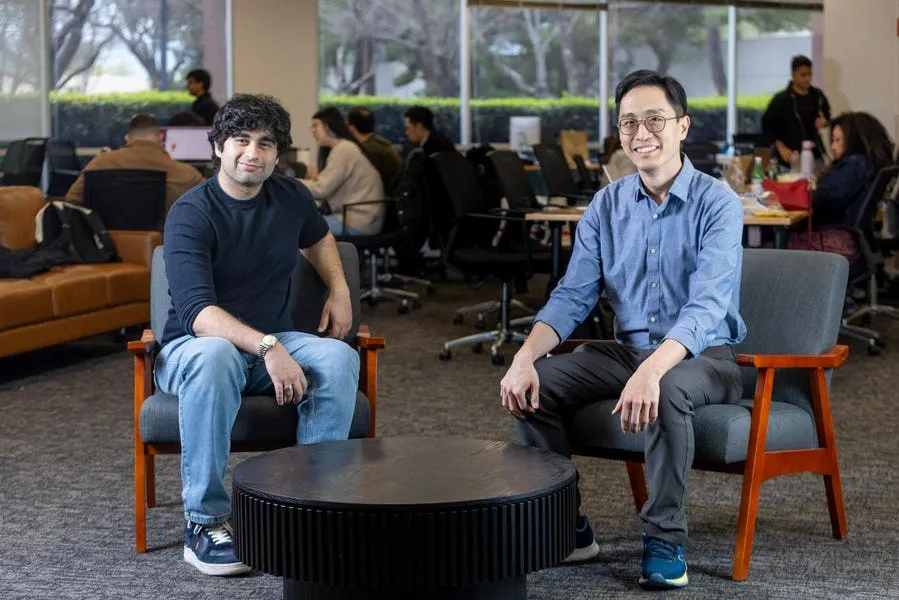
Kabir Nagrecha learned the enterprise software racket before he was old enough to drive.
Raised in London and California, he spent his childhood as the unofficial assistant to his father, who worked in high-level IT roles at firms like Jacobs Engineering, an American company specializing in large-scale construction projects.
Nagrecha's father specialized in IT transformation projects involving ERP systems: the vast and complex "central nervous systems" that manage a company's tax, accounting and supply chain. By the time he was eight, Nagrecha was listening to the massive 50-person stand-ups required to keep a 1,000-person project on track, and helping his father create the PowerPoint presentations used to brief other executives.
There, he learned firsthand the constant frustration and inefficiency that defined the traditional "system integrators" model, where such projects were largely outsourced to consulting firms like Accenture, Deloitte and Ernst & Young. He watched as multi-year projects were plagued by setbacks and consultants asking for a few extra million dollars every couple of months when a project inevitably went off the rails. There was even an industry joke for it: "every Accenture partner has a yacht, which they name 'Change Order'."
"There was this constant frustration of, 'Hey, how can we not run this in-house? Why do we not have the capability to do this ourselves? Where's the expertise gap? Where's the labor gap?"
After starting college at 13, earning a PhD in AI systems by 20, and working stints as an AI researcher at Meta and Netflix, Nagrecha founded Tessera Labs, a startup that aims to use AI agents to automate enterprise IT drudgework -- the kind of messy system migrations that have traditionally required gaggles of consultants, millions of dollars in "change order" checks and years of pain.
Tessera Labs recently emerged from stealth with a $60 million series A led by Andreessen Horowitz, valuing the startup at $320 million. Foundation Capital, Myriad Venture Partners and Osage University Partners also joined the round. The company is working directly with pharmaceutical giant Merck and Xerox and is in trials with a handful of other Fortune 500 enterprises, Nagrecha said.
Enterprise transformation is hardly the most headline-grabbing sector, but it is a "sneaky big" market, said Seema Amble, the partner at Andreessen Horowitz who led Tessera Labs' round.
"This is something that every CIO complains about and hates, but nobody in the outside world knows that this is a thing that companies spend a lot of money on,"
According to research from Arthur D. Little, the median IT spending for telecommunications companies is 4.6% of revenue. Of that budget, a staggering 60% to 70% is consumed by external human-led "services" to handle maintenance, upgrades, and migrations, Nagrecha said. Gartner pegged that market at nearly $1.4 trillion in 2024.
By replacing a "manual, human-based model" with what he calls "digital labor," Nagrecha believes Tessera Labs can shrink those nine-figure service contracts by an order of magnitude.
Tessera Labs deploys autonomous AI agents that are trained to handle the end-to-end complexity of ERP transformations -- from mapping out intricate business processes to automating code reconfiguration for massive system upgrades. Instead of 500 consultants, he says, Tessera can get the work done with five and it can shrinks ten-month coding cycles down to a matter of weeks.
"The savings numbers are big," he said. "We have seen that large enterprises are saving over 100 million a year."