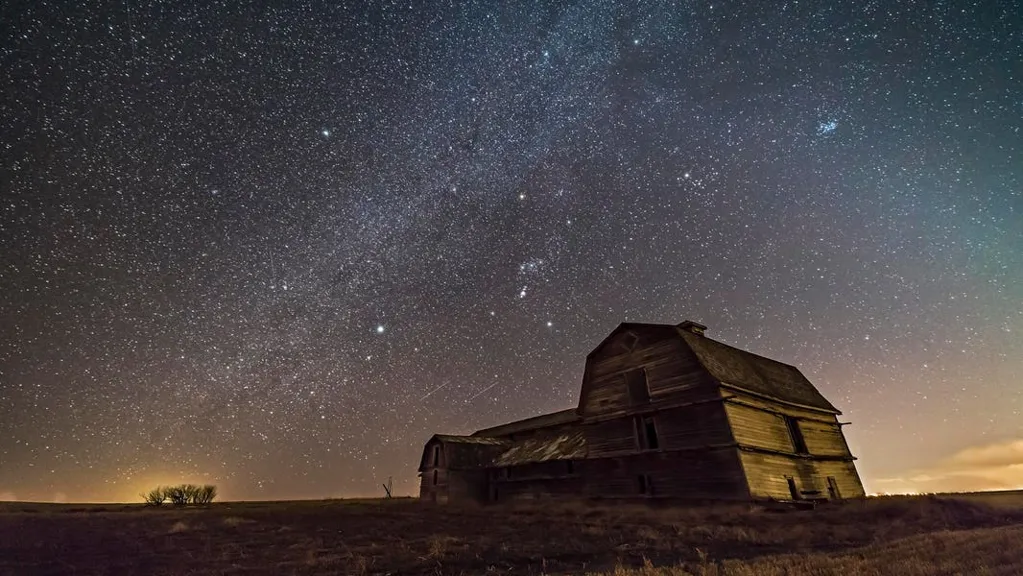
A moonless night sky this weekend presents an opportunity for stargazers after some of the best conditions of the year. With a slim crescent moon retreating from view and bright planets and star clusters high in the sky, this is a perfect time to head outside and look up. Whether you're scanning for Orion's Belt, tracing the arc of the Winter Circle or catching a rare glimpse of Jupiter at its brightest, this weekend's new moon -- which sets up Chinese New Year, Ramadan and a "ring of fire" solar eclipse in February -- offers a fine celestial lineup for amateur astronomers and casual skywatchers alike. Here's what to see even from a light-polluted city.
January's night sky is anchored by three of winter's most iconic constellations: Orion, Taurus and Gemini. Orion, "The Hunter," is the easiest to find -- just look for the three aligned stars of his Belt (Alnitak, Alnilam and Mintaka). Above Orion and to the right is Taurus, home to the red giant Aldebaran and several star clusters. High in the sky is Gemini, where Jupiter now outshines everything around it, including the constellation's "twins," Castor and Pollux.
Three of winter's most stunning objects are ideally placed this weekend. Near Taurus lies the Pleiades, a delicate cluster of hot, young stars visible to the naked eye (find it by following Orion's Belt up into the night sky). Slightly lower and wider is the Hyades, forming a "V" around Aldebaran. Look below Orion's Belt to find the Orion Nebula (M42), where new stars are forming. It's visible to the naked eye, but looks fabulous in binoculars as a hazy patch of light.
The Winter Circle -- also called the Winter Hexagon -- is a vast asterism made of the season’s brightest stars. If you can identify Orion’s Belt, you’re halfway there -- follow it down to Sirius and up to Aldebaran to orient yourself. Now find the circle, begin at the bottom, at Sirius in the constellation Canis Major, the brightest star in the night sky. From there, move clockwise to Procyon, then to Pollux in Gemini (with bright Jupiter nearby). Continue to Capella, overhead in Auriga; then to Aldebaran in Taurus; and finally down to Rigel in Orion before closing the loop at Sirius.
After the Jan. 17 new moon, the lunar cycle begins again. Look west just after sunset on Jan. 19, 20 and 21 for a crescent moon both bathed in Earthshine -- the faint glow from sunlight reflected off Earth. Later in the month, the moon will brush close to the Pleiades on Jan. 27 and pass near Jupiter again on Jan. 30, forming a beautiful celestial tableau with Gemini's twin stars.