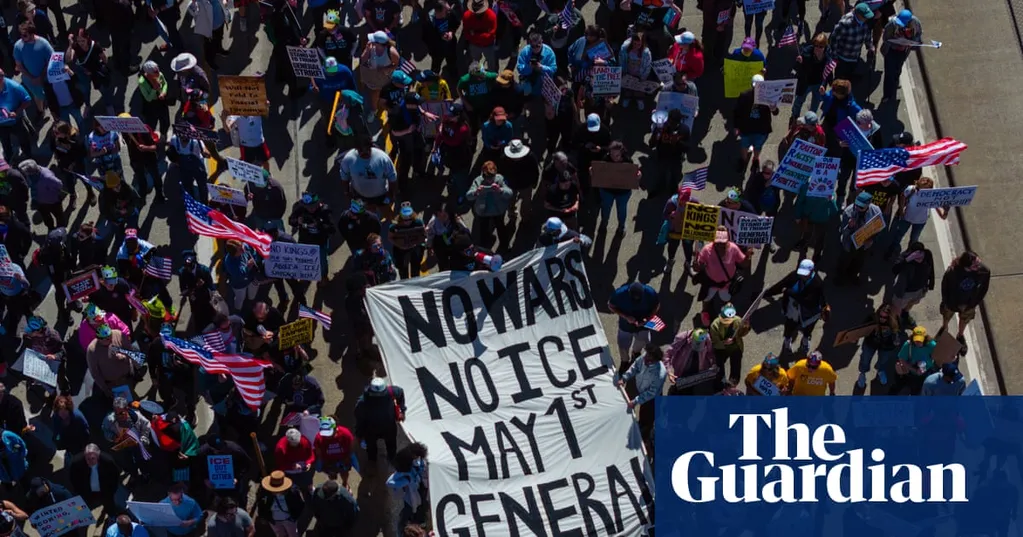
Thousands are set to join an economic blackout for International Workers' Day on Friday, as part of 3,500 "May Day Strong" events across the country. Organizers are calling for "no school, no work, no shopping" with walkouts, marches, block parties and other gatherings planned into the evening.
May Day has long been an annual day of protest for the labor movement, and this year, many active movements are converging to fight for "a nation that puts workers over billionaires". Demanding no ICE, no war, and taxing the rich, the May Day Strong coalition includes labor unions, immigrants rights groups, political organizations such as the Democratic Socialists of America, and the organizers behind the No Kings protests. Friday's economic disruption builds on a similar coordinated effort out of Minnesota in January, when tens of thousands of Twin Cities residents took off from school and work to flood the streets in protest of federal immigration agents storming the city.
Neidi Dominguez, founding executive director of Organized Power in Numbers and an executive team member of May Day Strong, said that they expect more than twice the number of May Day events than last year.
Leah Greenberg of Indivisible, one of the main organizations behind No Kings, described the May Day economic blackout as a "structure test" for the movement.
"We are asking people to take a step into further exerting their power in all aspects of their lives - as workers, as students, as members of local organizing hubs," she said. "It's important as it builds muscles towards greater non-cooperation."
Teachers' unions and students are an active part of the fight, a continuation of their months of organizing against ICE. At least 15 school districts in North Carolina have given teachers the day off to join a statewide May Day "Kids Over Corporations" rally for public education funding. In Chicago, Illinois, the Chicago Teachers Union fought and won to have May Day made a "day of civic action".
"As educators, we feel a very real accountability to the young people in the families that we serve," Stacy Davis Gates, president of the Chicago Teachers Union and Illinois Federation of Teachers, said earlier this week. "We want to connect people not just to the affordability crisis but the crisis of our institutions being marginalized in this moment and the impact on our young people."
Sanshray Kukutla, a student at Purdue University in West Lafayette, Indiana, and organizer with the campus's Sunrise Movement chapter, is helping coordinate a local walkout for students, teachers, workers and residents. "We're taking collective action to send a message to the billionaire class: it's our labor, our spending, and our participation that keeps the whole system running, and if we don't work, they don't have profits," said Kukutla.
Organizers say the day of action is an effort to build toward a general strike, which was essentially outlawed through the 1946 Taft-Hartley Act and hasn't happened in the US since. As a workaround, Shawn Fain, president of the United Auto Workers (UAW), has called for unions to work toward a general strike on 1 May 2028, by having existing union contracts expire in unison.