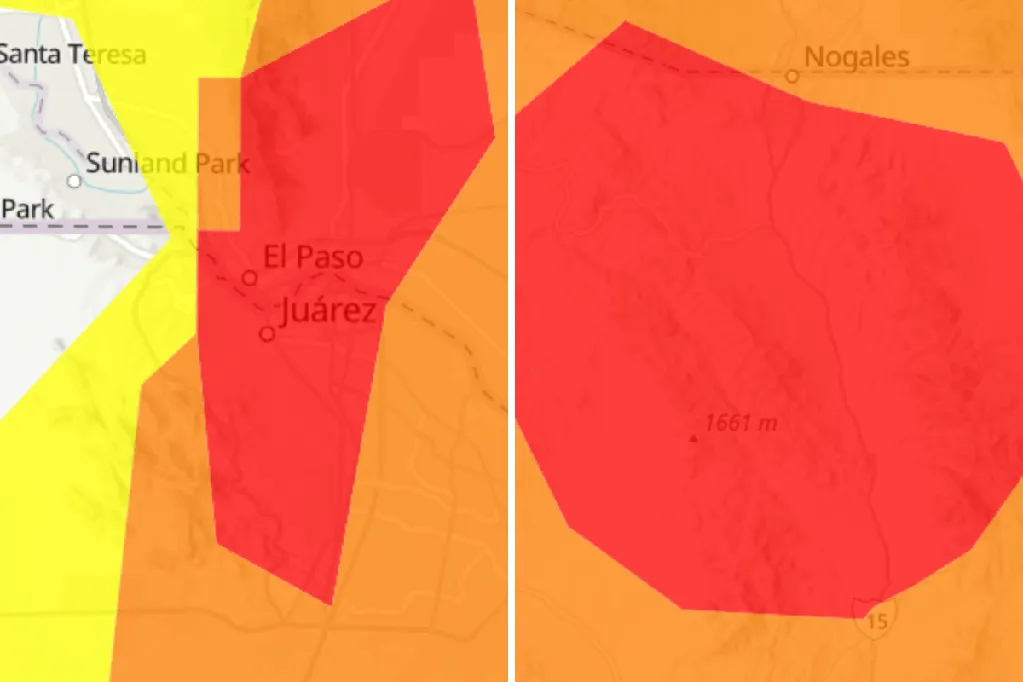
Thousands of residents in communities across Arizona (including the Nogales area), New Mexico (including Juárez), and Texas (including El Paso) have been advised to stay inside as fine particles of pollution (PM2.5) reached "unhealthy" levels, as of 3.15 a.m. ET on January 19, 2026.
This information comes from the Environmental Protection Agency's (EPA) AirNow Map, which uses the Air Quality Index (AQI) -- a standardized scale that measures and communicates air quality across the U.S. by categorizing conditions into six levels, from "Good," "Moderate," and "Unhealthy for Sensitive Groups" to "Unhealthy" "Very Unhealthy," and "Hazardous."
The EPA considers PM2.5 to be one of the most dangerous forms of air pollution. This is because the particles are so small -- each one is less than 2.5 micrometers in size, which is far thinner than a single strand of hair. When PM2.5 levels reach an "unhealthy" range, these particles can be easily inhaled, traveling deep into the lungs and, in some cases, entering the bloodstream. This can trigger irritation of the eyes, nose, throat, and lungs, as well as more serious effects such as chest tightness and shortness of breath.
"Unhealthy" levels of PM2.5 pose the greatest risk to sensitive groups, including older adults, children, and people with existing respiratory or cardiovascular conditions. Individuals with asthma, COPD, or heart disease are particularly vulnerable because elevated particle levels can worsen their underlying conditions and may even lead to hospitalization.
As a result, the EPA advises those in sensitive groups to avoid prolonged or intense outdoor activities. Everyone else is encouraged to reduce the duration or intensity of outdoor exertion until air quality improves.
Although residents in affected areas should avoid or reduce long or intense outdoor activity when PM2.5 reaches "unhealthy" levels, poor air quality can also affect the air inside homes. Because indoor particle levels can rise when outdoor pollution is high, the EPA and health agencies advise avoiding activities that generate additional indoor pollution -- such as burning candles, using woodstoves, or lighting indoor fires. They also recommend using air purifiers or high‑efficiency filters to keep indoor air as clean as possible.
The EPA has not established what is causing "unhealthy" levels of PM2.5 across Arizona, New Mexico, and Texas. However, PM2.5 can come from a variety of sources, including dust from unpaved roads and construction sites, smoke from fires or smokestacks, or emissions released from vehicles or power and industrial sites.